
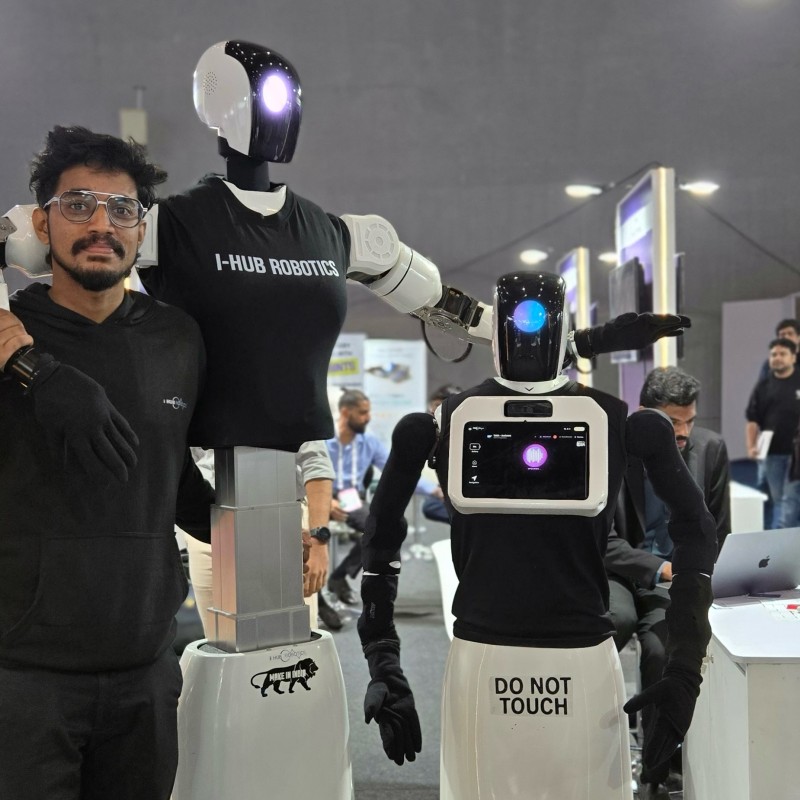
An Indian startup is developing an in-house VLA system for humanoids, aiming to move robots from simple prompts to real-world task execution.
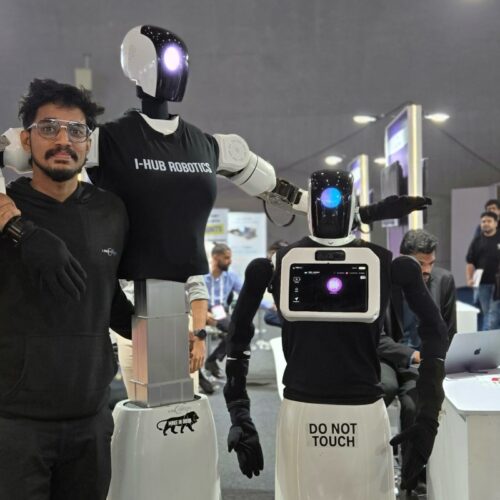
As physical AI shifts from screens to real-world machines, IHUB Robotics, an Indian startup company who builds humanoid robots is developing its own vision-language-action (VLA) system from scratch to power humanoid robots developed and deployed from India.

In a conversation with EFY, Athil Krishna, Founder & CEO of IHUB Robotics revealed that, “Our in-house Viveka decision core acts as the brain for our robots, combining vision, language, and action to help them understand environments and perform tasks. We are building it to move from prompt to action, where a simple instruction can trigger a complete physical task without detailed programming.”
This development supports the company’s growing humanoid portfolio. Its Tara Generation One robots have already been commercialised and deployed across multiple countries in service roles such as healthcare, education, and public-facing operations. The newer Daksha series focuses on industrial use cases including material handling, assembly, and logistics.
Unlike many companies that adapt existing AI models, the startup said it is building the full VLA stack internally. This includes object detection, task planning, motion control, and navigation capabilities, forming a complete physical AI system.
Physical AI represents the next stage of AI, where systems move beyond generating text or images to sensing, reasoning, and acting in real-world environments. VLA models play a key role in this shift by linking perception with execution in dynamic settings.
Athil added, “We are building such systems, and we see that it remains complex due to high training requirements, large datasets, and the need for advanced GPU infrastructure. To address this, we are developing lower-weight models that can run directly on hardware, reducing our dependence on cloud processing.”
Manufacturing and development are based in India, with most software built in-house and increasing localisation of hardware components such as actuators, control systems, and boards. The company said it is working to further reduce external dependencies over time.
Founded in 2022, the startup has already deployed dozens of humanoid robots across India and international markets, including the Middle East, and is preparing shipments to the United States as it scales its physical AI platform.