
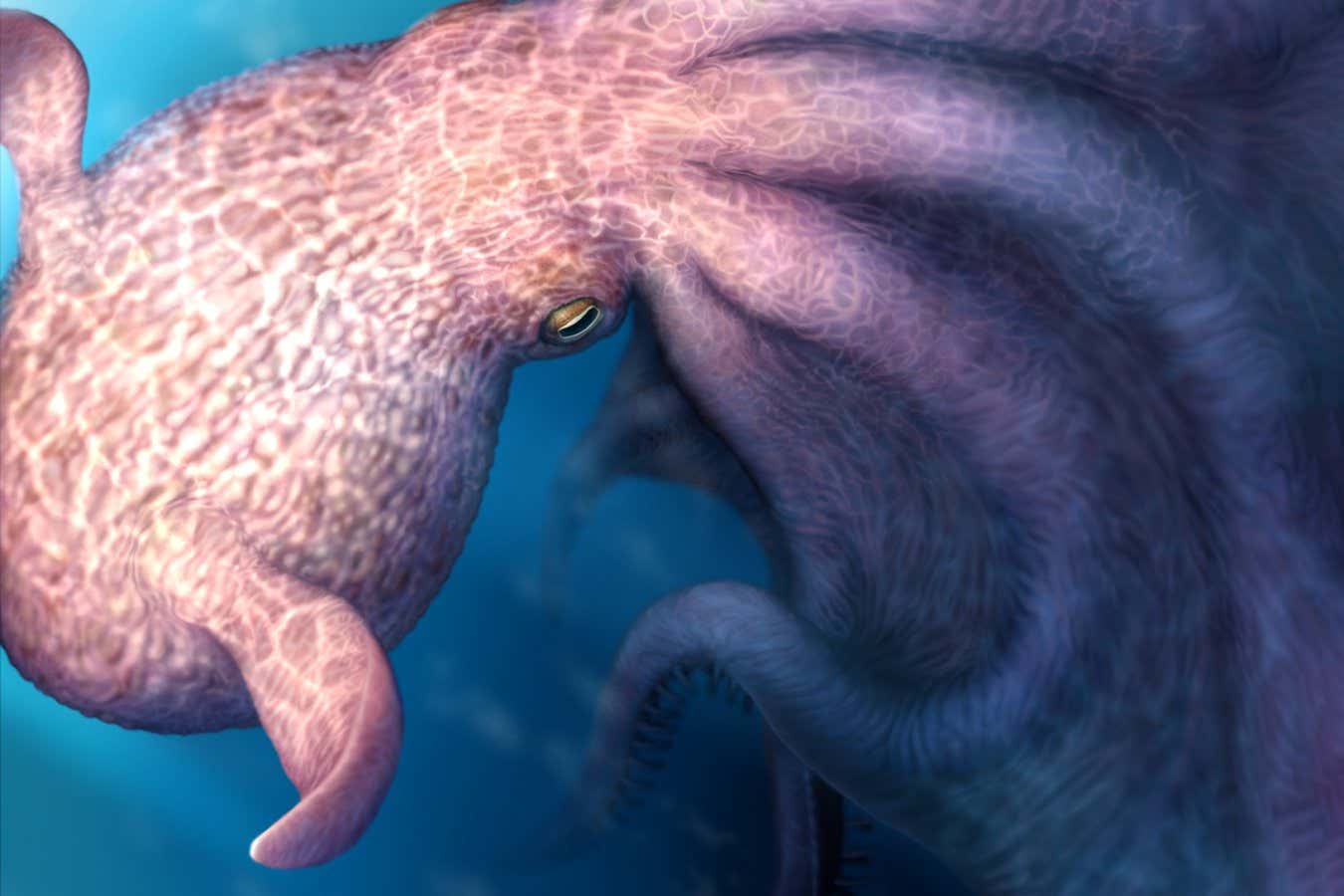

A reconstruction of the giant octopus
Yohei Utsuki/Department of Earth and Planetary Sciences, Hokkaido University
While dinosaurs ruled the land, Cretaceous oceans were home to a fierce and enormous octopus species that may have reached up to 19 metres in length, rivalling the size of the largest predators of the time, including sharks and marine reptiles like plesiosaurs and mosasaurs.
These octopuses were active predators, says Yasuhiro Iba at Hokkaido University in Japan.
“They could be thought of as the orcas or great white sharks of the invertebrate world – large, intelligent and highly effective apex predators,” says Iba. “These were animals over 10 metres long, with long arms, powerful jaws capable of crushing hard structures and probably advanced behaviour.”
Iba and his colleagues looked at 27 large, fossilised octopus jaws dating to between 100 million and 72 million years that had been collected in Japan and Vancouver Island, Canada.
A dozen of the octopus jaws were new to science and were locked inside rocks, says Iba. They became visible only when the researchers used high-tech scanning equipment and “digital fossil mining” combined with artificial intelligence to fully image the octopus remains hidden in the stone.
The octopus jaw, also called the beak, is often the only part of the animal to survive as a fossil because it is made primarily of durable chitin, while the rest of the animal is soft-bodied.
Previously, it was thought that there were five species of octopus living in the Cretaceous Period, but the team found that, in fact, there were just two so far confirmed – Nanaimoteuthis jeletzkyi and N. haggarti.
“We realised early on that the jaws were unusually large,” says Iba. “In particular, the jaws of N. haggarti stood out even when compared with large modern cephalopods.”
However, he says, the full scale became clear only after the team estimated N. haggarti’s body size using the relationship between jaw size and the length of the mantle – the head-like structure above the arms – of modern, long-bodied finned octopuses. “That analysis showed that N. haggarti may have reached about 6.6 to 18.6 meters in total length,” says Iba. “Nanaimoteuthis haggarti may have been among the largest invertebrates in Earth’s history.”
John Long at Flinders University, Australia, says he isn’t surprised by the findings, “as many creatures at this time went through gigantism – sharks, marine reptiles, ammonites – so the oceans were full of food for large predators”. But he says it is still a “gob-smacking” discovery. “Giant freaking killer octopi as apex predators were ruling the Cretaceous seas.”

How the octopus sizes up against other marine predators of the Cretaceous
Yohei Utsuki/Department of Earth and Planetary Sciences, Hokkaido University
Superficially, the ancient octopuses resembled today’s giant squid (Architeuthis dux), which reach lengths of over 12 metres. Like the giant squid, the ancient octopuses were open-water swimmers. But Iba says they were very different animals.
Squids typically have eight arms plus two long tentacles for prey capture, he says, while octopuses have eight arms and rely heavily on them all to capture prey.
“Nanaimoteuthis likely used long, flexible arms to seize prey and then processed it with powerful jaws, rather than chasing prey in the same way as a squid,” he says.
The team also analysed the scarring and wear on the ancient jaws, suggesting that it provides evidence of extensive “processing of hard materials”, says Iba, most likely animals with hard structures, such as large bivalves, ammonites, crustaceans, fish and other cephalopods.
“It is tempting to imagine them attacking very large animals, but we must be cautious,” he says. “We do not have direct evidence, such as stomach contents or bite marks on vertebrate bones, showing that they preyed on marine reptiles or sharks.”

Fossils of the jaws of Nanaimoteuthis haggarti (top) and N. jeletzkyi (bottom)
Hokkaido University
Another interesting find that the team has noted is that there is uneven wear of the jaws, possibly indicating “lateralisation”, which means favouring one side of the body over the other, behaviour that can imply intelligence – a trait for which modern octopuses are renowned.
In general, lateralisation is associated with increased brain complexity and more efficient information processing.
“In our fossils, asymmetric jaw wear suggests that these animals may have favoured one side during feeding,” says Iba. “This implies that they were not only physically powerful, but also behaviourally complex, with potentially individual behavioural tendencies.”
Topics: