
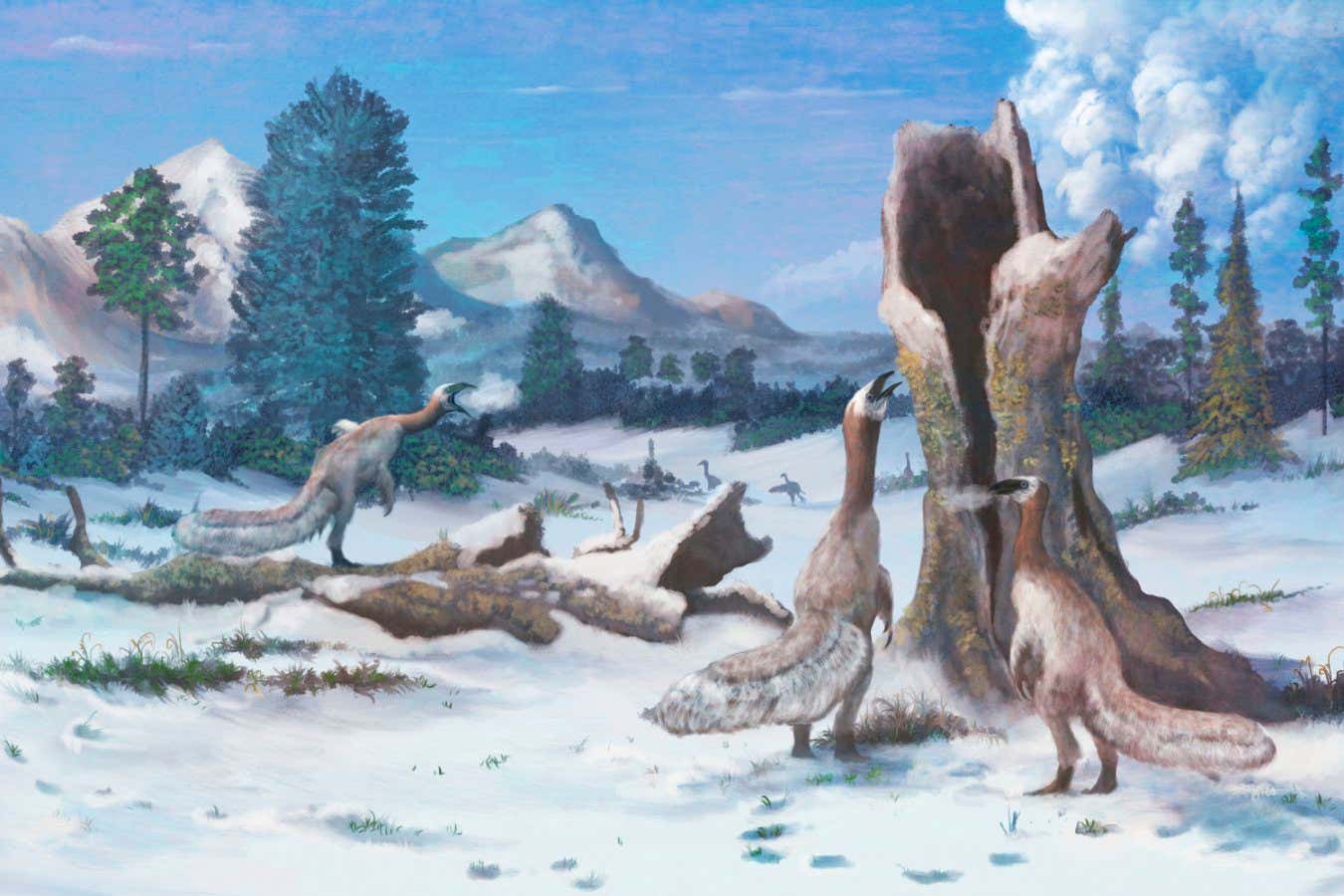

Dinosaurs could survive in cold conditions, as illustrated by Beipiaosaurus, a feathered dinosaur that lived between 127 and 121 million years ago
MARK P. WITTON/SCIENCE PHOTO LIBRARY
The Arctic was once home to a landmass three times the size of Antarctica. About 200 million years ago, it helped cause a cold spell that lasted for millennia and gave dinosaurs their chance to conquer the planet.
According to palaeontologist Paul Olsen at Columbia University in New York, this “giant Arctic continent” consisted of what is now Siberia and China.
For most of the Mesozoic Era – between 252 and 66 million years ago – all of Earth’s land was gathered into one supercontinent, Pangaea, except, it was thought, for what is now China. This slab of continental material was divided into two chunks that both drifted at a temperate latitude in what was the world’s only ocean at the time, named Panthalassa.
But recent analysis of the geology – including magnetic features in rocks, which offer a way of reconstructing the ancient latitude of their formation – has led Olsen and other researchers to conclude that both chunks of Mesozoic China were, in fact, connected to Pangaea. Furthermore, the whole assembly of continents was orientated in such a way that Siberia and China together filled most of the Arctic circle.
That arrangement makes the pieces of a climatological and biological puzzle fall into place, Olsen will tell the annual meeting of the European Geosciences Union in Vienna next month.
During the Mesozoic, the climate was much warmer than it is today. But 201 million years ago, towards the end of the first period of the Mesozoic, called the Triassic, Pangaea started to break up, forming the Atlantic Ocean. The intense volcanism that went along with that break-up coincided with an episode of global cooling, a drop in sea level, the extinction of many large animals and the rise of the dinosaurs. But how all these events were connected wasn’t quite clear.
Olsen suspects that the Arctic continent played a major role. For one thing, even in a warm climate, a large landmass around the North Pole would have had winters with snow and ice. Such frozen landscapes have a high albedo, meaning they reflect a relatively large part of the sun’s heat and light away from the planet.

Antarctica today (left) compared with the Arctic continent that existed 200 million years ago
Paul Olsen et al. 2026
The key point is that when the aerosols released into the atmosphere by the intense volcanism cooled the climate, this suppressed summer melt in the high north, allowing ice to remain in place and eventually keep reflecting sunlight away all year. “The albedo would be high during the summer, which enhanced the lack of melting, and with that feedback, you could get a much longer duration of really cold conditions, and maybe a polar ice cap, a transient one, lasting for millennia,” says Olsen.
The accumulation of ice in the Arctic would explain the drop in sea level, while the abrupt cooling from volcanic winters took care of the extinctions. Some dinosaurs escaped extinction driven by global cooling because they lived on the Arctic continent and had evolved an insulating coat of feathers to survive the cold winters there. So, when the whole Earth cooled, they were ready to take over, says Olsen.
“This is an amazing proposal because we mainly assume the Earth was ice-free through most of the Mesozoic,” says Mike Benton at the University of Bristol, UK. “To picture the first dinosaurs in a world with harsh winters is a novelty, even if it was for a relatively short time. This was a time of extinction and turnover among dinosaur faunas, so the combination of volcanic eruption and ice in the north might have had a profound effect on them.”
Olsen says the idea of a large Arctic continent has been “hiding in plain sight” for quite some time. “I think a lot of it has to do with the way scientists tend to show diagrams of the Earth in which poles are either infinitely expanded, like in a Mercator projection, or they’re almost invisible. Both ways tend to take attention away from the polar regions.”
Topics: