
A 3D-printed gel that bends, grips, and changes shape with magnets could help build robots and medical tools for drug delivery and fluid control.
Engineers at Massachusetts Institute of Technology (MIT), with collaborators at École Polytechnique Fédérale de Lausanne and University of Cincinnati, have developed a magnetic hydrogel that can be printed into structures capable of bending, gripping, and switching states under a magnetic field, opening possibilities for microrobotics and materials.

The material allows the creation of three-dimensional architectures whose parts can move and deform independently. That level of control could support applications such as drug delivery, biopsy collection, and fluid regulation inside biomedical systems, where devices need to be guided remotely and respond quickly.
At the center of the advance is a fabrication method that separates printing from magnetization. Instead of mixing magnetic nanoparticles into a resin before printing—a process that often reduces accuracy—the structures are printed first and magnetized afterward.
The process begins with two-photon lithography, a 3D printing technique in which a laser solidifies structures inside a polymer gel. After printing, the gel is soaked in an iron-ion solution, allowing the material to absorb the ions. A second chemical bath converts those ions into iron-oxide nanoparticles inside the structure, giving it magnetic properties without interfering with its shape.
The post-printing approach also allows different parts of the same structure to have different magnetic strengths. By adjusting laser power during printing, the density of the gel can be altered. Cross-linked regions produce fewer magnetic nanoparticles, while less dense regions produce more, creating structures with varied magnetic responses.
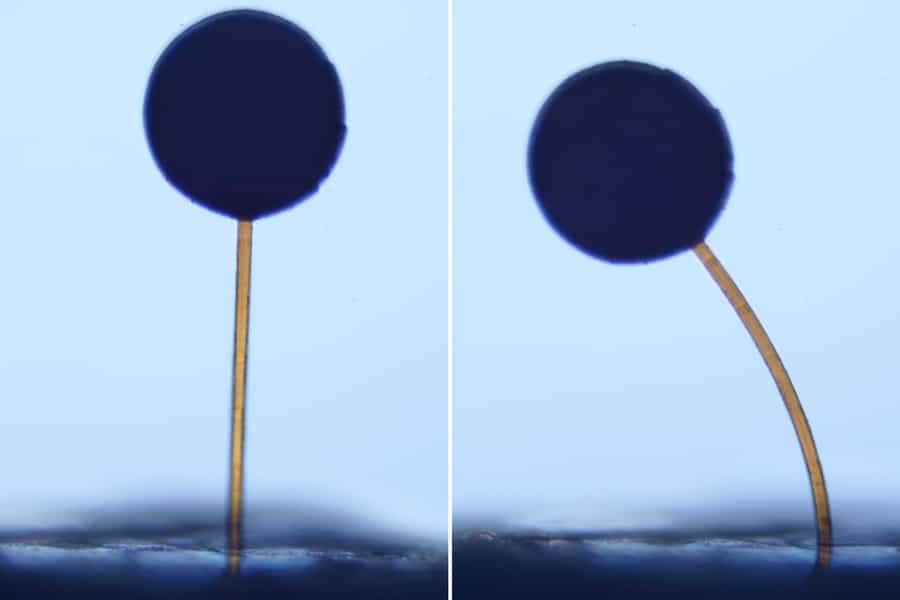
To demonstrate the technique, the researchers built ball-and-stick structures shaped like lollipops, each less than a millimeter tall. Their ends were engineered with different magnetic strengths, allowing them to bend and snap shut under a magnet like robotic grippers.
A second test produced a bistable switch made from a polymer strip with four magnetic paddles attached to its sides. When exposed to a magnetic field from one side, the paddles flipped and locked the strip into one position. Reversing the field caused the paddles to flip again, switching the structure into its alternate state.
That bistable design could function as a valve in microfluidic systems, regulating fluid flow in controlled environments. More broadly, the ability to create programmable structures could expand the design of robotic systems for medical and engineering use.