
Jon Wiener: From The Nation magazine, this is Start Making Sense. I’m Jon Wiener. Later in the show: The “Monuments” show in LA at MOCA’s Geffen Contemporary critiques Confederate monuments that have been taken down in response to protests. Critic Christopher Knight has our evaluation. The show closes Sunday. But first: winning some big battles with Trump – John Nichols has our political update – in a minute.
[BREAK]
JW: For our analysis of today’s political news, we turn to John Nichols. Of course, he’s executive editor of The Nation. John, welcome back.
John Nichols: It is great to be with you, Jon.
JW: After the white House Correspondents Dinner on Saturday night was disrupted by that would-be assassin, Trump told 60 Minutes, “The reason you have people like that is you have people doing No Kings.” Now, you were one of the 8 million people “doing No Kings.” You went to Saint Paul for the No Kings 3 flagship event, along with Bernie and Bruce Springsteen, Jane Fonda, Joan Baez, dozens of local and national leaders and grassroots activists. We talked about it here on the podcast. What would you say to Trump’s argument that the reason you have people like the would-be assassin is that you “have people doing No Kings”?
JN: Well, I also took my daughter to Saint Paul, and I want to tell you that I have enough affection for her that I wouldn’t take her to any place that I thought was overly dangerous or particularly disruptive. And I have to tell you that, you know, frankly, I wish the president could, you know, really witness a No Kings rally. What he’d see is a tremendous number of hard working, kind of very mainstream Americans. That doesn’t mean that there aren’t people at No Kings events who are very angry, very upset with the direction of the country, opposed to wars, opposed to the staggering economic inequality that is has emerged in this republic — and, you know, critical of a lot of other things.
And if I can sum it up, I guess it would be in the response of Bruce Springsteen to the attempted assassination or to what happened at the White House Correspondents Dinner. I believe it was the next night Springsteen was performing at one of these huge crowds, tens of thousands of people. And he literally took a reasonable amount of time to explain that he was very glad that the president of the United States was not harmed, that the vice president wasn’t harmed. Talked about how deeply important he thought it was that we not hate our rivals or our opponents to such an extent that we would wish harm to come to them. And it was a very sincere, very poignant statement of what I think most the overwhelming majority of people who attend No Kings events would tell you.
JW: Meanwhile, the war in Iran continues. Trump, you will recall, did not seek congressional approval for his attack on Iran. And he justified that refusal by claiming Iran posed an imminent threat to the United States. Now, of course, the CIA and the rest of our intelligence community said Iran did not pose an imminent threat, but the Republicans in Congress went along with this and agreed that Trump had the authority to launch the strikes under the 1973 War Powers Act, which is where the concept of the imminent threat as a basis for going to war without a declaration of war is found. But the War Powers Act also says that, 60 days after the start of a war, the president has to stop — unless Congress either declares war or authorizes the use of the military for that specific action. That 60 day window closes on May 1st, Friday. What do you think’s going to happen with Congress declaring war or authorizing the use of military force this week?
JN: I have very bad news for you, Jon. The Constitution and the extensions of it that that Congress has made, particularly during the Nixon era, when they were trying to rein in presidential war making, these things do not seem to have taken hold in the current Congress. Mike Johnson, who does not serve as speaker of the House but rather as Donald Trump’s floor leader in the House. He’s got the title of speaker, but but he doesn’t play that role. He’s not particularly interested in doing anything that might check and balance or trip up the Trump administration. So I would suggest to you that any effort to rein in presidential war making in this regard would have to come through a very circuitous and difficult route of seeking to force a vote.
And this you’ve got a complexity because while there are some Republicans who are opposed to this, this war, and most Democrats are opposed, you have that odd mix of a few Democrats who are somewhat sympathetic, most Republicans who are more or less on Trump’s side. So I think upending the House leadership and getting a real vote this week or even in your term is unlikely. And that’s that’s something we should all be very unsettled by.
JW: I want to talk about the movement to stop ICE from building that string of detention camps that Trump wants, that will that would house tens of thousands of people picked up in raids. Last Saturday there was a series of nationwide protests. Over 160 actions highlighted opposition to these new warehouse-style detention centers that are being planned. Saturday’s actions were in out of the way places I’d never heard of: Romulus, Michigan. McHenry, Illinois. Socorro, Texas. Trump’s goal, of course, is a million deportations annually. And in order to accomplish that, the Department of Homeland Security has purchased 11 empty warehouses across the country, for about $1 billion. And every one of these is facing opposition from locals.
The flagship challenge happens to be in Maryland, where the state, pushed by citizen activists, sued the federal government. A federal judge agreed with state of Maryland and blocked plans to transform this warehouse into a prison camp for thousands of people, citing the lack of an environmental review.
And now other cities and states are adopting the same tactic — in New Jersey, Michigan, Arizona, Tennessee. And a lot of these are Republicans joining in these efforts to kill these projects. A lot of these are in red states.
It may be, right now, not a single one of these projects is getting anywhere. It may be that none of these new detention camps will ever be opened. ICE is actually being defeated in this battle, at least right now. And it’s not taking millions of people in the street to win this; it’s just taking some popular opposition. What do you make of this?
JN: The same thing that I make of the protests against data centers, AI related data centers across the country. We are in a moment in America where economic and political power assumes that pretty much can do what it wants. And when you have the level of inequality that we have, and when you have the dysfunctional Congress that we have, and all these other things, that’s maybe not crazy that they make that assumption.
However, when you take things out to the grassroots, right, when you go to where people live and you say, “I’m going to put a data center here”, and they’re like, “well, what about our water? What about our utility rates? What about all of these other issues? And what about AI? We’d like to have a discussion about that.”
Similarly, if you put a detention center by people, they’re going to initially say, “do I want this near me? Is this something? Do I want that to be the best use of a major warehouse or of an industrial park or something in my area?” And then beyond that, there are the deeper questions related to it. You know, do we, should we, be letting ICE kind of guide us through a response to immigration that is that is so cruel and so ill thought-through and so irresponsible and frankly, at odds with, you know, so many of the historic values of the United States and the goals of a country that that has been built in so many ways by immigrants. And so it’s not surprising that you see this pushback at the grassroots level.
And I think it is, to me, a fascinating and encouraging reality. At the federal level, we have dysfunction. But boy, when you get this close to the people, you see a pushback. My sense is that what we ought to be looking to are those moments of intersection, right? Where those people pushing back at the local level might figure out that the one place where they could say ‘no’ to the federal government comes in November of a midterm election year.
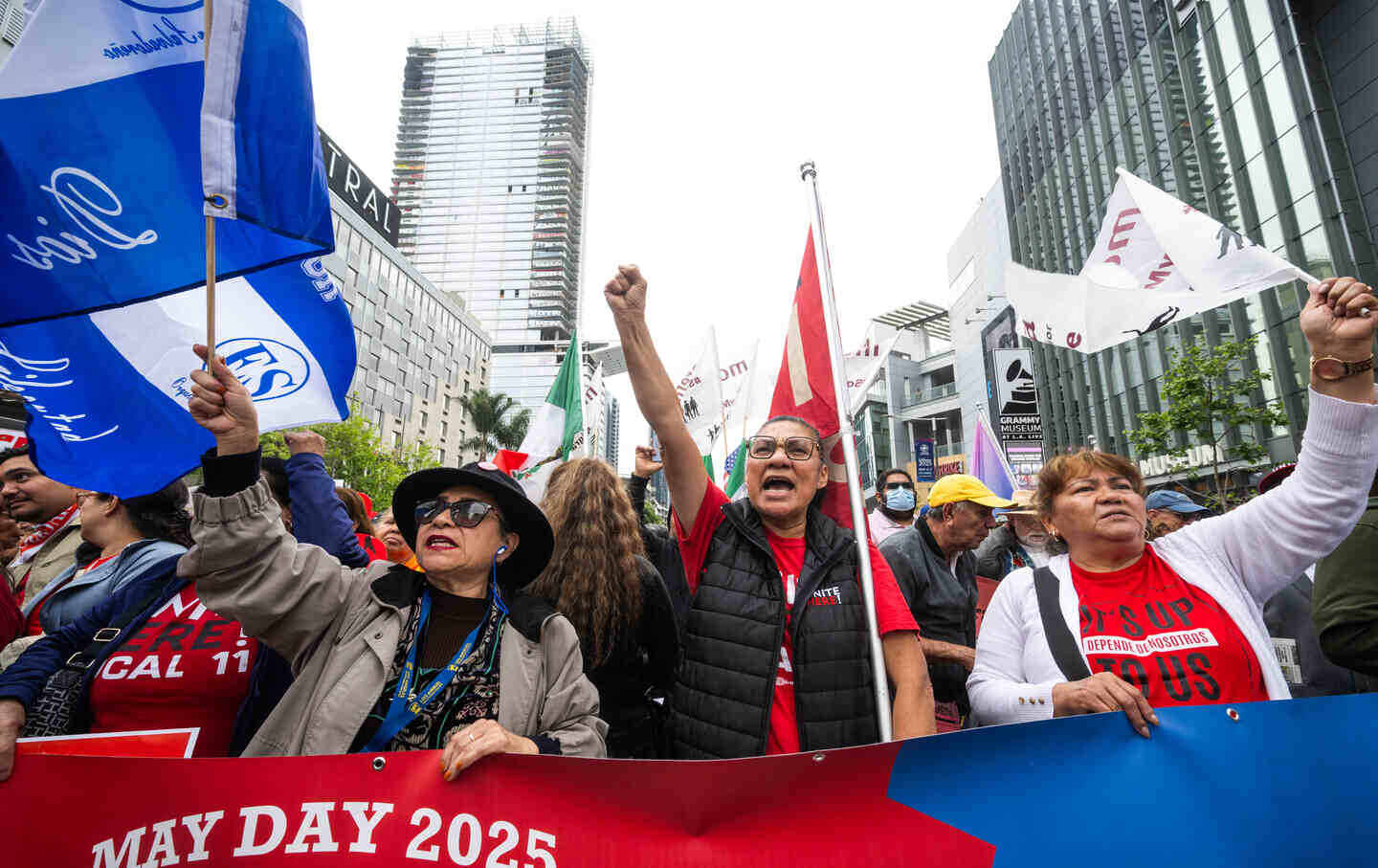
JW: Last Saturday was the “communities not cages” protests against the ICE detention center projects. This Friday is going to be the biggest May Day protest in our lifetimes in the United States. Over 1100 locations are going to declare “no work, no school, no shopping.” People united against the billionaire agenda. This is being organized by 500 labor unions, community organizations, immigrants rights groups, racial justice groups. There’s a huge alphabetical list. I took a look at it. It begins in the A’s: AAUP, AFSCME AFT. And at the end of the list, Working Families, Young Democrats. Yuba County Democratic Central Committee. No Zs yet, but the Ys are there.
JN: I’m concerned about the lack of Zs. Maybe Zoran Mamdani will weigh in.
JW: Maybe he should. He should sponsor one.
And a lot of very specific things are happening:. In North Carolina, a dozen school districts will be closed for educators to join a massive statewide protest go get the legislature to raise the budget for public schools in North Carolina.
In Chicago, the Chicago Teachers Union and the school district reached an agreement to declare Friday, May Day, an official day of civic action, where thousands of students will participate in field trips to places like the historic Operation Push offices. The district will provide busses and bag lunches to the kids.
This sort of thing is going to be happening all over the place, and Indivisible and the other participating groups see this May Day event on Friday not just as another protest, but as a kind of rehearsal for what they call “the kind of peaceful action will have to supercharge if Trump tries to sabotage the midterms.” That’s a quote from Ezra Levin, co-founder of Indivisible. “No work, no school, no shopping: A rehearsal for what we’ll do if Trump tries to sabotage the midterms.”
And it’s based on an idea which was first put into practice in Minneapolis, a single day of protest, Tens of thousands of people taking to the streets. Remind us about that day in Minneapolis.
JN: I will remind you of that day, but I’d be remiss if I didn’t say this: And I know this is going to shoCK you that Madison, Wisconsin, my hometown, will also be having a day off from school so that students and their teachers can join the demonstrations.
Now in Minneapolis, Yes, In fact, there was a day of protest. I have to say that they they were not as smart on their scheduling as some of the folks are on May Day. They scheduled it for one of the coldest days of the year. And I mean, it was literally, you know, way below zero, incredibly brutal cold. And yet they came by the tens of thousands, filling the streets of Minneapolis.
There are those who will say, well, what’s the point of a demonstration? Right? You put a lot of people in the streets, you get some, maybe some TV images. But what comes to that? I can tell you that what came of that in Minneapolis, having been up there, was a deepened commitment. People went to those demonstrations and they went baCK to their neighborhoods. And I think they they felt they weren’t alone anymore. And in Minneapolis, in those early days of the ICE surge, I think a lot of people felt isolated. They were deeply concerned about what was happening to their neighborhoods, to their neighbors, to their friends.
And having seen the size of the demonstration and the energy of it, I do think it strengthened the the project of resisting. And I think the same is true at this point. It is easy to focus on distant battles and all that. But when you come out in your hometown, whether it’s a big city or a small town, and you’re out there with your neighbors and there’s a lot of you, I think you feel emboldened. You feel like,” okay, there’s so many things happening that we don’t want to see.” We can often feel that Donald Trump just isn’t going to listen to us. And, and neither is Congress. And yet here we are with our with our friends, our neighbors, our family. If we can get the crowds out, you know, maybe that gives people the energy that sees them through to November.
And and I will just remind you that The Nation magazine has nominated Minneapolis for the Nobel Peace Prize — because of what they showed all of us was possible as regards resistance and protest and assembling and petitioning for the redress of grievances. I think the Minneapolis lesson is a huge one, and we are, on Friday, very likely to see it mirrored in much of the United States and in some very profound ways.
JW: Friday, May 1st, May Day: “No work. No school. No shopping.” Find the protest near [email protected]. And you can read John Nichols @thenation.com. John, thanks for talking with us today.
JN: It’s a great honor to be with you, and I hope the speakers on Friday will remind people that Nobel Prize nomination.
JW: [LAUGHTER] Okay.
[BREAK]
JW: This weekend is the last chance to see what has been described as the “most important art exhibition of our post-2020 era” and a landmark moment for American museums: The “Monuments” show at MOCA and the BriCK in Los Angeles. It’s a display of 10 decommissioned Confederate monuments and the work of 19 artists responding or relating to them. For comment, we turn to Christopher Knight. He’s winner of the Pulitzer Prize in criticism
and the former art critic for the LA Times. He’s appeared on 60 Minutes, the PBS NewsHour, NPRs Morning Edition and All Things Considered., and on CNN. Christopher, welcome baCK.
Christopher Knight: Hi, Jon. Happy to be here.
JW: There are so many ways this show could have gone wrong. Most obviously, lots of people worked very hard to get these monuments removed from public places – because, of course, honoring the defenders of slavery is unacceptable. And now Trump has issued an executive order instructing the Interior Department to restore statues that had been removed, to bring them baCK. And coincidentally, after years of preparation, MOCA is bringing some of them baCK — to a space where art is displayed. And lots of people would say that’s wrong. On the other hand, the curators here know all about this. They know the challenges they face. They’re smart and talented people. How did they do with this show?
CK: They did extremely well. It’s a brilliant exhibition.
I do think it’s a very complicated situation. People have the assumption that, if a sculpture or a painting is brought into the context of a museum, that that sculpture or painting is being honored — when in fact what is happening is it’s being treated seriously. And the monuments that were produced to honor the Confederacy really do need to be taken seriously, especially now, with the return of white supremacy into the halls of power, it’s important to look at these monuments in a historical sense.
We’ve tended, I think, to regard these monuments strictly in terms of their political role and their subject matter at the time, but not as works of art. But they are works of art. And a number of the artists who made them were, formally speaking, really talented. I mean, they were able to carry the message, the corrupt message, that the Daughters of the Confederacy, who sponsored many of these, that they wanted carried. And we have a chance to see that in this exhibition.
It’s about paying attention to the scourge of white supremacy, which this country has had to deal with from day one — and sometimes deals with well, and at other times, succumbs to in a really horrific way, which is what’s happening now.
JW: The history of this show really begins with the movement to remove Confederate statues and the opposition to that movement. And all of this focused on Charlottesville, Virginia, where in 2016, a high school student started a petition calling on the city government to remove the statue of Robert Lee standing in one of the city’s parks. Let’s say her name, Zyahna Bryant.
When the city government voted in favor of removing it in 2017, white nationalists and neo-Nazis seized on the issue as a rallying point. And then there was the famous ‘Unite the Right’ rally in August, 2017, when a self-described neo-Nazi rammed his car into a crowd of counter protestors, leaving many people injured and killing one person. Let’s say her name, Heather Heyer.
This was a point at which Trump, in his first year as president, said about the Unite the Right rally, that “there were very fine people on both sides.”
The City Council eventually put out a request for proposals from organizations interested in obtaining the old monuments, which had now been removed. The Robert E. Lee statue was given to a group called Swords into Plowshares, which had proposed melting it down. And the bronze ingots that resulted are on display in the ‘Monuments’ show at MOCA.
The other statue, of Stonewall Jackson on a horse, the city council voted to give to an arts organization in LA — today called the Brick — headed by Hamza Walker. It was his idea to invite the artist, Kara Walker, no relation, to transform that statue. And she accepted. The work that resulted is on display now in Los Angeles at the Brick. How would you describe what Kara Walker did with the Stonewall Jackson equestrian statue?
CK: It’s astounding what she did with it.
The other work, that’s at MOCA, the disassembled Lee piece, is also a total eye-opener, and was a big surprise when I saw it. When the group that was given that sculpture decided that they were going to melt it down –the idea of what’s called ‘iconoclasm’ or the destruction of icons has always been controversial. But what they did when they melted it down, they melted it into these briCKs that are staCKed up like ingots and they have a vaguely gold color. It looks like you’re looking at Fort Knox here, which is a really strange visual connection to have.
But what’s really interesting is that, by the end of this year, the group that melted it down expects to have chosen an artist who will take those gold briCKs and melt them down again to make a new piece. And that idea of transformation is really interesting, I think.
Meanwhile over at the Brick, Kara Walker has been involved in a completely different kind transformation with the Stonewall JaCKson sculpture, which she cut up another act of iconoclasm, and she reassembled it in a really interesting way – when you look at this very strange figure that she’s made by combining fragments of Stonewall JaCKson and fragments of his famous horse, who was known as Little Sorrow. It’s a kind of man-beast.
The original sculpture was an equestrian sculpture, which is an ancient motif of the hero, the man on a horse. And it’s a horizontal orientation of the figure, kind of riding across the landscape. It implies a certain dominance over the world. The man on a horse. And she took that horizontal configuration and entered it into a vertical, into this monolithic figure in which the limbs of the horse and the limbs of the man and the torso of the horse and the torso of the man, and they’re all kind of mashed together and smashed into each other.
There are two, I think, really interesting aspects of this. One is that it has no head. It’s clearly a figure. It’s like this kind of automaton in a way. It’s clearly a figure, but it has no head. It’s a headless horseman. And the headless horseman is an old European American folklore story about a corpse that will not die, that continues to menace the living. And I can’t think of, I can’t think of a better description of white supremacy than that. It’s this monster that refuses to die, and it is torturing us right now. It is riding through our landscape right now, and this sculpture kind of embodies that.
JW: Meanwhile, back at the Geffen contemporary space of MOCA in little Tokyo, there’s these 10 decommissioned Confederate monuments. The striking thing about them is they are not on pedestals. They’re not 25 feet high or 50 feet high. They’re at human eye level. They are monumental. But it’s an amazing experience to be so close to something so huge. And it’s actually, as you say, pretty well sculpted.
CK: Yeah, I mean, one of the words I’ve used to describe it is ‘thrilling.’ It’s thrilling to see these things that are, as you say, usually up on pedestals, 10 feet up, 30 feet up; in one case, 50 feet up in the air, and that are usually experienced as a drive-by. You see them on the way. And that kind of one-step-removed quality was, I think, part of what made them powerful, they sort of existed in the environment as almost like a watchman. They were keeping an eye on things.
We refer to them as confederate monuments, but they aren’t really, the subjects are Confederate, but as monuments, they’re Jim Crow monuments. They were put up precisely to let everybody know, whether you were white or black or something else, that white power still was in charge. And so to see them down on the floor, and to be looking at them face to face, it’s disturbing and confusing and exciting — because some of them are very beautiful.
The subject matter is often horrifying. There’s sculpture by a guy I’d never heard of, named J. Maxwell Miller, of ‘Confederate Women of Maryland.’ And it was meant to honor the women who, many of whom were nurses who took care of Confederate soldiers and so on. And there are three figures in the sculpture. There’s a woman standing in the back, and in front of her seated is another woman, who is cradling in her lap a dead confederate soldier, who’s wrapped in the Confederate battle flag.
And it’s essentially a pieta. It’s like the dead Confederate traitor is Jesus, and the woman holding him is the Virgin Mary, and the woman standing behind them is St. Anne, her mom. And it’s an incredibly offensive image — because the whole philosophy that Jesus was attempting to put forward was one of radical equality, the equality of all people. And here is this ridiculous monument to anything but radical equality.
JW: And one of the kind of unexpected things about the installation of this show is that that piece, ‘Confederate Women of Maryland,’ is facing a white plaster sculpture commissioned for this show by Karen Davis. It’s called ‘Descendant.’ It shows her young Black son playing with a toy soldier on a horse. And that’s a very striking juxtaposition of two realistic pieces, with very different ideas.
CK: Absolutely. And one of the things that I thought was really interesting about the Karen Davis is that the figure of her son, who’s like a kid, he’s just presented as a kid, and he’s dressed and he’s holding up this toy of a man on a horse. Who the man on the horse is, we don’t exactly know, but he looks vaguely like and could be Robert E. Lee or something like that. And he’s a toy to be played with. He’s not something to be feared and given reverence to.
And the figure that Davis made is a direct reference to a very well-known sculpture by another Los Angeles artist named Charles Ray called ‘Boy with a Frog.’ And it’s white plaster then made into a marble figure of a naked young boy who is holding — in exactly the same way that Davis is holding the man on a horse — is holding a frog. It’s a kind of reference to youthful fascination with a natural world and with experience in the world. And the Davis refers to that. And at the same time, this fascination with the cultural world, with social experience and social history, I thought it was a really interesting reference.
JW: The show does include some very powerful video. There’s one made by Julie Dash featuring a singer named Davóne Tines singing ‘This little light of mine, I’m gonna let it shine.’ Tell us about that one.
CK: It’s about 10 minutes long. Davóne Tines is a base baritone with an incredibly powerful voice. It begins at the Mother Emmanuel Church and moves from there to a site just out outside of town to a 400 year old tree, a spectacular ancient tree that was just a little sapling in 1619 when the first slaves arrived in Virginia. And the song concludes there. And it’s an amazing, again, another transformation over the course of 10 minutes — from a place that was built as a church, that was built as a refuge, and became a site of murder and assassination — to history, to a beautiful place of history. And I don’t know, I found it really enthralling. It’s a really good 10 minutes to spend.
JW: And there’s one other artist in the show that I want to mention. This is one who was not commissioned: Hugh Mangum. He was an unknown itinerant portrait photographer working in the south in the early 20th century. I had never heard of him, I’d never seen his photographs before, but they come from that period of Jim Crow when these statues were all commissioned. These are portraits of ordinary Black and white people in the south, and they offer the sharpest possible contrast to the grandiosity of the monuments. These people are dressed up, they’re sitting for their portraits. I found it really moving.
CK: It’s very moving. And they do, they come across as just folks. These are just folks who, ‘oh, I’m going to have my picture taken. I’m going to look good.’ Some are Black, some are white, some of them are double exposures, which are really, I mean, really turn your head around — where a white woman in her chest has the face of a Black person from the double exposure in the film.
And it becomes a kind of pictorial record of an artist who, as you said, I was not aware of, I did not know of him, but who was clearly a great human being. He knew what he was doing and he wanted to take pictures of people. And it didn’t matter who those people were, he did for them what he would do for anybody. And it becomes this kind of resonant series of pictures that are the opposite of what the monuments are doing. The monuments were put up in order to normalize white supremacy, in order to make white supremacy a perfectly normal and ordinary thing. And these photographs are involved in normalizing normality, normalizing people. That’s all just people. And that turns out to be a really powerful thing.
JW: This show, as I said that the outset, was conceived, its origins lie eight years ago in the era of the Unite the Right rally, the first Trump administration, and then the George Floyd protest. It’s been a long time coming, and I worried, as the date approached for the opening, that this was going to seem like yesterday’s issue. You think that’s the case?
CK: This is a show that meets the moment. It’s exactly what we need now. It’s also the kind of show that needs to be seen, I think, several times. There’s a lot to think about and a lot to see in it.
JW: Christopher Knight — his review of the Monument Show in LA at MOCA at the Brick is online @latimes.com. Thanks for talking with us today.
CK: It was great to be with you.
JW: We did that interview with Christopher Knight when the show opened in October, 2024. A postscript: Kara Walker’s piece, Unmanned Drone, now at The Brick, which is the “conceptual fulcrum” of the show, has been acquired by MOCA for its permanent collection. It will now go into short-term storage, but it will certainly be displayed again in Los Angeles, and soon.