
The invocation of values is a hallmark of enterprise positioning. Yet on its own, a values statement means very little — and can actually do harm to a brand’s reputation and thus its worth. Without an ethos of integrity, the value statement is a mere device, not a system — instead of a way for an organization and its stakeholders to connect — instead of serving as the driver of product or service design and delivery.
An ethos of integrity is characterized by measured alignment to values and execution within them. It emphasizes honesty in design and in positioning. It inoculates an enterprise from the forces — including executive ego — that focus on story alone. It is born with values, yet exists when leaders enact it consistently through project execution and performance measurement. An ethos of integrity protects the enterprise against rash and reckless action that threatens steady growth and performance.
This article is part of Branding Strategy Insider’s FREE newsletter. Join the world’s smartest marketers and subscribe here for actionable insights delivered directly to your inbox.
There are four structural levers that help an organization advance its integrity and thus its brand: a rigorous strategic plan; a straightforward decision framework; unadulterated data; and a potent governance architecture. Pulling these levers is essential to keeping the organization’s stated ethos real and productive. Without them, resources devoted to the brand are largely wasted.
The Strategic Plan
The plan is the organization’s platform for action. A rigorous, board-approved strategic plan with defined objectives and key results (OKRs), resource allocation, and key performance indicators (KPIs) acts as an institutional anchor. Unilever’s Compass strategy, introduced in 2020, is an example of how this works. The Unilever Compass is based on the input of 40,000 employees and external stakeholders. The Compass states aspirations — yet it sets quantifiable targets across 15 priority areas with defined timelines. Capital allocation is made, trade-offs are agreed, and people are held accountable. There are time-bound roadmaps, with investment needs integrated into the business planning cycles and regular checkpoints at the top of the organization. The organization benefits from the whole might of the company and the sense of urgency with which the rest of the business is typically managed. The brand extrapolation is direct: Unilever’s purpose-driven brands (Dove, Ben & Jerry’s, Seventh Generation) are not marketing campaigns layered onto conventional products. They are the output of a strategic framework that requires every brand to have a defined social or environmental purpose connected to measurable targets. Success is measured through the Compass, which tracks both financial metrics, like underlying operating margin, and sustainability metrics.
The Decision Framework
The decision framework checks ideas for efficacy. It prevents mere whims and wishes from joining the pantheon of projects. When a manager wants to chase a pet project or redirect resources on an untested rationale, the decision framework forces a formal review. There are different options — RACI matrices (Responsible, Accountable, Consulted, Informed), the board investment committee, stage-gate processes — that help to document rationale, capture input from multiple functions, and define approval chains. Toyota institutionalized how decisions get made, removing the possibility of unilateral executive overrides. Nemawashi is the first step in the decision-making process — the sharing of information about decisions that will be made, to involve all employees in the process. The word literally translates to “going around the roots,” drawn from the practice of carefully preparing a tree’s root system before transplanting it. Toyota codified this in Principle 13 of the Toyota Way: decide slowly by consensus, considering all options; implement rapidly. The A3 report — which compresses all information needed for a complex decision onto one sheet of paper — forces structured thinking and documented rationale. Toyota’s brand is reliability. This is not a positioning statement invented by a marketing team — it is the direct output of the Toyota Production System showing up in the product. Through kaizen, Toyota implemented a new way of building cars, eliminating waste and implementing just-in-time manufacturing as well as giving workers the autonomy to stop the production line if a quality issue arises — fixing it at its source. Nemawashi, the A3 reports, the consensus culture — these internal practices produce cars that consistently top reliability charts. Toyota did not have to claim reliability in advertising and then hope the product delivered. The internal system guaranteed the external outcome. When the practices slipped, so did the brand. The pursuit of growth took priority, which led to the recall crisis of 2009-2010. The brand did not degrade because of bad marketing. It degraded because the internal system was compromised by growth pressure.
Data-Centric Workflow
Dashboards that pull data from financial as well as production sources depict undeniable reality, which should inform workflows — highlighting redundancies, areas for improvement, and cost savings. Source-based information that follows a direct flow immunizes the enterprise against data manipulation, especially when it comes across in real time. Danaher uses its Danaher Business System (DBS) to coalesce data, analysis, and insights that inform decisions and foster improvement. Every department, every operating company, every site, every platform runs to around seven different key performance indicators. They make problems visible rather than hide them. A policy deployment tool monitors strategy implementation. Because the data is standardized, visible, and updated daily, it becomes very difficult for any individual — including a CEO — to selectively curate what the organization or the board sees. As a B2B conglomerate, Danaher’s DBS is its brand — with a promise to deliver value, reliably, to partners, holdings, and institutional investors. These stakeholders sign on to the performance promise made possible by the operating system, in which employees have direct responsibilities.
Governance
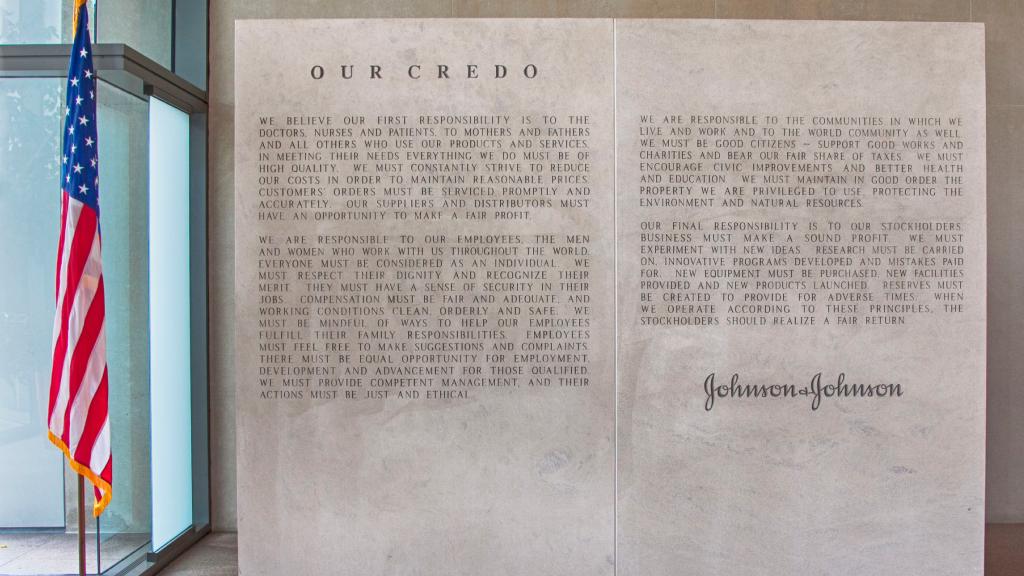
A strong, independent board with real oversight authority sets a path to enterprise-brand cohesion. They govern performance to values and assert their responsibility when things do not line up. While formal committee structures are critical to distributing management, even more critical is the board’s vigilance to what is being put in front of them. J&J illustrates both the strengths and tensions of governance architecture. The company is governed by the values set forth in its Credo, which extend to its corporate governance practices and are reflected in its By-Laws and Principles of Corporate Governance. Structurally, all directors other than the Chairman and CEO are independent, and all committees other than the Finance Committee are comprised only of independent directors. J&J’s Credo, written in 1943, exemplifies how internal governance principles become the brand itself. It was written before company culture and corporate responsibility became buzz phrases, and it includes five key responsibilities: to doctors, nurses, hospitals, and mothers who use the products, and lastly to stockholders. That stakeholder ordering — customers first, shareholders last — is J&J’s brand identity. The Credo prevailed in 1982 with the Tylenol crisis. The Credo told them what to do, and the brand was strengthened by visible adherence to it. Yet without attention, everlasting immunity to misalignment is not a given, and there is always the risk of any credo being used to control others rather than check power. The role of the board is to pay attention to the signals, which often happen first in the gut. When they are ignored, the values become tools of internal delusion that cause serious damage to the brand — as exemplified in recent J&J litigation.
Brand should strengthen competitive position, pricing power, and enterprise value. The Blake Project helps make that happen.
Integrity And The Path To Brand Relevance
Sometimes a reputation issue becomes a catalyst for change. In the moments or eras when a brand sustains major damage, it is often because of a departure from the ethos of integrity. Erode the ethos and you erode the brand. Straightforward strategic action informed by early warning tools, measurement, and decisiveness strengthens the relationships that keep an enterprise productive and a brand relevant. An intact ethos of integrity uses strategy to constrain the weaker aspects of human leaders — instead of merely relying on the leaders to be good.
Contributed to Branding Strategy Insider by Mary Trigiani, Performing at the intersection of strategy, narrative, and enterprise transformation.
At The Blake Project, we help leaders turn brand into a disciplined driver of financial performance — strengthening pricing power, competitive position, and enterprise value. Email us to start a conversation about enduring profitable growth. For The EBITDA.
Branding Strategy Insider is a service of The Blake Project, a strategic brand consultancy focused on turning brand into pricing power, growth, and enterprise value.