
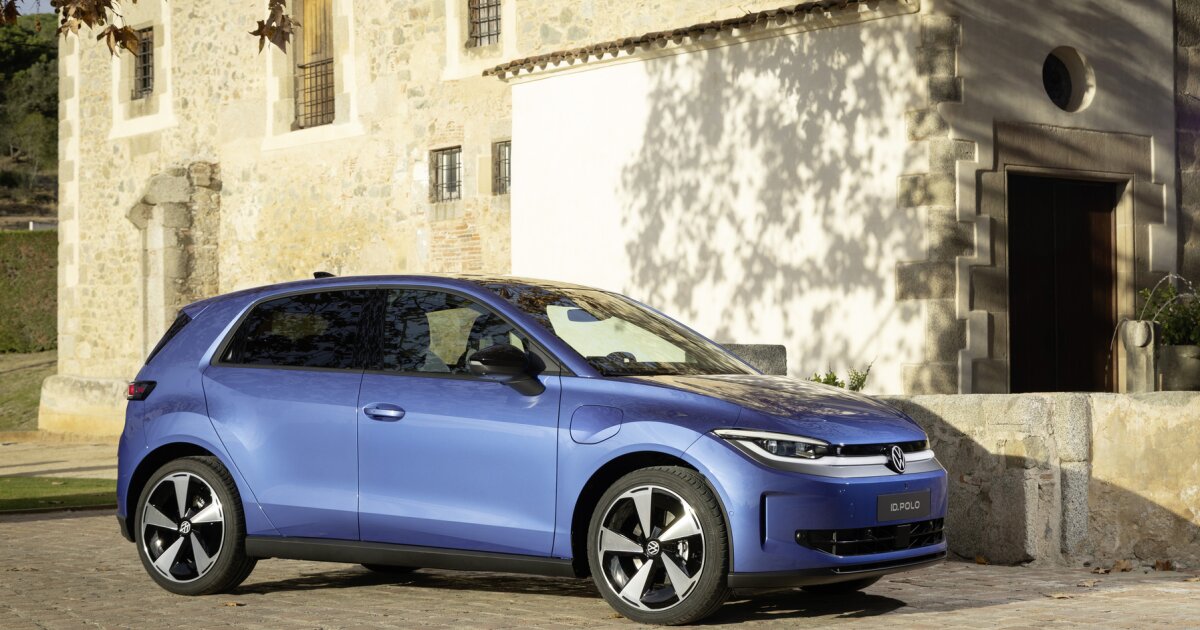
In response to a growing backlash to a decade of touchscreen overload, VW has taken a step back into traditional territory with its new electric hatchback. The ID.Polo is the first of the brand’s new electric-vehicle (EV) range to revive a generic name from the ICE era. The futuristic styling of the ID.3 has been dumped and, best of all, VW has brought back tactile buttons on the dashboard.
The global launch of the ID.Polo comes as consumers across various industries are reportedly pushing back against over-digitization, and seeking out products that offer tactile feedback, simplicity and a sense of human-centric design.
The front-drive, five-door hatchback is not posing as a glimpse of the future. It’s classic VW: solidly-built, standard middle-ground automotive fare. The styling skips the ID.3’s futuristic eco-blob look for a friendly facade and a C-pillar that seems inspired by an old Mk1 Golf. It’s a neater version of the ID.2 concept we revealed two years ago.

Volkswagen
Old-school values jump out everywhere: the EV is slightly shorter than the gas Polo, yet has prioritized offering a deep 441-liter trunk – which is larger than the ICE Polo (that has to put a fuel tank and exhaust pipe in that space). There’s even more space than in the much bigger VW Golf. One reviewer said the trunk is so deep ‘you expect to find Australians living in the bottom.’
The ID reinstates physical buttons for climate control and steering wheel functions alongside the touchscreen. There are no ‘haptic’ touch-sensitive sliders. Instead, it includes the ability to switch the digital dash into a style that mimics 1970s analog dials.

Volkswagen
The numbers that only buyers need are: a 37-kWh battery can be had with either 85 kW or 99 kW (charges up to 90 kW); a bigger 52-kWh battery offers 155 kW (charges up to 105 kW). Early VW range estimates are 329 km (204 miles) and 454 km (282 miles) for the small and big batteries, respectively. But note that all versions of the electric Polo weigh more than 1.5 tons, more than twice what the first gasoline Polo weighed.
Originally planned as the “ID.2,” the new car was hurriedly renamed the ID. Polo because VW realized in the current consumer climate the Polo name carries 50 years of value that a numbered system lacks. More than 20 million Polos have been sold worldwide since 1975. At the same time VW has also announced a stay of execution for Polos with exhaust pipes, with a commitment to sell a gasoline hybrid version until at least 2033.
The company is also confirming an ID. Polo GTI. The old VW GTI badge is not something allocated flippantly. It’s the first time it has been used on any production electric car. Expect the hot Polo in 2027 and rumors are 166 kW will be on tap.

Volkswagen
Polite face or not, the ID.Polo has stiff competition ahead from the undeniably cooler Renault 5. The Hyundai Inster, Fiat Grande Panda and upcoming Hyundai Ioniq 3 are all on the warpath too. Things like trunk size and buttons may turn out to be vital.
The Polo has a legacy but its heyday was a decade ago when the fifth generation sold six million units between 2009 and 2017. We reported on its progress back in 2012, but production in Europe stopped in 2024 and shifted to South Africa. The ID.Polo will be built in the SEAT plant in Martorell, Spain.
VW’s new compact e-hatch will start pre-sale very soon, with European pricing starting from €24,995 – above the Grande Panda and close to the Renault 5.
Source: VW