
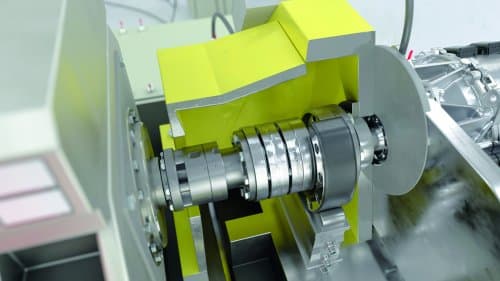
New motion-control hardware combines lightweight couplings, fail-safe brakes and predictive monitoring to improve precision, vibration control and uptime in high-speed automotive drivetrain test environments.
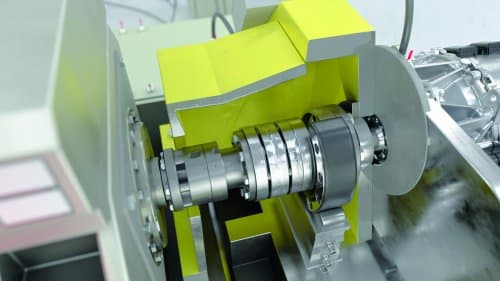
Automotive drivetrain test benches are evolving rapidly as electric mobility reshapes speed profiles, load conditions and validation routines. To meet these demands, a new portfolio of lightweight couplings, safety brakes and intelligent monitoring systems has been introduced to improve measurement accuracy, machine protection and maintenance efficiency.

The key features are:
- Aluminium coupling cuts inertia by up to 60%
- Supports speeds up to 32,000 rpm
- G 2.5 balancing for low vibration
- Sensorless brake health monitoring
- Ethernet-ready remote diagnostics support
At the centre of Mayr Power Transmission’s launch is a new aluminium disk-pack coupling engineered for high-speed test stand applications. Developed from an established steel design, the updated version significantly reduces mass and rotational inertia while maintaining the same power density. Depending on the configuration, overall mass and inertia are reduced by 40% to 60% compared with comparable steel versions, while the outer diameter is trimmed by up to 10 mm.
The reduced inertia helps test systems accelerate and decelerate faster while lowering unwanted reaction forces on connected equipment. Designed for rotational speeds up to 32,000 rpm, the coupling supports demanding e-drive and powertrain validation tasks. A balanced quality of G 2.5 at 5,000 rpm enables smooth, low-vibration operation, helping improve repeatability and data accuracy across wide speed ranges.
The coupling also incorporates corrosion-resistant construction, including nickel-plated surfaces, stainless steel disk packs and galvanised fasteners. Backlash-free shaft connections using shrink-disk hubs support stable torque transmission and reproducible measurements. Compatibility with common torque transducers simplifies integration into existing test systems.
Beyond couplings, the range includes braking solutions for vertical axes and linear movements commonly found in test stands. Rail brakes clamp moving masses with high rigidity, while piston-rod brakes provide fail-safe emergency stopping on round rods. Compact motor brakes can function as holding or dynamic braking systems directly at the drive motor.
The latest monitoring modules add predictive maintenance capability. By analysing current and voltage, the system detects brake-switching status without sensors and can warn users of issues such as low supply voltage, overheating coils, or increasing air gaps before failure occurs. Ethernet connectivity enables dashboard visualisation, remote diagnostics and planned servicing, helping reduce unplanned downtime in automated test environments.
Click here for the original announcement.