
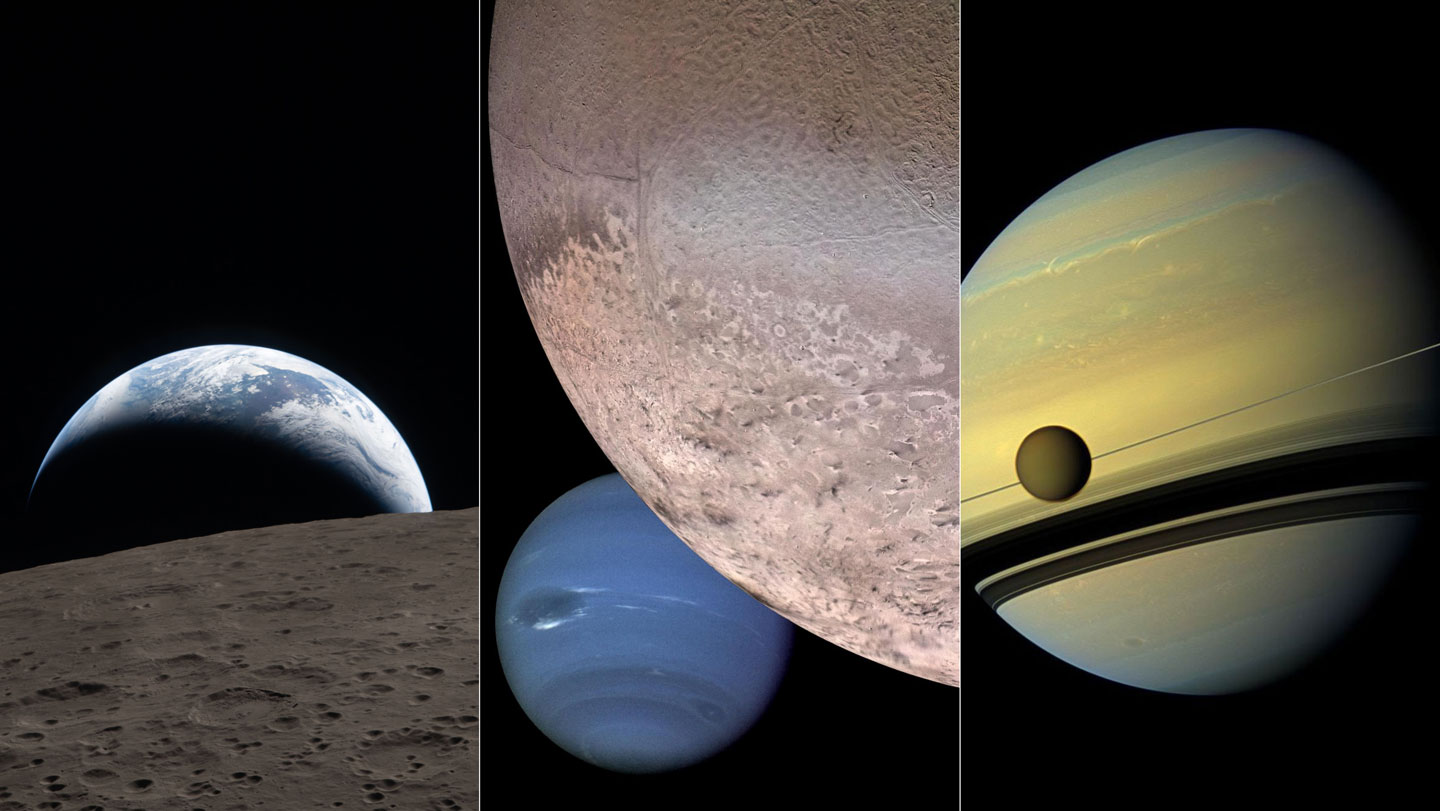
Humankind’s recent journey around the moon produced a spectacular photo album of our corner of the universe. Here was the crescent Earth, a luminous sliver surrounded by complete darkness, behind the graphite-colored moon. There was the moon’s farside rippled with craters, the way raindrops draw rings across the surface of a lake. There was the moon again, this time a shadowy marble levitating in space, encased in the soft glow of sunlight.
Only four people truly basked in these spellbinding views, but by capturing the scenery and sharing the snapshots, the Artemis II astronauts made myself and many others back on Earth feel momentarily, dazzlingly weightless.
That’s the magic of a good space picture. A single frame can shrink the distance between here and way out there, compressing the wonders of our celestial neighborhood down to the scale of human experience.
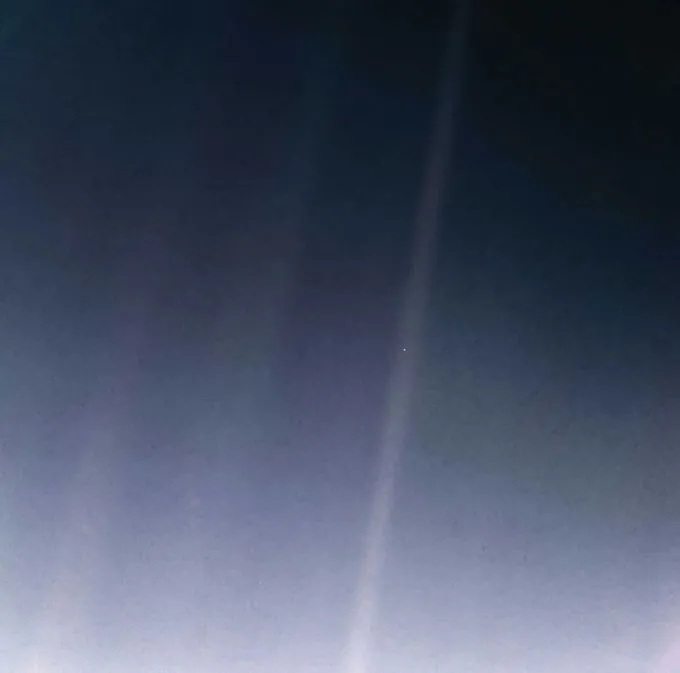
When I think about such poignant, otherworldly photography, I think of Candy. Candice Hansen-Koharcheck was a planetary scientist, not an astronaut, but through nearly 50 years of robotic space missions, she touched almost every planet in the solar system and many of its moons. She was the first person to lay eyes on the “Pale Blue Dot,” the iconic portrait of Earth from afar, the perspective that inspired Carl Sagan’s memorable description of our planet as “a mote of dust suspended in a sunbeam.”
Hansen-Koharcheck died of cancer on April 11, the day after the Artemis crew returned home, according to the Planetary Science Institute in Tucson, Ariz., where she worked.
As a space journalist, I’d interviewed Hansen-Koharcheck over the years — about the Cassini mission’s exploration of Saturn before its plunge into the ringed planet’s atmosphere, or the workings of the Voyager probes that still call home all the way from interstellar space. Most often, we’d marvel at pictures of Jupiter from the Juno mission, where she led the camera team. “Even with the best possible telescope, you’ll never get a perspective like this from the Earth,” she once told me.
She knew well the power of space photography, and the purpose of bringing it home. Most human beings will never travel beyond Earth, at least not in the foreseeable future. The camera may be the most meaningful piece of equipment on any space mission. Why go to outer space if you’re not going to show everyone else what you witnessed?
At the moon, the Artemis astronauts created a modern-day version of one of the most iconic space pictures in history: the Apollo 8 mission’s “Earthrise,” taken in 1968. While an uncrewed spacecraft had previously snapped a similar shot, the Apollo one was in full, glorious color. The arresting image walloped the public with the existential reality of the world as a vulnerable planet, and helped ignite the modern environmental movement.
Not long after the Apollo missions recast the moon as a real place, not just a mystical orb, NASA dispatched two uncrewed spacecraft even deeper into space in 1977. Hansen-Koharcheck joined the Voyager mission right at the start, her first job out of college. For 12 years, the probes pirouetted past Jupiter, Saturn, Uranus, Neptune and an assortment of their moons. Hansen-Koharcheck designed every flyby’s camera sequences: timing, filters, exposures.
“I feel like Voyager really belongs to everyone in the world,” Hansen-Koharcheck told me in 2019. “It wasn’t like there was some lucky person on a spacecraft standing at a porthole who had a better view than anybody else. We all experienced that same view of passing through our solar system and seeing things for the first time.” It seemed as if the world was crowded into a darkroom, watching the results materialize.
The “Pale Blue Dot” came along in 1990, as Voyager 1 flew toward the solar system’s edges. Sagan, Hansen-Koharcheck and others on the imaging team at NASA’s Jet Propulsion Laboratory in Pasadena, Calif., had spent years trying to convince the top brass that one final look back was worth it before the cameras shut off. Hansen-Koharcheck was in her office when the dusky image, beamed across roughly 6 billion kilometers, appeared on her computer screen. “It was really quite overwhelming to think about,” she told National Geographic in 2020. “That our little spacecraft was so far away, that this was a picture of home, and somewhere in that little bright speck, I was sitting at my desk.”
Hansen-Koharcheck’s research interests took her to the ethereal plumes of Saturn’s moon Enceladus, the diaphanous atmosphere of Jupiter’s moon Europa and the icy surface of Pluto, amassing a stunning gallery along the way. As deputy principal investigator on HiRISE, the powerful camera aboard NASA’s Mars Reconnaissance Orbiter, she also investigated seasonal shifts on Mars’ frosted polar regions. “It’s hard not to think about her anywhere you go in the solar system,” says Alfred McEwen, a planetary geologist at the University of Arizona in Tucson and her colleague on HiRISE, which has been photographing Mars since 2006.
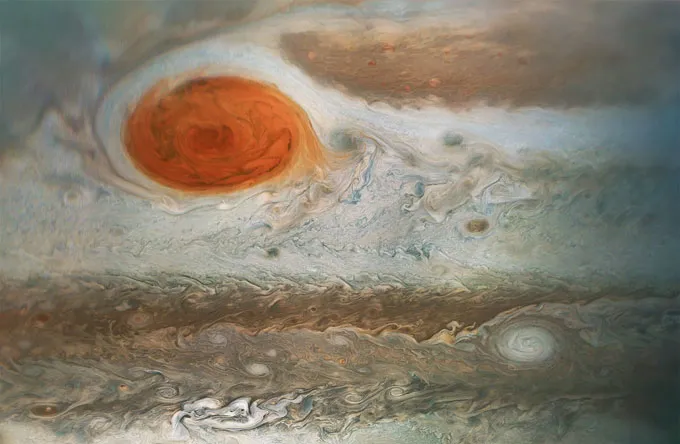
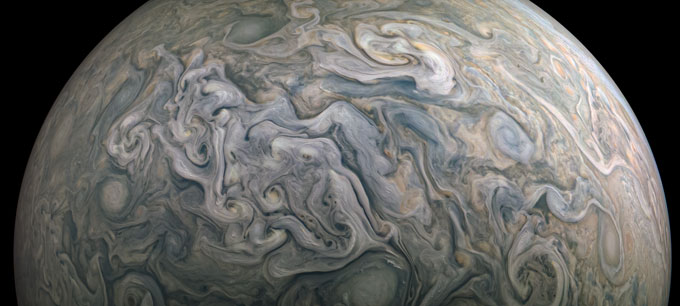
Hansen-Koharcheck always brought nonscientists along. The HiRISE team solicited public suggestions for spots to photograph on Mars; so did her group on JunoCam, the Juno mission’s camera that upended the historical view of Jupiter after reaching the giant planet in 2016. The raw data went online right away, letting space enthusiasts process the images to reveal Jupiter’s stormy atmosphere in exquisite, painterly detail. The clouds, rendered in soft beiges and blues, made me think of cold cream swirling in coffee; they reminded Hansen-Koharcheck of her grandmother’s crochet patterns.
The best space pictures make the unfathomable feel familiar like this, turning the local universe from abstraction into home.
In recent years, Hansen-Koharcheck was excited about two spacecraft now bound for Jupiter’s icy moons — NASA’s Europa Clipper and the European Space Agency’s Juice mission — and still dreamed of a dedicated mission to Uranus, says Fran Bagenal, a planetary scientist at the University of Colorado Boulder, who worked with her on Voyager and Juno. She was particularly eager for a spacecraft to return to Neptune’s largest moon, Triton, where Voyager 2 spotted geyserlike activity in 1989; scientists suspect a liquid ocean lies beneath its frigid surface, which would make Triton one of the most distant ocean worlds in the solar system.
For Hansen-Koharcheck, there was always more to learn, more to see — and she loved the anticipation. In 2017, as the Juno mission revealed the fiery eddies within Jupiter’s Great Red Spot, coming within just 9,000 kilometers of the atmosphere, I asked what it felt like to come so close to the colossal storm. She pointed me to an artist’s illustration on JunoCam’s website of a brown-haired child standing on a colorful precipice, angelic feathers draped across her back, gazing up at a massive, glowing planet. “I would say, emotionally, this captures it for me,” she said. “Just moving in closer and closer and seeing this world. And as you get closer, you don’t know what you’re gonna see. But you know it’s gonna be fantastic.”