
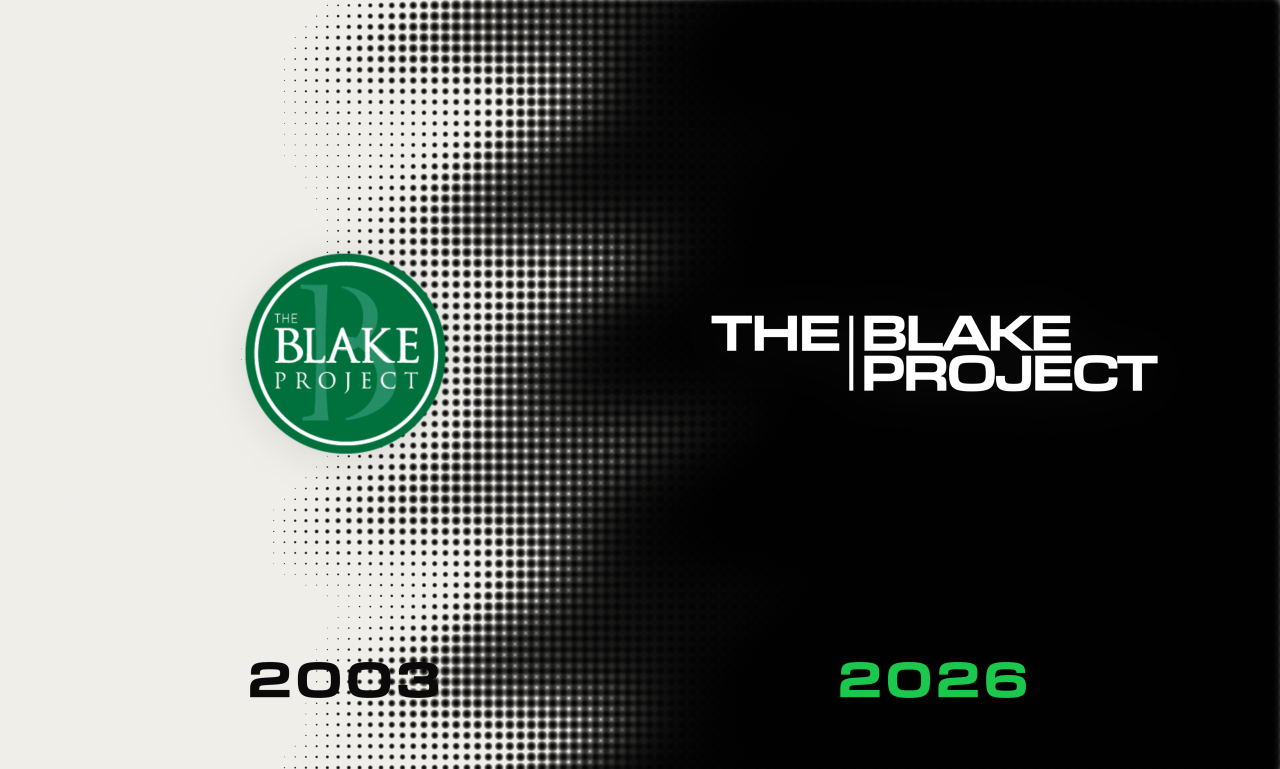
For more than twenty years, The Blake Project carried the same identity into the world.
It was there when we opened our doors in 2003. It appeared on our first proposals, our first client deliverables, and our earliest expressions of a point of view that has never changed: brand is not decoration. Brand is a source of meaning, preference, trust, differentiation, and economic value.
Over time, that identity became familiar. To our clients, it signaled a certain kind of strategic seriousness. To us, it carried memory, the weight of more than 250 client engagements built one relationship, one hard-won insight at a time.
So changing it was not easy.
Anyone who has managed brand change knows the reaction is rarely only rational.
That is the part of brand management that never makes it into case studies. The decision to reposition may be strategic, but the act of letting go is personal. A mark becomes more than a mark when you have built a business under it. It becomes a record of effort. It holds client trust, sacrifice, professional pride, and the quiet confidence that comes from staying in the work long enough to know what really matters.
There comes a point when honoring the past means refusing to let it limit the future.
That is where we found ourselves.
The Strategic Case For Repositioning
The Blake Project has repositioned around the mid-market, not as a retreat from ambition, but as a concentration of it. Over two decades, we served global category leaders, national icons, and enterprise-scale organizations. That work showed us how brand decisions touch leadership alignment, pricing power, customer preference, portfolio clarity, culture, and enterprise value.
Today, we are bringing that pattern recognition to mid-market companies, private equity-backed businesses, growth-stage firms, and leadership teams at pivotal moments, where brand performance is not a marketing question. It is a boardroom question.
The repositioning is simple in principle and significant in practice: trusted by global brands, built for mid-market value creation.
That is why the identity had to change.
This article is part of Branding Strategy Insider’s FREE newsletter. Join the world’s smartest marketers and subscribe here for actionable insights delivered directly to your inbox.
Repositioning Is Not A Cosmetic Exercise
Think about what Deloitte did when it reorganized its global brand architecture in the early 2000s. Each member firm had operated with its own personality and its own way of going to market. The move toward a unified global identity was not driven by a desire for visual consistency. It was driven by a business reality: clients operating across borders needed to know that the Deloitte teams in Frankfurt and Singapore were drawing from the same methodology and standards of accountability. The identity change was the strategy made visible.
Or look at what PwC did when it simplified PricewaterhouseCoopers down to a two-letter mark and a new visual system in 2010. The firm had been operating under a name that accurately reflected a 1998 merger — but one that had stopped being useful for market positioning. The simplified identity was not a cosmetic decision. It was an acknowledgment that the brand had to work harder in a market where clients had more choices and less patience for institutional complexity.
A serious identity change starts not with a design brief, but with a harder question.
What must this brand now help the business become?
For The Blake Project, the answer became increasingly clear. We were no longer describing brand as a source of emotional and distinctive advantage. We were helping leaders understand brand as a financial asset; connecting brand decisions to EBITDA, enterprise value, pricing power, demand quality, and customer retention. The work had become more pointed. The stakes had become more commercial. The audience had become more specific.
Our old identity carried trust and heritage. It did that well. But it no longer carried enough of the urgency, discipline, and financial consequence of the work we are now doing.
That is the distinction every leadership team eventually has to make. Not whether the current identity still has value — it often does. But whether it still creates the right value for the next stage of the business.
The Hardest Part: Separating Equity From Attachment
I have advised clients for years to protect what matters and let go of what no longer serves the strategy. That counsel is easier to give than to follow when it is your own brand on the table.
The original identity of The Blake Project had equity. It had recognition, history, and emotional weight. It represented a firm that had earned its place through substance, not show.
But attachment can impersonate equity when you are too close to the work. That is the risk no one openly talks about.
Equity lives in the client’s mind. It helps people recognize, trust, choose, and return. Attachment lives inside the organization. It is real and meaningful, but it does not always serve the client.
McKinsey faced a version of this tension when internal debates about brand expression — whether to publish more, to become more visible, to let its consultants carry a more recognizable public identity — ran headlong into decades of institutional preference for discretion. The attachment to anonymity had once served the brand well. It signaled exclusivity and client focus. But as the market for strategic advice became more transparent and more competitive, that same discretion began working against the firm’s ability to demonstrate relevance and attract the next generation of clients and talent. The equity was real. So was the need to evolve.
We asked ourselves the same unsentimental question: were we holding on to the old identity because it still helped future clients understand the value we create? Or because it reminded us of what it took to get here?
The answer was uncomfortable. The old identity told the story of where we had been. It did not do enough to tell the story of where we are going.
That is when the decision became clear.
What The New Identity Needed To Signal
The new identity had to do more than look contemporary. It had to express a sharpened business strategy in the language of the people we are now built to serve.
Mid-market CEOs, CMOs, CFOs, and private equity operating partners are not looking for branding theater. They are not looking for a new language system that makes the organization sound more interesting while the business stays the same. They are looking for clarity, leverage, alignment, and advantage that shows up in the numbers.
When IBM Global Services rebranded as IBM Consulting in 2021, the name change was not about modernization. It was about telling a specific buying audience, C-suite leaders evaluating transformation partners, that this was no longer primarily a technology services operation. It was a strategic advisory business. The identity had to signal that shift before the first conversation, because in professional services, the brand does half the selling.
That logic guided our thinking.
The new identity needed to feel credible to a CEO, grounding to a CFO, and practical to a leadership team that needs brand to move the business. It needed to signal that we have worked at global and national scale, while making clear that we are built to work differently than the large consultancies: faster, closer to the business, and without the overhead structures that make enterprise firms expensive and slow for mid-market clients.
The new identity is more assertive. More exacting. More performance-oriented. It signals strategic force rather than strategic heritage. That is intentional. We are not trying to look different for its own sake. We are making our firm easier to understand for the leaders we are focused on serving.
What We Preserved
A repositioning should not erase the soul of the brand. That is one of the real dangers in identity change. In the pursuit of relevance, organizations can abandon the meaning that made them worth choosing in the first place.
When Andersen Consulting separated from Arthur Andersen and became Accenture in 2001, the firm faced a genuine question: what, beyond the name, had actually transferred to clients and what needed to be rebuilt? The answer shaped everything. The institutional credibility, methodologies, partner relationships, and delivery culture were worth protecting. The name was, by that point, a liability. The firm distinguished carefully between the two, and it showed in how the transition landed with clients. Accenture did not try to pretend the change was incremental. It was complete. But the underlying promise — transformation capability at scale — never moved.
We held the same line.
The Blake Project is still built on the belief that brands create value by shaping meaning in how people think, what they prefer, and why they choose. Emotional connection matters. Differentiation matters. Culture matters. Brand is one of the most powerful assets a business can build when it is managed with discipline and real strategic courage.
What changed is how we express those beliefs. We now speak more directly to the financial pressures mid-market leaders face; connecting brand to the board conversation, the balance sheet, the sales pipeline, and the enterprise value discussion.
The heart of the firm remains. The expression has become sharper.
What Others Can Learn
For any leadership team weighing a rebrand, refresh, or repositioning, I offer this from inside the decision.
Do not change your identity until you know what business truth is making the change necessary. Identity follows strategy. When that order gets reversed, the result is expensive decoration. When Booz & Company became Strategy& under PwC in 2014, the identity change was not a marketing exercise. It was a strategic acknowledgment that the firm’s positioning as an independent strategy shop had become untenable after the merger, and that its value to clients would now flow through the PwC relationship, not despite it. The brand had a job to do, and it was built around that job, not around aesthetics.
Respect the emotional reaction inside the firm. People build a sense of belonging around the symbols of the institutions they helped create. Dismissing that is a mistake. But letting it make the strategic decision is also a mistake. Both errors cost firms real time and money, and both are more common than anyone admits publicly.
Define what must be preserved before deciding what should change. When we began this process, the first question was not what the new identity should look like. It was what the old one had actually earned. Twenty-plus years of client relationships, a point of view on brand that had been tested across more than 250 engagements, and a reputation for strategic substance over creative show — those were worth protecting. The visual language and heritage signals of the original mark belonged to a version of the firm we were moving beyond. The name, and everything it had come to mean, was staying. That distinction — between what the identity had earned and what it was no longer able to carry forward — has to be made before a single design brief is written.
Ask whether your current identity helps the next client understand your value faster. If it requires a paragraph of context before the value proposition can land, if it creates confusion about what you do or who you serve, it is working against you. In professional services, where relationships begin with perception, a brand that creates friction in the first impression is a competitive liability that compounds over time.
And make the change real inside the organization before asking the market to believe it outside. A new identity that is not backed by changed language, behavior, or measures of success is wallpaper. The firms that executed brand transitions well — Deloitte, Accenture, IBM Consulting — treated the internal launch as seriously as the external one. The people delivering the work are the brand. They have to understand and believe what it means before anyone else will.
Brand should strengthen competitive position, pricing power, and enterprise value. The Blake Project helps make that happen.
The Larger Lesson
The Blake Project’s new identity is not a design story. It is a strategy story.
It reflects a choice about where we can create the most value, who we are best equipped to serve, and how the breadth and depth of our brand experience can matter more in the next chapter of the firm.
We are proud of the original identity. We are grateful for what it carried. We are not running from it.
We are building from it.
The past should not be discarded casually. It should be understood, honored, and then translated into a future the client can see.
For The Blake Project, that future is clear. We are bringing the strategic discipline of global and national brand work to mid-market leaders who need brand to perform with greater consequence — in the boardroom, on the balance sheet, and in the market.
Because brand should not sit outside the economics of the business.
It should help change them.
Derrick Daye is the Managing Partner of The Blake Project and Publisher of Branding Strategy Insider.
At The Blake Project, we help leaders turn brand into a disciplined driver of financial performance — strengthening pricing power, competitive position, and enterprise value. Email us to start a conversation about enduring profitable growth. For The EBITDA.
Branding Strategy Insider is a service of The Blake Project, a strategic brand consultancy focused on turning brand into pricing power, growth, and enterprise value.