Artificial intelligence (AI) – and in particular agentic AI – can bring considerable increases in productivity to any organisation that uses it, with potential gains of £10 for every £1 spent. But achieving those rewards will require great effort to ensure AI becomes part of organisational culture.
That’s the view shared by executives at a Node4 user day event in Nottingham this week, where the mid-market enterprise application, software-as-a-service (SaaS) provider and Microsoft partner showcased a range of AI-based solutions.
According to Derby-based Node4, we are set to move past the era of “clunky” AI experiments and into a period where the technology is being industrialised at a rate that outpaces most corporate governance structures. Also showcased was agentic AI, but here, Node4 thinks it will be a year or so before customers trust it.
Meanwhile, data sovereignty is an everyday conversation for the company (see box).
The three rings of AI: From assistance to orchestration
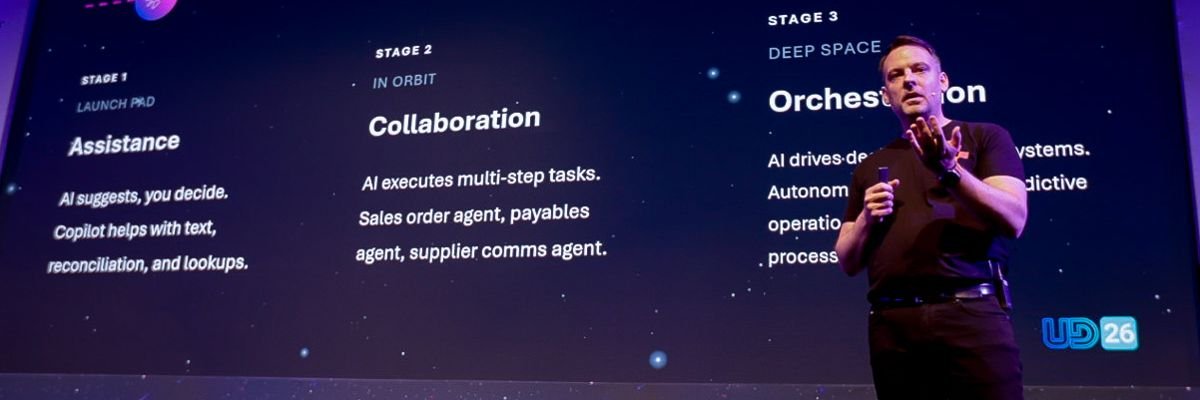
Core to the thinking on AI are three stages of AI adoption: First, simple assistance, where users ask questions of a large language model (LLM) where once they would have used a web search tool. Second is co-work, where co-pilot-type tools in an environment help more directly, such as Claude Code. And third, there is orchestration via agentic AI, where agents that are built to carry out specific tasks can be invoked in a variety of settings, often autonomously by preset triggers.
But while such capabilities already exist in almost all enterprise application environments, including, for example, in the Microsoft Dynamics 365 Business Central for which Node4 is a specialist, most customers have yet to make use of them.
Mark Skelton, chief technology officer (CTO) at Node4 (pictured, above), said: “It’s something we’re struggling with. The challenge with AI at the moment is the consumerisation effect.
“We did two roundtables last night, and we had probably 30 customers in those sessions. We asked them, where are you on your AI journey? Almost everyone in the room said, ‘Well, we’re nowhere’.
“But when we asked the question, ‘Are you using OpenAI or ChatGPT or cloud?’ Most hands went up. So, what’s happening is business users are using this stuff on their personal accounts.”
The concern here, said Skelton, is that if personal accounts are being used, business data is at risk of leaking out.
Skelton said the Node4 solution is to help train customers and to showcase what’s possible with simple AI assistance, co-work and agentic AI by means of free-of-charge consulting sessions, “innovation factories” and showing customers how AI can help with real-world workloads.
“One thing we do is automate board reports, for example,” said Skelton. “We have to do it every month. And there’s no reason why AI can’t do it. Every organisation will have to do a similar process.
“You start with something like that. The customer goes, ‘OK, right, you’re solving a big problem. That’s a bunch of work and five days’ worth of someone’s time that I can now automate and free up their time’.”
Agentic the future, but trust will take time
Despite recognising the challenges of how to get there, Node4 executives envisage a future of agentic AI. At the event, it showcased pre-built agents and custom agent-building capabilities in Business Central, as well as a set of agents it develops, named “enhanced”, that tackle functions not covered by Microsoft.
Currently, Node4 is keen to emphasise that there will be a human-in-the-loop for some time and that AI agents will not be off the leash and able to change or move corporate data.
We’re probably [six months to a year] away from having [AI agents] committing stuff without human checking. I think that’s sensible because we are still in a phase where this stuff can hallucinate Mark Shelton, Node4
So, when will Node4 customers be able to trust an AI agent to make changes in a finance ledger or an enterprise resource planning database?
“The technology is definitely capable,” said Skelton. “But I think we’re probably in a six-month-to-year window away from actually having these things committing stuff without human checking. I think that’s sensible because we are still in a phase where this stuff can hallucinate.
“If it’s not designed right, it can be dangerous. So, I reckon about a year away, but whenever a CTO predicts these days, you can probably halve it because of the rate of innovation.
“The human and the guardrails are still very important at this stage,” added Skelton. “Once you’ve built your model and built all the intelligence into the agent, it’s repeatable, and that’s where you get your value. But that starting point – understanding the process you’re trying to automate and execute – is critical, because if you get the input wrong, the output could be catastrophic.”
Node4 has around 1,800 customers, of which 800 are users of the Microsoft Dynamics platform. Of those, 63% are on the fully SaaS Business Central, with the remainder on various legacy iterations of Navision.
The company also runs its own cloud and datacentres, which can be used for sovereign capability should a customer require it.
Customer base: Different sectors, different speeds
About 1,200 customers are private sector, and 600 public sector. Node4 made north of £33m from the UK public sector for 2024-2025, according to Tussell figures, with its biggest UK government customer being the Department for the Environment, Food and Rural Affairs (£23m).
Node4 customers that are not yet SaaS users comprise a fair chunk of the customer base. According to Skelton, it’s not that they don’t want to move. Many simply lack the time and resources to do so.
He said: “Traditionally, it’s been very costly to move because the move from Navision to Business Central is not like a Windows upgrade where you click a button and it does it for you.
“There are complexities around code conversion and workflow. These are traditionally big projects. They could be 200-day, 300-day projects – so very costly for businesses to do. Where you see this long Navision tail, it tends to be in the smaller organisations that don’t have the big IT departments.
“Now, we’re using AI to automate a lot of this process. We’re using AI to do all the code conversion, the workflow remappings, all that kind of stuff. And then we’re going to look at future pipelines about how we automate all the testing.”