
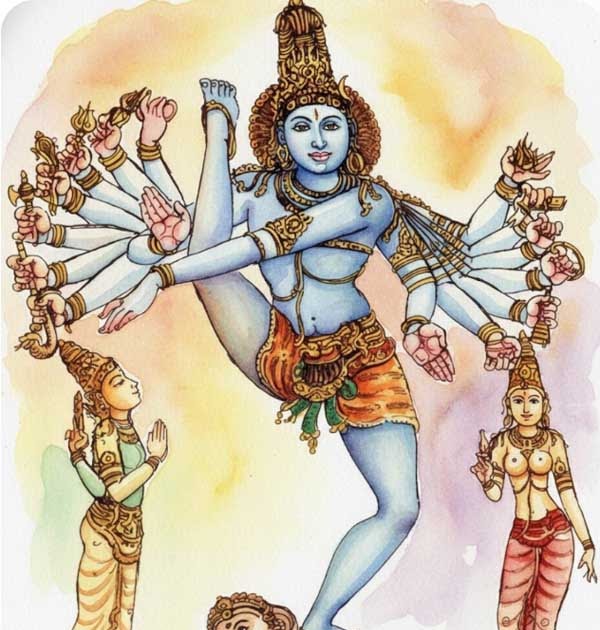
Shiva’s Tripura Tandava – The Divine Form of Cosmic Absorption
Understanding the Divine Form
The Tripura Tandava represents one of the most powerful manifestations of Lord Shiva, embodying the cosmic principle of dissolution and absorption known as Tirobhava or Tirodhana. This sixteen-armed form stands distinct from Shiva’s other dance manifestations, symbolizing the supreme moment when the universe returns to its primordial state. Unlike the popular Nataraja form associated with creation and destruction, Tripura Tandava specifically signifies the withdrawal of cosmic existence into the divine consciousness.
This magnificent form depicts Shiva with only two eyes, in contrast to his more commonly known three-eyed representation. The significance of this dual-eyed manifestation lies in the complete absorption of the universe, where even the third eye of transcendental vision merges into the absolute reality. The absence of the third eye indicates that at this cosmic moment, there is no need for the fire of destruction, as everything willingly dissolves into the supreme consciousness.

The Sacred Attributes and Their Symbolism
The sixteen arms of Tripura Tandava carry profound symbolic meaning, each representing different aspects of cosmic control and divine grace. In his right hands, Shiva displays the Abhaya mudra (gesture of fearlessness), assuring devotees that even in dissolution there is no cause for fear. The damaru (small drum) represents the primordial sound from which creation emerged and into which it returns. The vajra symbolizes indestructible reality, while the trishula (trident) represents the three fundamental qualities of nature – sattva, rajas, and tamas.
The noose signifies the binding power of maya and karma from which Shiva liberates souls. The chisel represents the cutting away of ignorance, while the staff denotes authority over the cosmic order. The serpent held in his hand symbolizes kundalini energy and the cycle of time itself, which ultimately rests in Shiva’s control.
In his left hands, the Varada mudra (boon-bestowing gesture) demonstrates that even in dissolution, divine grace flows ceaselessly. The bell produces the sound that dispels evil and announces divine presence. The skull cup (kapala) represents detachment from worldly existence and the transcendence of death. The shield offers protection to devotees, while the book signifies supreme knowledge. The fire represents the transformative power of consciousness, and the flag symbolizes victory over ignorance. The arm flung across in gajahasta posture mimics an elephant’s trunk, representing the removal of obstacles and the strength to overcome all challenges.
The Divine Family in Sacred Unity
The presence of Goddess Parvati to Shiva’s left, depicted with two arms, represents Shakti – the dynamic energy without which even Shiva remains inert. Her position signifies that consciousness (Shiva) and energy (Shakti) are inseparable even during cosmic dissolution. She embodies the compassionate aspect of the divine, ensuring that absorption into the supreme is not annihilation but a return to the source.
Lord Skanda (Kartikeya), shown with four arms in Anjali mudra to Shiva’s right, represents devotion, discipline, and the warrior spirit. His presence in this cosmic scene indicates that true spiritual warriors understand and accept the cyclical nature of existence. The Anjali mudra demonstrates complete surrender and reverence before the cosmic reality that Shiva embodies.
Philosophical Significance
The Tripura Tandava form illustrates the Hindu understanding of time as cyclical rather than linear. The universe undergoes perpetual cycles of creation, preservation, and dissolution. The Shiva Purana elaborates on these cosmic cycles, stating that Shiva’s dance encompasses all phases of existence. This form specifically addresses Tirodhana, the fifth and final cosmic function attributed to Shiva, which completes the cycle before renewal begins again.
The concept of Tripura itself carries deep meaning – it represents the three cities or realms of existence: physical, subtle, and causal. Shiva’s destruction of the three cities, as narrated in various Puranas, symbolizes the transcendence of all limited existence. When these three levels of reality dissolve in the supreme consciousness during Tripura Tandava, what remains is pure, undifferentiated awareness.
The Path of Spiritual Liberation
For spiritual seekers, the Tripura Tandava form offers profound teachings. It reminds us that all manifestation is temporary and that true peace comes from recognizing the eternal reality beyond changing forms. The multiple arms suggest the omnipotent nature of the divine, capable of managing infinite cosmic functions simultaneously while remaining serene and balanced.
The two-eyed representation teaches that when the dualities of existence merge into unity, even the transcendental third eye becomes unnecessary. This signifies the ultimate non-dual state where observer, observed, and observation become one.
Understanding this form helps devotees develop vairagya (detachment) not through rejection of life but through recognition of its transient nature. It encourages embracing each phase of existence – growth and decline, union and separation – as natural expressions of divine will. The protective and benevolent gestures assure that this cosmic absorption is not to be feared but welcomed as the soul’s return to its eternal home in divine consciousness.