
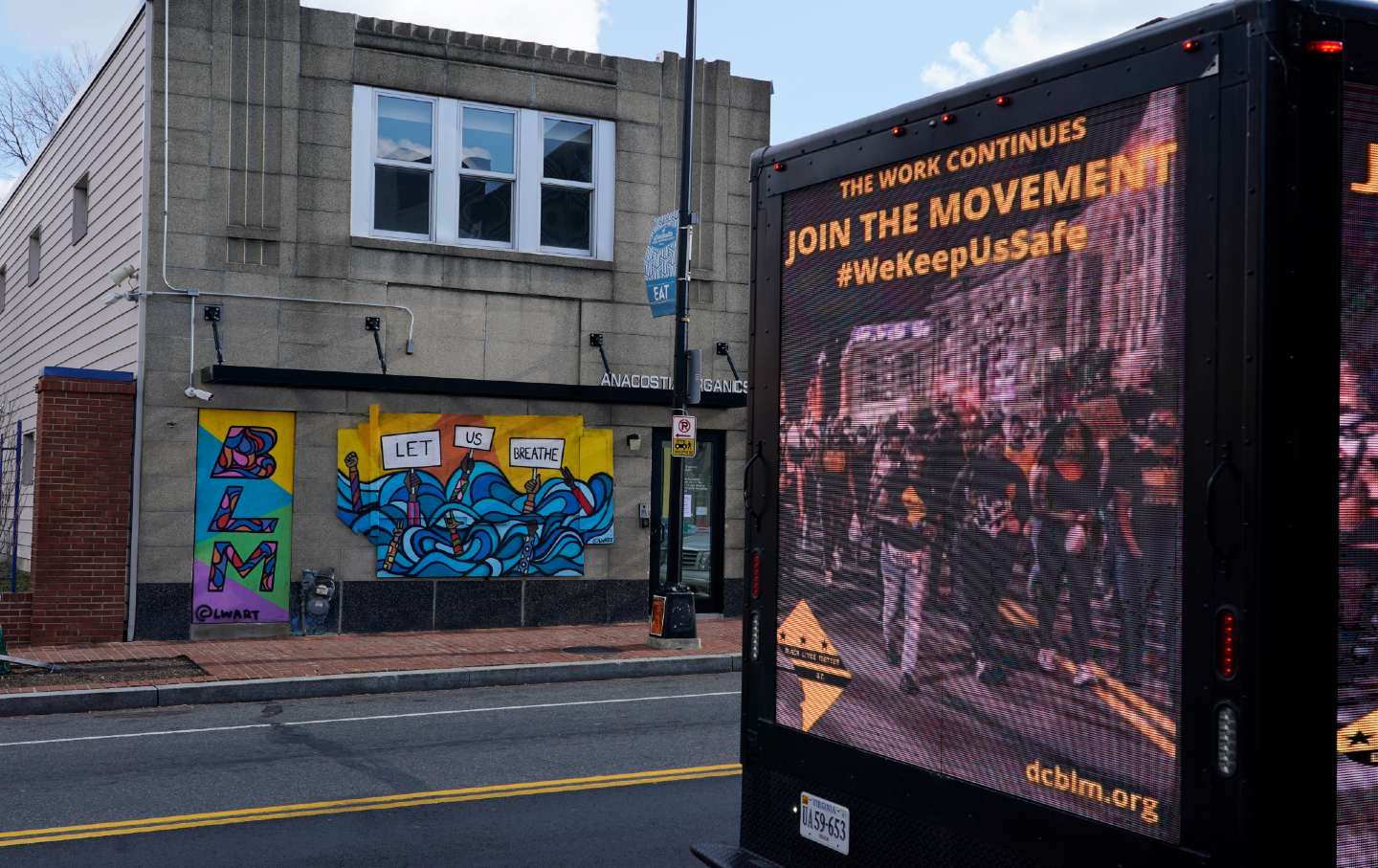
Since its founding in New York in 1998, the Working Families Party has tested a proposition that many Black voters are led to dismiss outright: Political power does not need to be tethered to permanent loyalty to the Democratic Party. Founded in New York in 1998, the WFP has pursued a strategy rooted in labor organizing, fusion voting, and independent ballot lines—methods designed not to replace the two-party system overnight but to exploit its vulnerabilities. Its aim was to elect more union-backed progressives—and thereby shift the Democratic coalition back in line with the interests of working people.
As voters across all demographics become increasingly disillusioned with the Democratic Party’s failure to function as an effective opposition party during Donald Trump’s extremist second term in office, the WFP’s model raises an urgent question for Black Americans in particular: Does the traditional logic of political pragmatism—holding forth the promise of incremental change in exchange for unwavering group loyalty—still make sense when the Democratic Party stops delivering change?
“What I get frustrated with,” says Colin Radix-Carter of the Independent News Network, “is mainstream commentators will say, ‘The GOP sucks. Democratic leadership sucks, but we need to vote for them.’ You can admit that the Democrats are shit, but you’re not talking about thinking of an alternative, so that we’re not relying on Democrats for things that we need. The [Congressional] Black Caucus is not going to do it for us. The politicians on both sides are not going to do it for us. We need to start talking about alternative means that will enable us to fend for ourselves. We don’t do that enough. And we aren’t having those conversations.”
Radix-Carter is right, and his comments highlight a broader pathology in contemporary Black political discourse: Critique is permitted; independence is not. As Radix-Carter noted, “We call out the problem, we recognize the problem, but the solution we say is that ‘we need to vote for the same people and party.’ And no we don’t.”
Indeed, we do not.
Black Americans have moved in near lockstep with the Democratic Party since the middle of the 20th century—a migration that began with the partial realignment of the New Deal and crystallized after the civil rights era. Black voters’ prior status as party-line voters for Republican candidates in the wake of the Civil War underlines that they, perhaps more than any other segment of the electorate, have seen their political aspirations confined within the two-party system. That’s been an abiding source of tension for Black Americans who also have long honored the legacy of community resistance harking back to the slave diaspora: to make a way out of no way.
In this broader historical context, the question facing many Black progressives isn’t whether to keep faith with the Democratic Party, but rather how we can start imagining a political future beyond it. With a reactionary Republican regime taking up the rhetoric and program of white nationalism, and unleashing death squad assaults on opponents that extend the legacy of police killings of Black citizens, this is less a theoretical quandary than an existential challenge—for both Black Americans and the fate of whatever remains of our multiracial democracy.
The Working Families Party offers one tentative answer—not by rejecting the two-party system outright but by navigating it strategically. The WFP seeks to transform movement-based reform into electoral success through the mechanism of fusion voting, which allows multiple political parties to nominate the same candidate on separate ballot lines. Fusion voting allows voters to support a candidate without having to endorse the major party that typically claims ownership of them. It is a way of registering dissent without disengagement—of signaling political independence while still influencing an election’s outcome. And by adopting provisional alliances with a major party, fusion tickets avoid the major charge levied against third-party candidacies—that they lapse into spoiler efforts that siphon votes away from Democrats, and lend support to the GOP.
“Sometimes we endorse normies [non-WFP-aligned Democratic candidates] to block a Republican,” Maurice Mitchell, the national director of the Working Families Party, said in an interview with The Nation. “We don’t vote for the Democrats because we love the Democrats. It’s because we’re in a rigid two-party system, and the Republican Party wants to kill us.”
“We deprive Republicans of governing power everywhere that they’re trying to gain governing power because they are a threat to the human rights of everybody on this planet,” Mitchell continued, “And we advantage union-backed progressives in the Democratic Party coalition. The work we do aims to accomplish both. It’s part of our strategy.”
In many settings, the strategy has worked. In New York, it has already reshaped electoral outcomes in ways that would not have been possible through Democratic Party channels alone. The standing of the WFP has also benefited from New York’s adoption of ranked-choice voting, which has freed the state’s electorate from the zero-sum logic of first-past-the-post balloting between two major-party candidates. In 2025, WFP-endorsed State Senator Sean Ryan defeated acting Democratic Mayor Chris Scanlon in Buffalo’s Democratic primary for mayor. In 2024, votes cast on the Working Families Party ballot line proved decisive in Democratic nominee Josh Riley’s victory over Republican Marc Molinaro in New York’s 19th Congressional District. Riley won by 7,997 votes, and clocked 21,948 on the WFP’s ballot line. Riley’s narrow victory drove home a basic truth that often goes unacknowledged in discussions about third parties: Independence does not dilute power; when it is authentic and organized, it concentrates it.
The same dynamic played out more dramatically in New York City’s 2025 mayoral race. Zohran Mamdani, a democratic socialist state assemblyman anchored by the Democratic Socialists of America and endorsed by the Working Families Party, entered the Democratic primary as an outsider facing a deeply entrenched political machine. Former governor Andrew Cuomo’s decades-long presence in New York politics—reinforced by institutional endorsements, donor networks, and close institutional ties with the Black community—gave him an early advantage. Although Mamdani won the Democratic primary, Cuomo defeated Mamdani in precincts where at least 60 percent of residents were Black, a result that was quickly misread as ideological resistance to left politics in Black communities.
In reality, Cuomo’s initial strong showing with Black voters showed the disparate ways that primary candidates conducted outreach to prospective Black supporters. Mamdani’s campaign had not yet built a sufficient political base in Black neighborhoods, and the corresponding signals from prominent Black figures in the Democratic establishment—ranging from silence and neutrality to outright hostility—worked against him.
That dynamic shifted dramatically after the primary. In concert with the WFP and DSA, Mamdani broke out of the traditional parochial mode of courting Black support in New York, and focused intently on issues like broader access to public goods, housing, and affordability. His general election campaign, in broad outline, reflected the same program that won Black voters over to the Democrats during the New Deal, even as FDR continued to court the support of Democrats in the segregationist South.
By the general election, New York’s electoral map looked different. Mamdani again defeated Cuomo—who was now running as a third-party candidate—and all but reversed the advantage among the city’s Black electorate that the former governor amassed in the primary. Mamdani received 61 percent of the vote in precincts where more than 60 percent of residents are Black. Indeed, among all the city’s racial and ethnic groups, Black voters emerged as Mamdani’s strongest base of support. While Mamdani obviously benefited greatly from running this time as the Democrats’ nominee, that doesn’t explain the complete turnaround in Black support.
That reversal is rooted in a deeper truth that’s again overlooked in the traditional narratives of two-party dominance: An outsiders’ movement of reform can gain real traction if it gains a serious hearing. Mechanisms such as the fusion strategy of the WFP—as well as the crucial on-the-ground organizational prowess of DSA—helped Mamdani secure that hearing. As WFP leader Mitchell puts it, “If Black people were offered a viable option, we would take it.”
The Working Families Party’s recent adoption of a national platform, the Working Families Guarantee, outlines what a viable option can mean for Black Americans beyond any one candidate. Endorsed by 18 members of Congress, the agenda calls for a national jobs program to place workers in union jobs, universal health care, and 12 weeks of paid family and medical leave. These policies are not usually the centerpiece of appeals to Black voters, even though Black Americans suffer the consequences of a political economy that has constrained Black wealth for generations. “Black people are not unlike everybody else,” Mitchell said. “We care about how these policies will make our lives better, and the material benefit to us, our families, and our communities.”
As with any left-oriented movement or political party, navigating the contours of what is acceptable progressive policy can be difficult. “We’ll have our factional disagreements,” Mitchell said. “We get beef from people who think they’re left of us. Maybe they are. Maybe they’re not. We don’t want to fight a multisided war.”
That emphasis matters because outreach to Black voters is too often reduced to symbolic recognition or narrow, clichéd appeals against anti-Black racism. To be clear, dismantling the legal, economic, and social structure that relegates Black Americans to a subordinate economic status remains a vital political concern. And Black voters are also workers without job security, tenants, parents, caregivers, and taxpayers. The Working Families Guarantee does not confine Black political concerns to diversity or representation, or offer a single candidate as the savior for Black Americans’ plight. The guarantee instead offers commitment to working-class policy demands that can resonate across identity demographics without pretending that racial oppression is incidental—the political thesis that led to Mamdani’s success with Black voters.
Mamdani’s experience is by no means an outlier. Another prominent New York political leader, Attorney General Letitia James, was elected initially on a WFP line, and has offered a clear model for working closely alongside, but not always within, the state’s Democratic establishment that Mamdani is already heeding in his mayoralty.
Meanwhile, across the country, Black Working Families Party candidates have demonstrated that a viable independent political infrastructure can win—even in direct opposition to Democratic incumbents. And these victories have mostly taken place in locales like New York that have adopted basic electoral reforms such as fusion and ranked-choice balloting to broaden the choices before voters so that their electoral voices aren’t diluted by the major party duopoly.
In Seattle, Dionne Foster defeated Democratic incumbent Sara Nelson for a seat on the City Council, again campaigning on universalist and egalitarian issues like labor rights, access to affordable housing, and greater public accountability for city officials. In Dayton, Ohio, WFP member Shenise Turner-Sloss unseated Democratic incumbent Jeffrey Mims Jr. to become the city’s third Black woman mayor. And in Detroit, 33-year-old Democratic Socialist Denzel McCampbell defeated Democratic State Representative Karen Whitsett in another city council race, running on a platform stressing housing justice and working-class governance.
These victories vary in scale and geography, but they share a common structure. In each case, independent organization preceded electoral success; winning candidates first secured the trust of their communities before navigating electoral politics. In this context, the independence of the WFP serves as a fulcrum—permitting reformist candidates to leverage their community support at the ballot box without sacrificing the basis of that appeal to local party leaders. The ballot lines afforded by fusion voting work as a sort of halfway house for such candidates—and they are now demonstrating that the WFP model can work with any voting constituency, not simply the New York electorate it was originally devised to serve.
Popular
“swipe left below to view more authors”Swipe →
“Because I am a Working Families Party member, I have my own political affiliation, my own monetary apparatus to change things, and my own people to move things,” Kendra Brooks, minority leader of Philadelphia’s City Council, said. In 2019, Brooks became the first third-party candidate in modern history to win a seat on the council, breaking a 70-year hold Republicans had maintained on the city’s minority-party seats. Like other fusion candidates, Brooks owes her victoryand subsequent reelection—to sustained community organizing translated into independent electoral power. “I understand the strength and power in that,” Brooks said. “Because of the WFP here in Pennsylvania, and, in general, my power comes directly from the people.”
In April, Brooks introduced legislation that prohibits ICE agents from wearing masks or using unmarked vehicles and requires all law enforcement officers to display badges. Her measure also prohibits city agencies, including police, from collaborating with ICE and other federal immigration enforcement agents without a judicial warrant.
Brooks launched her political career via community organizing and activism. She helped organize the dismantling of Philadelphia’s School Reform Commission (SRC), a five-member body of state-appointed officials established in 2001 who governed schools in place of a school board—and typically substituted the interests of their donors above the needs of the city’s families and schoolchildren. The SRC oversaw the closure of several Philadelphia public schools, and in 2004 voted to remove health benefits from teachers’ contracts. After Brooks helped to abolish the SRC in 2017, Mayor Jim Kenney chose her to serve on a panel nominating members to the city’s new school board. “That’s the work of me, a Black democratic socialist, Working Families Party, elected black woman from North Philly,” she recounts.
Brooks’s success, like Mamdani’s, depended on support from outside the Democratic Party’s traditional political model—-and produced striking changes in Black political behavior. When alternatives are stale, vague, symbolic, or disconnected from material life, skepticism among Black Americans is rational—and necessary. When alternatives are concrete, organized, and capable of winning, Black voters respond—not as a bloc bound by an amorphous sense of racial duty but as strategic actors assessing power. “The work we have to do as progressive or Working Families Party or DSA electees is changing the narrative for Black folks,” Brooks said.
It is difficult to dislodge the narrative that Black Americans who explore political options outside the Democratic Party establishment are guilty of political defection, or worse, racial betrayal. In this account, Black political agency is reduced to racial duty, and Black political ideology is stripped of the full range of radical or progressive possibilities. Among other things, this social myth flattens out the story of Black Americans’ participation in American politics into a state of complacency and loyalty, rather than one of subversion, critique, and progressive leadership. Not only does this narrative stifle dissent among Black Americans—it also negates history, turning Black Americans’ record of insurgent political creativity into a tale of unqualified permanent allegiance to the Democratic Party.
This narrowing of Black political possibility is not historically grounded. As Omar H. Ali, professor of comparative African diaspora history at the University of North Carolina at Greensboro, argues in his book In the Balance of Power, Black political independence has long been a strategic resource. “When Malcolm X says ‘By any means necessary,’ that’s a sort of refrain that goes back to Black political leadership,” Ali told me. “At least back to Frederick Douglass, who was basically looking at any means necessary. And one of those means he joined was the effort to establish the Liberty Party, which he wasn’t supportive of but saw as a valuable tool in the tool kit to dismantle the white supremacist structure that governs American politics.”
As Ali reminds us, Black political progress has rarely come from unconditional loyalty to any party. It has come from organized pressure—pressure that forced parties to compete for Black support. “African Americans have always, in some ways, been independent at various times,” he said. “As Du Bois and others have said, it’s helpful to maybe join the ranks of one party tactically as part of a larger strategy. But one cannot think that the interests of Black people solely lie in either of the two major parties, or quite frankly, any political party.” When independence is stigmatized, and alternatives are preemptively delegitimized, the result is not unity but stagnation: a politics that demands allegiance without offering leverage.
Indeed, the Democratic Party passed the 1964 Civil Rights Act and the 1965 Voting Rights Act. But those rights were not gifts or loans to be remitted through uncritical electoral support. We must ask how much loyalty a political party should receive from Black Americans because that party “gave” rights to Black Americans that belonged to us in the first place. It is also worth noting that the Democratic Party passed those bills under pressure from the civil rights movement—a nonpartisan social and political rebellion led by Black Americans.
Black voters must now decide whether this tradition of political independence can still work within a system designed to punish it. The Working Families Party represents a rare attempt to meet this challenge by building an independent organization capable of contesting power without surrendering it to permanent party loyalty.
Ultimately, then, the many cautions Democratic strategists raise against revived Black political independence go well beyond the well-worn debates over how this model of politics serves to “spoil” the party’s showing in this or that electoral cycle. Such laments are really about control—about who gets to define the boundaries of acceptable Black political action. The WFP’s insistence on maintaining an independent ballot line, its willingness to challenge Democratic incumbents, and its refusal to treat loyalty as an end in itself disrupts a system that depends on Black voters’ being loyal but politically constrained. As the country faces a brewing fascist and white nationalist seizure of power from on high, Black Americans are driving home the pivotal message that constraint is not enough.
From illegal war on Iran to an inhumane fuel blockade of Cuba, from AI weapons to crypto corruption, this is a time of staggering chaos, cruelty, and violence.
Unlike other publications that parrot the views of authoritarians, billionaires, and corporations, The Nation publishes stories that hold the powerful to account and center the communities too often denied a voice in the national media—stories like the one you’ve just read.
Each day, our journalism cuts through lies and distortions, contextualizes the developments reshaping politics around the globe, and advances progressive ideas that oxygenate our movements and instigate change in the halls of power.
This independent journalism is only possible with the support of our readers. If you want to see more urgent coverage like this, please donate to The Nation today.
More from The Nation
The lieutenant governor of the state is ramping up her Democratic Senate primary campaign as her state battles Trump’s brutal assault.
Feature
/
Joan Walsh

A flood of billionaire money is pouring into Maine’s Senate race to stop a populist challenger.
Donald Shaw

Trump promised voters revitalization and growth. But he doesn’t know the first thing about economics.
Column
/
Chris Lehmann
Democrats must stop conceding that the only answer for various racist voting laws is that Democrats just have to vote more and harder and better.
Joan Walsh