
For weeks, Gulf States had repeatedly urged de-escalation between Washington and Tehran. When a two-week ceasefire was announced on 8 April, brokered by Pakistan, it reflected both the influence of that pressure and its limits. The truce has since been extended, but remains fragile, with the Strait of Hormuz still effectively closed and U.S.-Iran talks yielding no agreement.
Qatar’s exposure has been immediate. Al Udeid, the largest U.S. airbase in the region, is located on its territory, placing the country directly within Iran’s retaliatory calculations.
On 18 March, Israel struck Iran’s largest gas-processing hub in Asaluyeh — an attack Israeli Prime Minister Benjamin Netanyahu later described as Israel acting independently — damaging four plants that process gas from the South Pars field shared with Qatar. Hours later, Iran launched what it described as a retaliatory strike on Qatar’s Ras Laffan industrial city, knocking out roughly 17% of the country’s liquefied natural gas (LNG) export capacity and inflicting an estimated $20 billion in annual losses. QatarEnergy has since declared force majeure on several long-term contracts, disrupting supplies to Europe and Asia.
This shift toward direct confrontation accelerated under Iran’s new leadership. For years, Tehran relied on the Axis of Resistance as a buffer to deter the U.S. and Israel without engaging them directly. But during the 12-Day War in June 2025, after Israel carried out airstrikes on Iranian military and nuclear facilities as well as residential neighbourhoods, Iran launched large-scale missile and drone strikes, including on the Al Udeid base in Qatar.
Iran’s efforts to restrict shipping through the Strait of Hormuz — a route for roughly 20% of the global oil and LNG — marked a significant escalation, weaponising a chokepoint on which its own economy also depends. In March, Iran continued exporting its own oil even as it paralysed traffic for others. Since U.S. President Donald Trump announced a naval blockade on Iran on 12 April, traffic through the Strait has largely halted, forcing Iran to absorb some economic impact as well.
Qatar’s Foreign Ministry stated on 18 March that “the Iranian side continues its escalatory policies that are pushing the region toward the brink and drawing countries not party to this crisis into the conflict zone.”
Concerns about wider escalation had already been growing in the Gulf. In early January, as protests intensified across Iran and Washington threatened to intervene over the crackdown, Saudi Arabia, Qatar, Oman and Turkey initiated a diplomatic effort aimed at both Washington and Tehran, warning that a U.S. strike on Iran could trigger a wider regional conflict. On 15 January, Trump ultimately stood down, citing a decline in violence inside Iran.
A month later, the war broke out regardless.
Although Qatar has reaffirmed its relationship with the U.S., its diplomatic posture has shifted. On 24 March, Qatar’s Foreign Ministry spokesperson Majed Al Ansari announced Qatar was not currently mediating between the parties — a role Qatar has often played — though it continued to support all “informal and formal” diplomatic channels.
On 19 March, Qatar expelled Iran’s military and security attachés from the Iranian embassy in Doha, its first concrete diplomatic response to the Iranian strike on Ras Laffan. Qatar also announced that diplomatic talks with Iran are only possible if Iran ceases its attacks.
“Qatar has not been part of the campaign targeting Iran. We are exercising our right in self-defence and deterring Iranian attacks against our country,” Al Ansari wrote on X. Speaking at a press briefing on 24 March, he added that “total annihilation of Iran is not an option,” pointing out that the two countries will always be neighbours and must find a way to live next to each other.
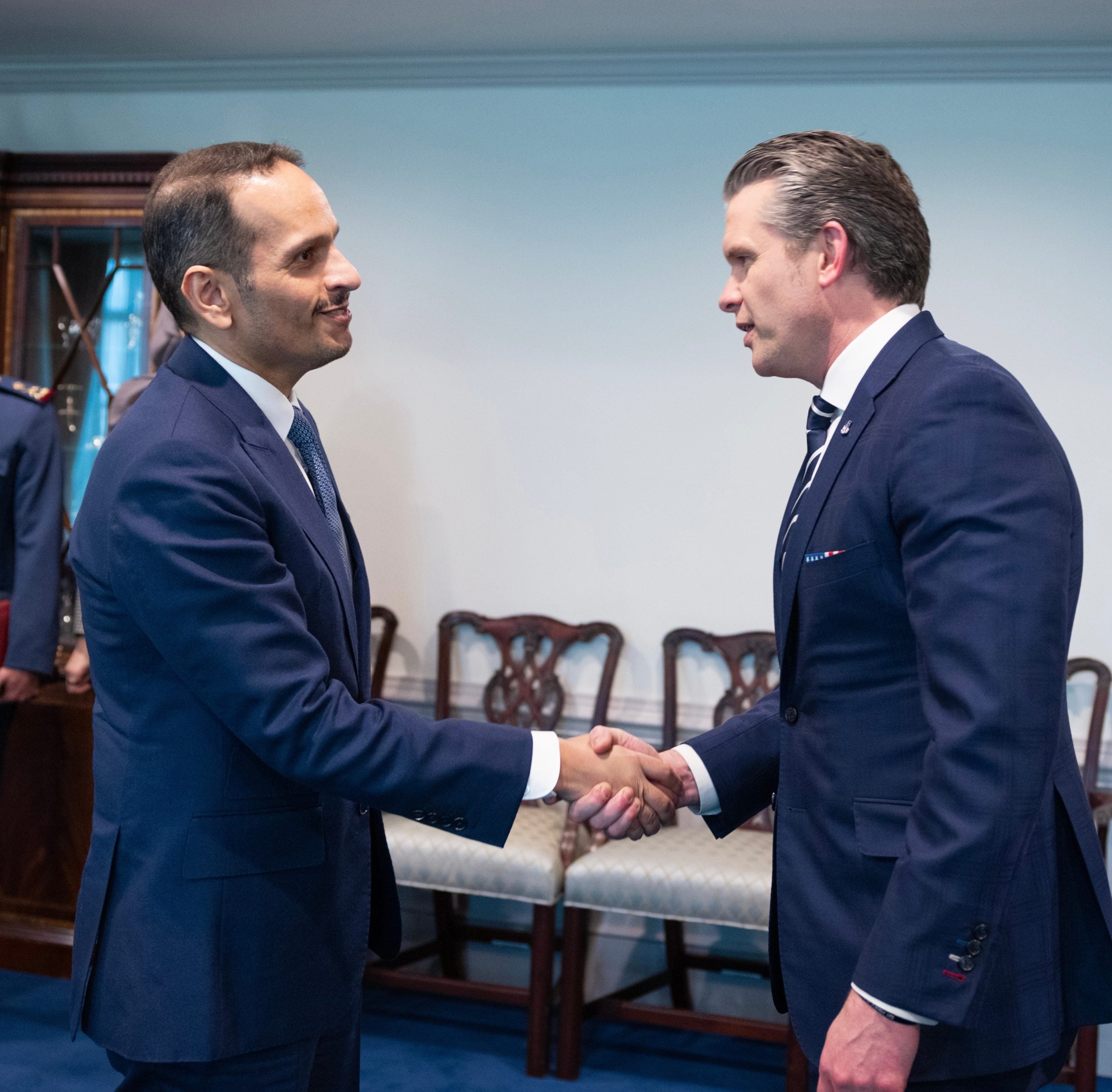
Despite distancing itself from mediation, Qatar has remained in close contact with Washington. “We are working very closely with them on how to de-escalate, on how to find a way out of this crisis and stop attacks on our countries,” Al Ansari said. Qatar’s Prime Minister Sheikh Mohammed bin Abdulrahman Al Thani met senior U.S. officials in Washington on 26–27 March, including Vice President JD Vance, Treasury Secretary Scott Bessent and Defence Secretary Pete Hegseth. The talks explored ways to strengthen “close strategic cooperation,” particularly in defence partnership amid current regional developments. Both sides stressed the need to ensure continued LNG flows to global markets.
Qatar has been explicit about its expectations. In a statement on 18 March, it called on all parties to refrain from targeting civilian and energy facilities, “including within the territory of the Islamic Republic of Iran to preserve the resources of the region’s peoples and safeguard international peace.”
On 27 March, Gulf officials told Washington in a private meeting that any deal with Tehran must go beyond ending this war, calling for lasting limits on Iran’s missile and drone capabilities and ensuring energy supplies can never again be weaponised, according to four Gulf sources cited by Reuters. The Gulf Cooperation Council signalled a unified front against any settlement that sidelines Gulf security, but is divided on pace, according to a report by Reuters. Qatar, Oman, and Kuwait pushed for a swift end to the war, while the UAE, Saudi Arabia and Bahrain demonstrated readiness to absorb an escalation, stating they would not accept a post-war Iran still capable of using the Strait of Hormuz as leverage.
By 7 April, Al Ansari warned that the war on Iran was pushing the region toward a point where it “cannot be controlled,” urging all sides to reach a resolution before the situation spiralled further.
For weeks, those appeals went unanswered. Trump repeatedly threatened to strike Iranian civilian infrastructure if the Strait of Hormuz was not reopened, referencing power plants, oil facilities and Kharg Island. On 7 April, the same day as a self-imposed 8pm ET deadline for Iran to reopen the Strait of Hormuz, Trump wrote on Truth Social that “a whole civilisation will die tonight” if Iran failed to comply. His rhetoric shifted within hours — just 90 minutes before that deadline, he agreed to suspend the planned bombing of Iran for two weeks, underscoring Gulf concerns about Washington’s reliability as a long-term partner.
On 11–12 April, senior U.S. and Iranian officials met in Islamabad for peace talks — the highest-level direct engagement between the two countries since 1979 — but the meeting ended without agreement.
On April 28, with talks stalled, Al Ansari said Qatar did not want to see “a frozen conflict that ends up being thawed every time there is a political reason.”
For Mahjoob Zweiri, an academic and senior political analyst specialising in Iran and Middle East politics, the pattern points to a deeper shift. “The United States after this war is becoming more a burden than a supporter,” he said. “If all of these wars are causing insecurity to Gulf States, why does the U.S. have a presence in the region? These questions are already being raised and will only be debated more.”
Zweiri argued that Gulf states “can push for more diplomacy, but the U.S. is not convinced that this war is harming its own alliances.” He added, “If the U.S. stops, Israel will stop immediately. They are trying to build on the fact that the U.S. is still in control.”
The war has emboldened Gulf states, prompting them to seek long‑term security guarantees they had not previously set out so explicitly. But when the ceasefire arrived, it was Pakistani mediation that ultimately moved Washington.