
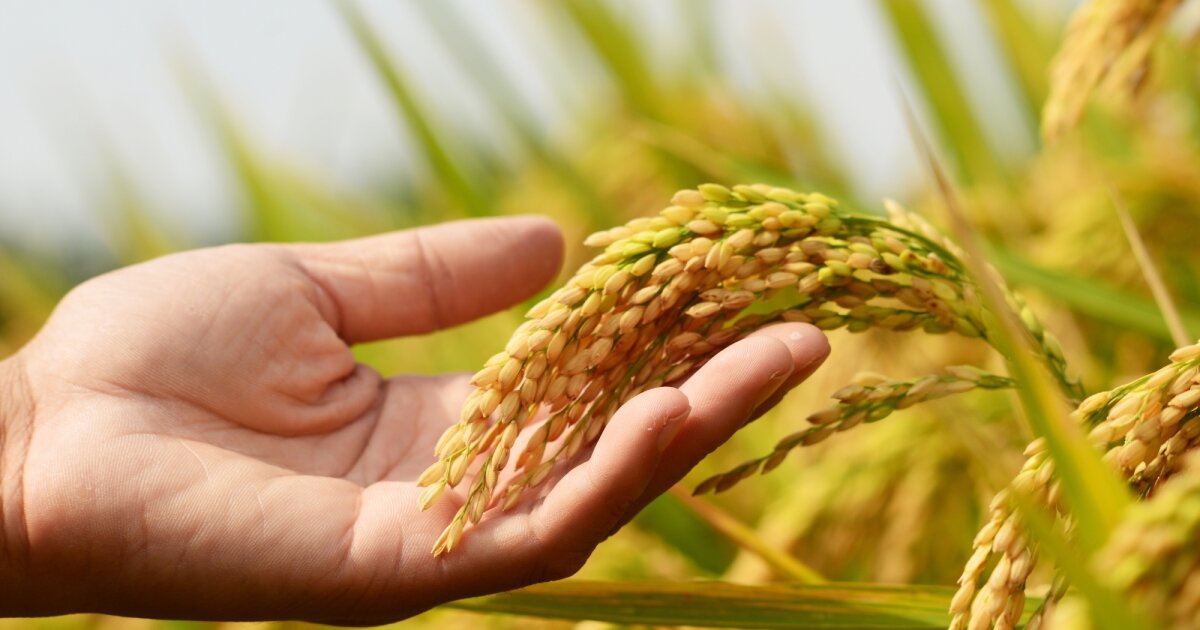
Rice is one of the most widely grown staple crops, providing around 20% of the daily calorie intake for more than half of the world’s population.
However, the rice we cultivate is an annual crop, meaning that new plants must be sown each year. Its wild relatives, on the other hand, are perennial; they flower and continue producing new shoots year after year.
In a study published in Science, researchers investigated the traits associated with perenniality in wild rice (Oryza rufipogon) and identified two genes that trigger vegetative propagation. By transferring these genes into cultivated rice (Oryza sativa), the team engineered a rice crop that exhibits the perennial growth found in its wild counterparts.
Researchers believe that the annual rice that we cultivate today evolved from perennial ancestors. However, in response to domestication, the regenerative ability was lost.
To identify the perennial traits in wild relatives, Chinese Academy of Sciences geneticist Bin Han and his colleagues compared 446 wild rice samples with cultivated varieties. They found a genomic region on chromosome 1 called Endless Branches and Tillers 1 (EBT1) features two copies of the regulatory gene microRNA156, coded simply as B and C.
In young plants, this sequence is highly active, keeping the plant in a juvenile, vegetative state. As the plant matures, the activity of microRNA156 B and C fades. In wild rice, this region resets after flowering, allowing the plant to resume growth rather than shut down.

(Dai et al., Science, 2026)
To see what this gene actually does in living plants, the researchers crossed O. rufipogon with cultivated O. Sativa. From those hybrid specimens, researchers selected one coded G43, which demonstrated an ability to stop flowering and resume vegetative propagation.
In reactivating vegetative growth, G43 grows secondary shoots known as tillers, which branch from the base of the plant. While a normal rice plant produces around 10 tillers between flowering and dying, G43 produced an average of more than 70.
The big limitation of these secondary tillers is that they are sterile, producing abnormal flowers without seeds. The researchers suggest genes inserted at additional locations may be needed to make fully fertile perennial rice plants.
“Currently, the problem is that the EBT1 locus also suppresses flowering and therefore it reduces yield,” plant geneticist Salomé Prat from the Centre for Research in Agricultural Genomics told Refractor. “In this allele, the gene becomes again reactivated after flowering in tillering buds, enabling the formation of new tillers.”
University of California, Davis, plant biologist Jorge Dubcovsky says that this gene-edited rice is unlikely to “reach the public soon”.
“Perennial plants have lower yield than annuals,” Dubcovsky told Refractor. “Given the current population growth, I do not think we can afford switching our productive annual crops by less productive ones, even if they provide some ecological advantages.” Neither Prat nor Dubcovsky was involved with the research.
The study has been published in Science.
Fact-checked by Mike McRae.