
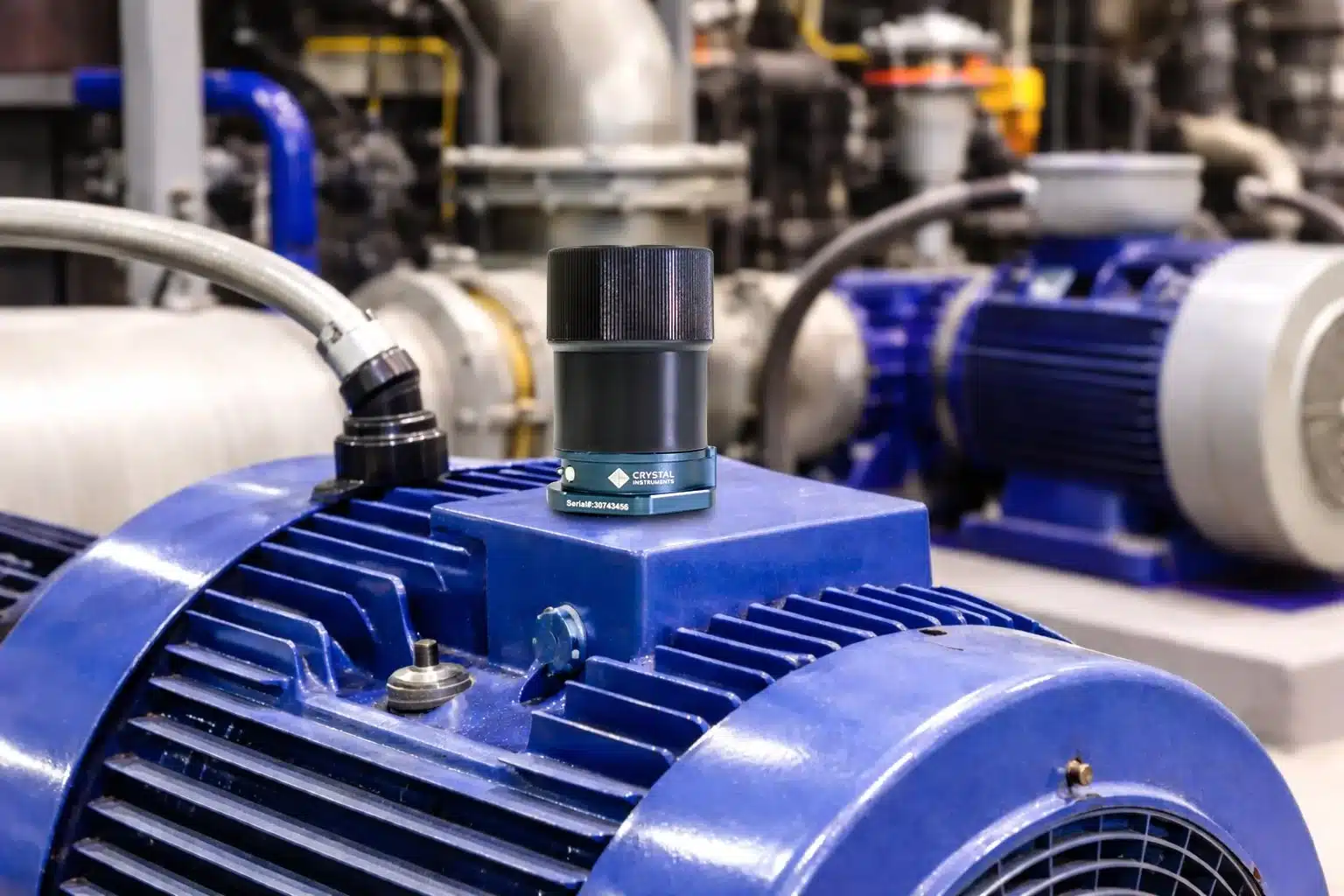
What if machine failures could be detected before production stops? A monitoring system is changing how facilities track vibration, diagnose faults, and reduce downtime.

Crystal Instruments’ Ruby wireless vibration sensor is designed to make industrial condition monitoring easier to deploy, scale, and maintain. Built for predictive maintenance applications, Ruby combines high-precision vibration measurement with wireless connectivity, allowing maintenance teams to monitor machine health without the complexity of traditional wired systems.

The sensor captures three-axis (triaxial) vibration and shock data with low-noise performance comparable to laboratory-grade instruments. Engineers can use this data to identify early signs of imbalance, misalignment, looseness, and bearing faults before they lead to unplanned downtime.
Unlike conventional wired monitoring systems that require extensive cabling and infrastructure, Ruby supports flexible wireless deployment across the plant floor. Sensors can be installed on multiple machines and connected through strategically placed gateways, enabling centralized monitoring throughout an entire facility.
Ruby also integrates with Crystal Instruments software platforms, including Remote Condition Monitoring (RCM) software for downloading recordings, trigger data, and vibration spectra, as well as EDM software for system control and monitoring. Together, the hardware and software ecosystem provides actionable diagnostic insights for maintenance and reliability teams.

Designed for industrial environments, Ruby features an IP67-rated enclosure for dust and water resistance, a rugged metal housing, and an operating temperature range from -40°C to 55°C. These features make it suitable for use in harsh manufacturing and processing environments where reliability is critical.
The sensor supports Bluetooth and USB connectivity, allowing users to access data directly from mobile devices or connected systems. Its scalable architecture also supports large deployments with hundreds of sensors distributed across multiple assets and production lines.
Power efficiency is another key advantage of the Ruby platform. The sensor’s ultra-low-power design keeps it in deep-sleep mode between measurements, consuming only microamps of current. Powered by a standard 3.6V D-size lithium battery, Ruby can operate for up to two years without battery replacement. Since the batteries are commercially available, replacements can be sourced easily from online or local retailers.
For facilities implementing predictive maintenance programs, Ruby offers a practical alternative to wired condition monitoring systems by reducing installation costs, simplifying deployment, and providing real-time machine health insights across critical equipment.
Click here for the original announcement.