
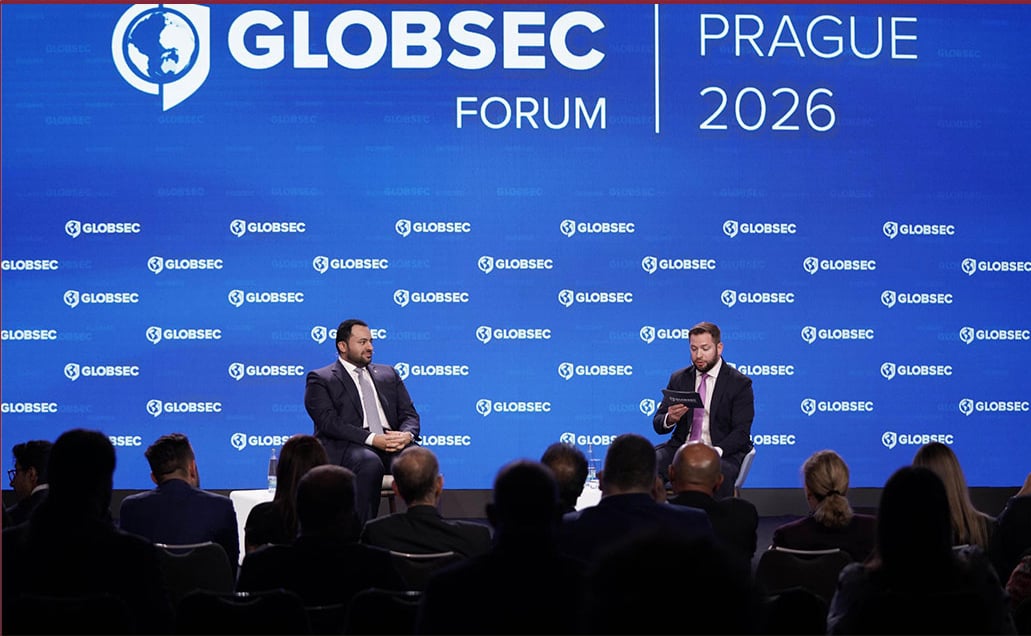
Qatar’s Minister of State at the Foreign Ministry Mohammed bin Abdulaziz Al-Khulaifi highlighted Doha’s mediation efforts and called for stronger diplomacy and partnerships during the GLOBSEC Forum 2026 in Prague.
Qatar’s Minister of State at the Ministry of Foreign Affairs Mohammed bin Abdulaziz Al-Khulaifi said on Thursday that mediation is a core part of Qatar’s national identity and foreign policy, as he highlighted Doha’s role in conflict resolution efforts across the Middle East and beyond.
Speaking during a main session titled “Pursuing Peace in the Middle East and Beyond” at the GLOBSEC Forum 2026 in Prague, Al-Khulaifi warned that modern conflicts no longer remain confined to their geographic boundaries.
“We are living in a moment where conflicts are no longer contained within their geography,” he said. “War produces humanitarian, economic, political, security and social consequences that extend far beyond borders.”
Al-Khulaifi said Qatar’s approach to mediation was rooted in Article 7 of the country’s constitution, which commits the state to supporting peaceful resolution of international disputes.
He pointed to Qatar’s years-long involvement in mediation, dialogue and facilitation efforts in Gaza, Afghanistan, Iran, Lebanon, Sudan, Chad, Venezuela, Ukraine and other regions.
“Our approach is actually simple,” he said. “We do not engage in mediation because it is easy, but because the alternative is often worse.”
The minister stressed that mediators can make a meaningful difference when they are trusted by the parties involved.
Discussing the impact of ongoing conflicts, Al-Khulaifi said humanitarian collapse was often the first consequence, citing displacement, hunger, trauma, hostage-taking, family separation and destruction of civilian infrastructure.
“In Gaza, for example, the humanitarian dimension is not secondary to diplomacy, it is its core,” he said, stressing that international efforts to ensure humanitarian access and protect civilians must move in parallel.
He also warned that conflicts in the Middle East rarely remain localised, with crises quickly affecting the Gulf, Red Sea, Levant and beyond.
Al-Khulaifi further warned of growing public distrust in diplomacy itself, saying prolonged wars can lead people to believe that dialogue is weakness and mediation merely symbolic.
“That is dangerous,” he said.
The minister added that conflicts also place pressure on the global economy by affecting energy and food supplies, investment, aviation, maritime security and migration.
“Peace-making is not only a moral duty, but also a strategic necessity,” he said.
Al-Khulaifi said Qatar’s experience had shown that even limited agreements, such as ceasefires, humanitarian truces, prisoner releases or opening communication channels, could help prevent wider escalation.
Asked about diplomatic tools that best support peace and stability, the minister identified trusted communication channels as the first priority, saying mediators must often first make communication possible between parties that do not trust one another.
He also highlighted humanitarian diplomacy, saying measures such as civilian releases, medical evacuations, humanitarian access and family reunification can help reduce tensions and build trust even when political peace remains out of reach.
Al-Khulaifi said patience and confidentiality were also essential, adding that “some of the most important breakthroughs in the most complex conflicts happen quietly”.
He further stressed the importance of partnerships, noting that Qatar rarely works alone in mediation efforts.
“In Gaza, Qatar has worked closely with Egypt, Turkey and the United States in ceasefire and humanitarian arrangements,” he said.
The minister added that mediators must also understand when to pursue comprehensive agreements and when to begin with smaller steps, saying even limited humanitarian successes can become the foundation for wider political processes.
He stressed that success in mediation is not always measured by signing a final agreement.
“Sometimes success is preventing the next escalation, opening the first channel, or saving the first life,” he said.
Al-Khulaifi also said partnerships were essential for sustainable peace, noting that mediators can help build trust and open doors, but lasting solutions require political will from the parties involved and support from regional and international partners.
Discussing regional diplomacy, he said Qatar’s role in files related to Iran had stemmed from its ability to maintain credible communication with different parties.
“That does not mean Qatar agrees with every party,” he said. “It means it believes communication is necessary precisely when relations are difficult.”
He added that partnerships can support peace-building through political backing, humanitarian support, security guarantees and post-conflict investment, warning that peace without reconstruction, jobs and institutions remains fragile.
“Mediation can open the door to peace, but partnerships are what stop that door from closing again,” he said.
Al-Khulaifi said Qatar does not claim mediation resolves every conflict, but argued that without serious mediation many wars become longer, more violent and harder to end.
“For Qatar, mediation is not a public relations exercise,” he said. “It is a strategic tool to contain escalation, protect civilians, secure the release of detainees, preserve dialogue and create opportunities that did not previously exist.”
He reaffirmed that Qatar would continue working with partners to keep communication channels open, reduce suffering and support peace efforts in the Middle East and beyond.