


TL;DR
- Supervive launched in July 2025 with its Armory system, overhauling its equipment.
- The Armory system allowed players to earn and upgrade powerful equipment using Prisma that they could then find in their shops.
- It became controversial because of its grindy meta progression, unfair matchmaking, and seasonal resets.
- The Armory system drew ire in Steam reviews and online forums.
Supervive is a free-to-play MOBA battle royale hybrid from Theorycraft Games. The team is comprised of veteran developers who have worked on games like League of Legends, VALORANT, Destiny, Team Fortress 2, Halo, and more. The game was in open beta before its official launch in July 2025.
However, the launch was met with overwhelmingly negative feedback due to a last-minute addition: the Armory system. What exactly is this change that’s affecting an otherwise fun game?
What is the new Supervive armory system?
Supervive is a free-to-play competitive action game that blends elements of MOBA and battle royale genres with a top-down perspective. Its fast-paced, skillshot-heavy combat feels right at home for anyone who’s played League of Legends or Battlerite, but instead, players will have their teamfights in a shrinking arena with points of interest, monster camps, and players scattered throughout.

Additionally, mechanics like levelling up abilities, gliding over and dunking players down the abyss, and creating synergistic builds and team comps add complexity to Supervive’s moment-to-moment combat. The goals from battle royales, like world drops, map objectives, and player-dropped loot, demand teams to adapt on the fly.
This is how Supervive functioned throughout its beta phase in 2024. With the official 1.0 launch in July 2025, Supervive introduced a major new feature called the Armory, which fundamentally overhauls how items and progression work in the game.
The Armory is essentially a meta-progression system where players unlock gear (equipment items) over time outside of matches, and then bring those chosen items into each match as part of their loadout. This is a big change from the open beta, where players simply looted items during a match; now, your out-of-match progress defines what items you can access in-game.
At its core, the Armory system adds persistent progression and customisable loadouts to Supervive. The plethora of items is categorised into Relics, Grips, Kicks, and Perks, allowing for different possible build combinations for every character.
Each item type offers a unique kind of benefit. For example, Relics are powerful artefacts that grant major effects, Grips (hand items) give moderate stat boosts, Perks are minor passive bonuses, and Kicks (boots) improve movement with speed or perks related to a character’s dash.
Earning and spending Prisma
Before a match, you can theorycraft a custom build by selecting up to two Relics, two Grips, five Perks, and one pair of Kicks for your Hunter. However, you must unlock these items in your Armory first to use them.
The new currency, Prisma, is the key to unlocking items. Players earn Prisma primarily through gameplay, such as getting PvE and PvP kills, completing objectives, placing high in matches, and through rotating missions. However, Prisma collected during a match is partially lost on dying, unless saved through Prisma Extractors or by simply winning the match.
During a match, players can gain items from looting monsters, vaults, or use coins at special shops on the map to buy the gear they’ve unlocked in their Armory. Otherwise, you can loot them after defeating enemy Hunters equipped with their items.
But to permanently add an item to your collection, making it always available in future matches, you must obtain it through the Armory using Prisma outside of matches. Prisma can be spent in two ways: buy a specific item from a rotating Armory shop called the Shaper or open a Prismatic Capsule (a loot box) for a random reward at a cheaper Prisma price.
Importantly, Prisma cannot be purchased with real money. It’s an earned currency only, so the Armory is not designed to be pay-to-win. However, there is a system that rewards players who heavily invest their time into the game.
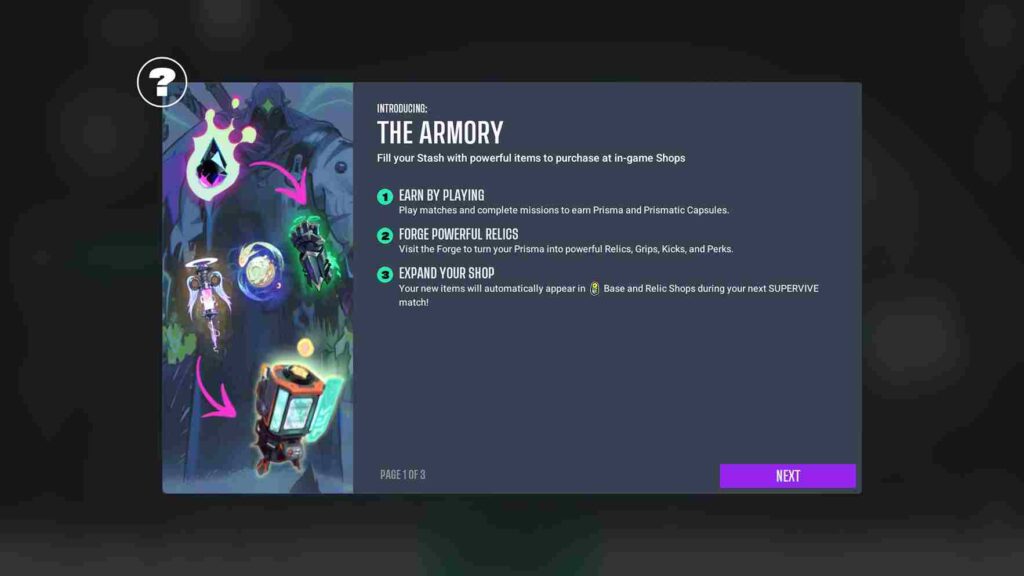
There is even a forge system to upgrade items: if you unlock duplicate copies of the same item, you can combine them to raise that item’s tier, boosting its stats or adding new effects. The differences between the higher tiers of the items are a significant boost, where outliers like Ardent Songbow can make or break characters.
One controversial decision is that the Armory adds a seasonal progression loop to Supervive. For a season (about three months long), you will gradually collect and upgrade items in your personal Armory. However, when a new season begins, the Armory resets along with everyone’s items and equipment.
The new Armory system grants Hunters consistency in their runs by gaining power outside of the game and a relatively simple meta progression goal. Play matches to earn Prisma, spend Prisma to unlock gear, then use that gear to customise your character’s build in subsequent matches.
Main pain points
Any sweeping change to a game’s core systems can split the community, and the Armory is no exception. Reactions to the change have been mostly negative, and it’s affecting the perception of the game.
The conversation around this game in reviews and forums revolves around the last-minute implementation of the Armory system, which puts off potential players.
It’s a shame because the discussion detracts from an otherwise great game. The controversy boils down to a feeling among many players that the Armory introduced grind and imbalance into what was previously a pick-up-and-play battle royale.
Heavy time investment
First, the Armory is an unnecessary grind. Because players must unlock equipment via accumulating Prisma, then relying on a rotating shop and often through random loot capsules, it can take a lot of matches (and luck) to get the exact gear you want.

It’s one thing to unlock the base item, but it’s another to gain enough duplicates to gain the higher-tiered upgrades, which can make a big difference during fights.
A fair PvP game with competitive integrity strays away from borrowed power gained outside the game that can create imbalance. Skill and the ability to outplay opponents should be at the forefront of the game, and it shouldn’t be considered a skill to have more hours invested than your opponent.
This system is reminiscent of the Rune system from League of Legends, which is outdated for a reason. These Summoner Runes combine glyphs, marks, and seals to grant stat bonuses to champions before the game even starts. These Runes were purchased from Riot’s shop using Influence Points, currency gained from playing matches.
Players who invested enough time to fill their Rune Page will have an inherent advantage over their opponents. Additionally, players who can fill multiple Rune pages are much more flexible with choosing different Champions.
At the very least, every player had access to the same shop in League of Legends. Supervive’s Armory system purposefully locks players out of the shop without earning their desired item first. To be on equal footing, players need to grind out their items first, making it difficult to switch characters without equal time investment for the Armory freely.
Unfair matchmaking
Second, this leads to a competitive imbalance, where newcomers and casuals are always at a disadvantage. Veterans and hardcore players will have spent more time in the game, creating a power gap with their better Armory. It breaks one of the principles of both a battle royale and a MOBA, where all players should be on an even field in each match.
Additionally, knowing that you have an insurmountable disadvantage over enemies is frustrating and can leave players tilted mentally. It’s much harder to accept that there was a chance to outplay the opponents when there’s an imbalance in equipment.
In an interview with a developer for Supervive, Andrew Yip (former director for Legends of Runeterra), addresses the imbalance with their matchmaking. Their matchmaking takes into account the “lobby star level,” which is a total of all the player’s armory levels to determine what quality of loot will drop during the match, ensuring fair loot.
Throughout the interview, Andrew insists that their matchmaking algorithm works. He promises that their “fights are fair” with their matchmaking, but not that the reasons why the fights are fair are the same. For them, when players with a lower armory are in the same lobby as players with a better armory, it’s intentional because their “source of powers” is different, referring to raw skill against gear.
So, if players with higher skill but low gear have the potential to outplay their opponents, this means that they now have access to better gear, letting them cruise through the lobby. Another issue is that eventually, better players will climb through the ranks and hit a wall against equally skilled players but with higher-tiered equipment. Or, that low-skilled players with better equipment will sink until they can brute force lower-ranked teams.
Seasonal reset
Finally, if players continue to play Supervive regularly, fill out their vault, and upgrade their favourite items, they have to go through it again after the season resets every three months. The developers stated that they plan on tweaking the armory when this happens by adding, removing, and tuning problematic items.

Additionally, they said that it creates a new entry point where players can have a fresh start, but wouldn’t it have the opposite effect? Hardcore players would quickly build up their armory, outpacing the casuals with less time to play. Sure, they may be able to catch up every season, but once they slack off, they fall behind.
One purpose for its inclusion is that it diversifies item builds. While the items at launch have more depth than the cookie-cutter stat-boosts from its beta, players will most likely stick to a build they’ve already invested their time and effort into.
Because why go through all the trouble of building up an armory, investing time and Prisma only to lose progress? Not to mention that these items can get nerfed and balanced in the middle of the season, which further devalues the time invested. Filling up the Armory is already a heavy grind, but is it a worthwhile one?
Conclusion
Supervive’s Armory system is a painful grind that gives external power to players who have spent more hours in the game. On the other hand, not everyone hates the Armory, and that’s part of what makes it controversial. Many players enjoy progression and feel like every match is a step towards better power, and love the fresh depth after every reset.
The biggest worry is that sticking to this system and slowly tweaking it could take away valuable resources. Away from manpower that could’ve been used for more Hunters, maps, and items.
Supervive’s core gameplay is still action-packed, and Theorycraft Games could slowly tune the pain points out over time. However, the negative attention isn’t helping, and this Hail Mary system for player retention could see another huge dip in player count once the first hard reset rolls in.
FAQs
Supervive is often described as a hybrid of a MOBA and a battle royale. It has the action-combat of League of Legends and Battlerite, but matches play out like Apex Legends. Its dunking mechanic and ability to cross platforms also draw comparisons to Super Smash Bros.
Supervive gained a lot of attention during its beta and peaked at 47,913 players. Upon its 1.0 release as a free-to-play title, it saw a peak of 15,243 players and was generally well-received by critics. However, the recent Armory controversy has tempered some enthusiasm.
The old system, where players could find the same items during a match, was straightforward and uncomplicated. Other players argue that the Armory is a significant improvement in terms of depth and customised playstyles, but are concerned about its progression and the seasonal reset.
References
The post Supervive’s controversial armory system explained appeared first on Esports Insider.