
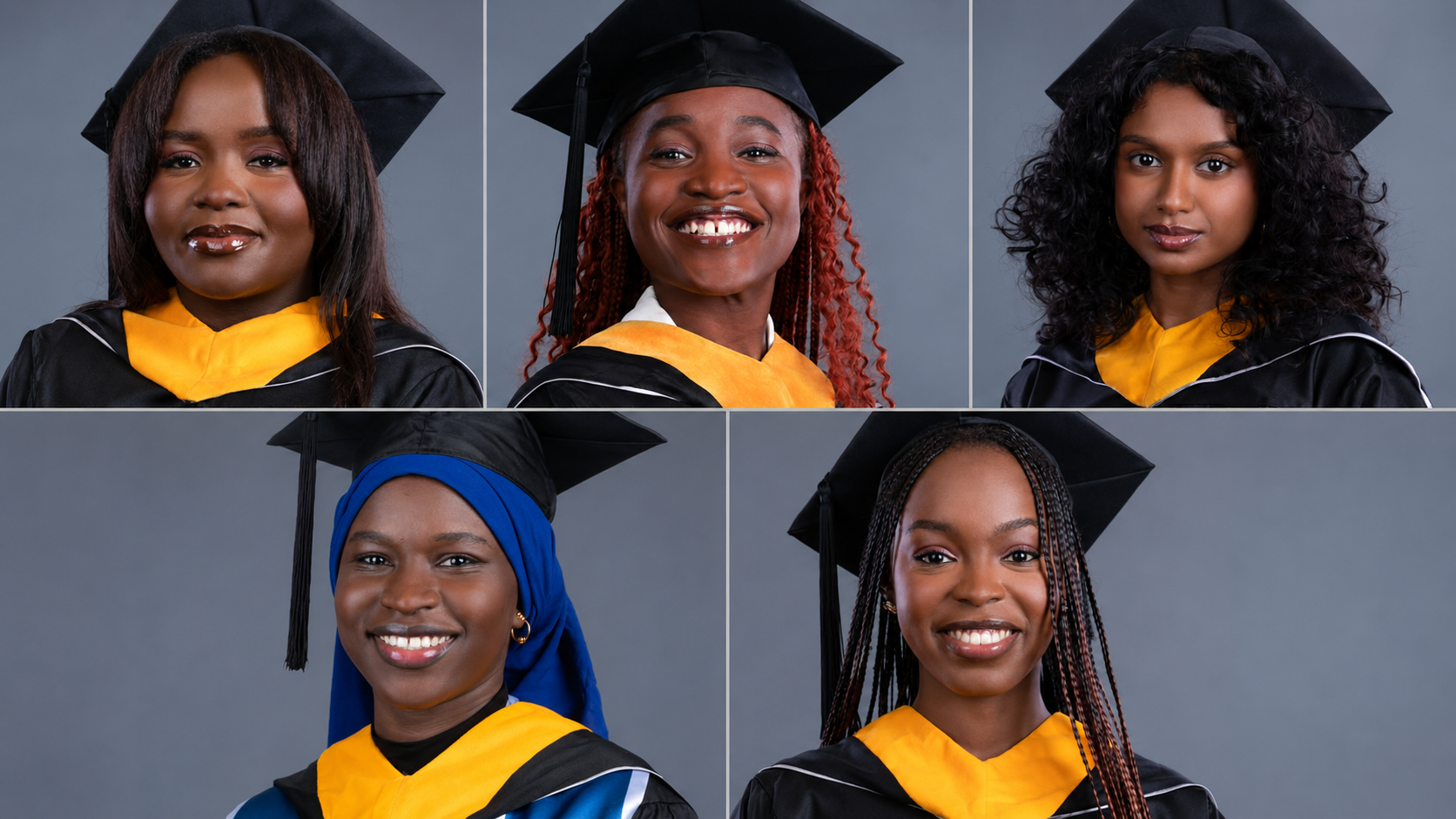
At Georgetown University in Qatar, six students from Nigeria, South Africa, Zambia, Uganda, Senegal and Cameroon found a space to study the world while looking back at Africa with sharper questions and bigger ambitions.
Global education hubs have long been synonymous with the United Kingdom and the United States. But Doha has quietly and steadily carved out its own place on that map — a serious destination for ambitious students looking beyond the traditional routes.
For six graduates of the African Leadership Academy, that path led to Qatar Foundation’s Education City, and more specifically, to Georgetown University in Qatar.
Their journey began at the African Leadership Academy, an internationally recognised institution built around one mission: identifying and educating the brightest young minds across the African continent. From there, the world opened up. Accepted into universities across the globe, the six chose Doha.
At Georgetown Qatar, the Edmund A. Walsh School of Foreign Service offered something that went beyond an alternative to the Washington DC campus. For these graduates, it became a vantage point — a place to look back at their own continent with fresh eyes, while building a deeper understanding of global politics, culture, identity, and what leadership actually demands.
Jemimah Golo: Reframing Africa through music and identity

For Jemimah Golo, a Nigerian graduate who studied Culture and Politics, Georgetown Qatar did not just broaden her academic horizons — it reshaped the way she understood her own continent.
“Africa is not a monolith,” she said.
Growing up as part of an ethnic minority in Nigeria, Golo arrived at GU-Q with one perspective. A class trip to Mauritius gave her another. “It’s limitless in its possibilities, resources, and number of talented people on the ground,” she said. “I am excited for its future.”
Music sits at the centre of Golo’s academic and creative identity. At GU-Q, she focused her studies on the relationship between music, society, and power — a lens through which she examined Africa not just as a place, but as a sound. She interned with Mavin Records, one of Africa’s largest record labels, and used university research funding to travel to Ghana, where she explored how diaspora communities shape global perceptions of African music.
Her work also found a stage in Qatar. When Golo performed her original songs at GU-Q’s Africa Night celebration, the audience did not just listen. “They were singing along to my lyrics,” she said. “I was quite humbled.”
Jaelene Iyman: Tracing identity, belonging, and leadership across continents

Jaelene Iyman carries history with her. Growing up in South Africa as a descendant of Indian indentured labourers who arrived in Durban more than 170 years ago, she came to Georgetown Qatar with deep questions about identity and belonging. It was precisely GU-Q’s multicultural environment that gave her the space — and the tools — to work through them.
As an International Politics major, Iyman’s academic journey unfolded across continents. She interned in Washington DC, observed the American legal system through a clinic in New York, conducted fieldwork in Kenya, and studied at an overseas academic centre in Fiesole, Italy. Back in Doha, she helped create Aswatna, GU-Q’s first student writing anthology — a publication built around one idea: that every voice in the room deserved to be heard.
A first-generation college student and the first from her community to study abroad, Iyman left GU-Q with more than a degree. “Being able to travel abroad to conduct research and learn from local people is something that can’t be quantified,” she said.
Nelly Kakeya Kalukango: Turning representation into agency

Nelly Kakeya Kalukango arrived in Doha from Lusaka, Zambia, as a first-generation college student and the only Zambian at Georgetown Qatar. She began her GU-Q journey intending to study International Economics, but later shifted toward Culture and Politics, with a focus on human agency and the power people have to shape change in their own communities.
For Kakeya, that understanding became clearer during a women’s leadership trip to Georgetown’s US campus in her third year. Surrounded by global peers and women working within the halls of the US government, she said the experience helped her overcome her fears and represent herself, her country, and her people with more confidence. “It made me solidify my thoughts on the complete power of passion to effect change,” she said.
Kakeya later carried that sense of agency into her work in Doha, securing an internship at the Zambian Embassy and serving as vice president of the African Students Association, where she helped build support systems for students arriving in Qatar.
Ruth Nicole Kulyomulunda: Building the guide she once needed

Ruth Nicole Kulyomulunda arrived in Doha with the same questions most international students carry through their first weeks in a new country: where to go, who to ask, and how to find your footing.
The Ugandan International Economics major found her answers — and then made sure the next person would not have to search as hard. She created a practical guide for future Ugandan students coming to Education City, the kind of resource she wished had existed when she first landed in Doha.
Her time at GU-Q stretched well beyond the classroom. Through student experience funding, she contributed to Uganda’s diplomatic engagement in Qatar. During the 2022 FIFA World Cup, her creative side took centre stage when she performed in a dance trio alongside Jemimah. She also pursued a minor in Philosophy, and found something in Qatar she had not expected.
“Even in a Muslim-majority country, I found a community that supported my Christian spiritual journey,” she said. “For that, I am deeply grateful.”
Her story sits alongside those of Seynabou Tall of Senegal, a Culture and Politics major, and Jessica Ornella Nett of Cameroon, who graduated cum laude in International Economics. Together, they formed part of a GU-Q cohort whose academic work, field research, and student experiences stretched across more than a dozen countries.
A bridge between ALA, Education City, and Africa’s next leaders
Following in the footsteps of ALA alumni before them — including Rhodes Scholar Fatima Yunusa, GU-Q Class of 2025 — this year’s graduates did not just pass through Education City. They helped build the path for those coming next.
The Class of 2026 mentored the eight ALA students who enrolled after them, offering the kind of support that matters most when you are far from home and still figuring out who you are becoming.
That connection between ALA and Georgetown Qatar runs through every part of their story. ALA gave them the foundation — a way of thinking about leadership as service, responsibility, and imagination. GU-Q gave them the classrooms, fieldwork, internships, and global networks to put that into practice.
They leave with degrees, research experience, embassy internships, and diplomatic exposure. But they also leave with something harder to measure: a clearer sense of what it means to lead without losing sight of where you come from.
“The ALA community in Education City has been a pillar and my rock,” Jaelene said.
Doha was not the obvious choice. But for these six graduates, it became the place where their ALA foundation met a wider world — and where their leadership began to take real shape, across campuses, countries, and communities.