
Even when you’re one of the first people to go to the moon in half a century, there’s no place like home.
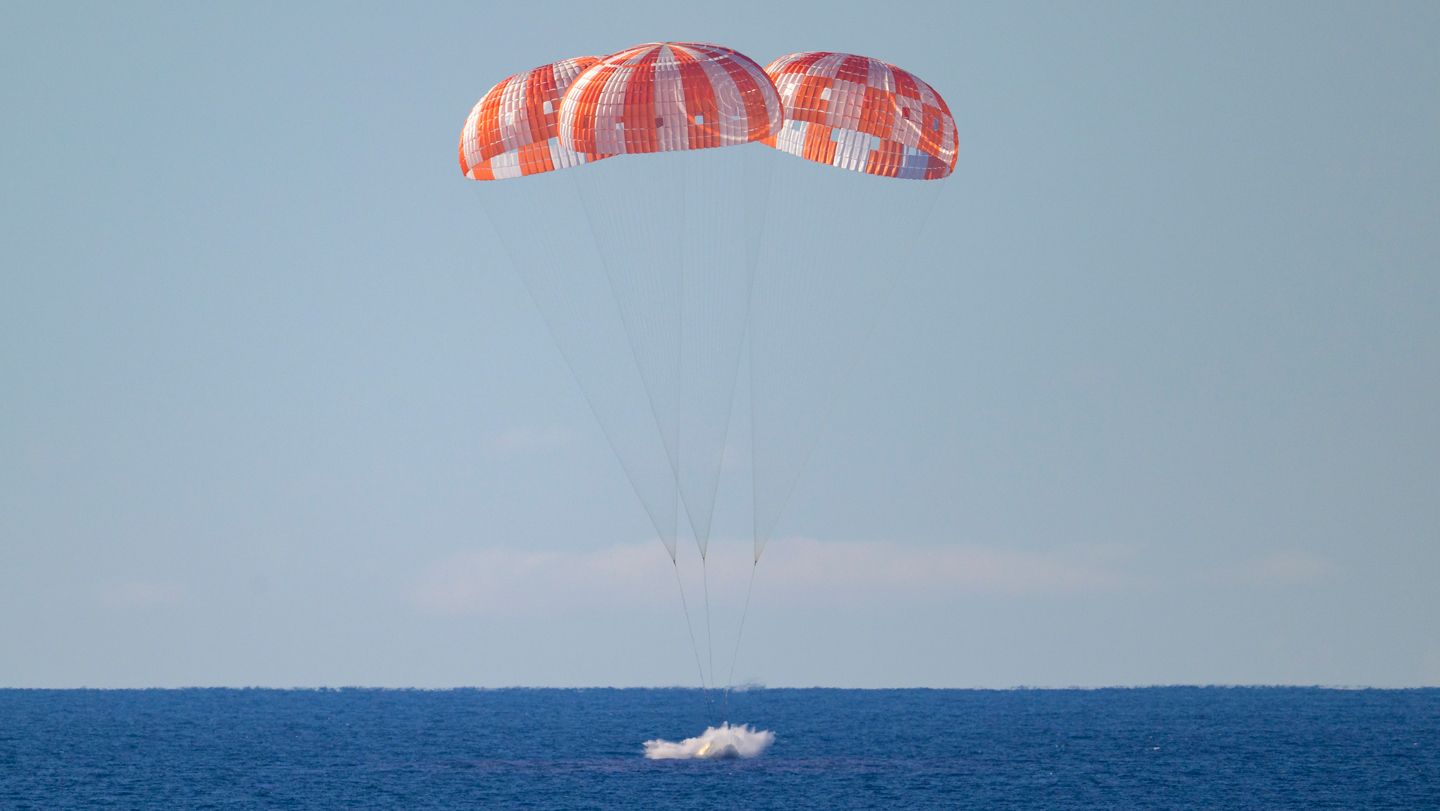
Artemis II has reached the end of its historic lunar flyby. The Orion space capsule and its four astronauts splashed down off the coast of San Diego on April 10 at 8:07 p.m. Eastern.
“A perfect bulls-eye splashdown. All four crew members are in excellent shape,” said NASA commentator Rob Navais. “It was for all intents and purposes a textbook mission.”.
Reentering Earth’s atmosphere gave the Orion capsule its most harrowing test yet. The capsule touched the atmosphere for the first time since launch at 7:53 p.m. at an altitude of about 122 kilometers and moving more than 38,000 kilometers per hour.
“What a journey,” said mission commander Reid Wiseman moments after splashdown.
The overall flight plan was not that different from those of the Apollo missions, said Artemis II flight director Jeff Radigan in an April 9 news briefing. “Big picture, coming back from the moon is all really close to the same thing,” he said. “It parallels Apollo much more than it does some of our low-Earth orbit returns.”
Shortly after reentry began, the crew was out of contact with mission control for about six minutes. The friction of the atmosphere heated Orion’s heatshield to nearly 2800° Celsius, creating a layer of superheated plasma that blocked communication from the spacecraft.
NASA engineers will be keeping a close eye on how the heat shield behaved. When the uncrewed Artemis I mission’s Orion capsule came back to Earth in December 2022, the heat shield returned unexpectedly scorched. Chunks of material were missing and other parts were cracked.
After an extensive investigation, NASA announced in 2024 that the cause of the charring was a buildup of gases that became trapped under an outer layer of material called Avocat, designed to decompose and carry heat away from the spacecraft. Instead of redesigning the heat shield itself, NASA redesigned the spacecraft’s reentry trajectory to lower the heat stress on the shield.
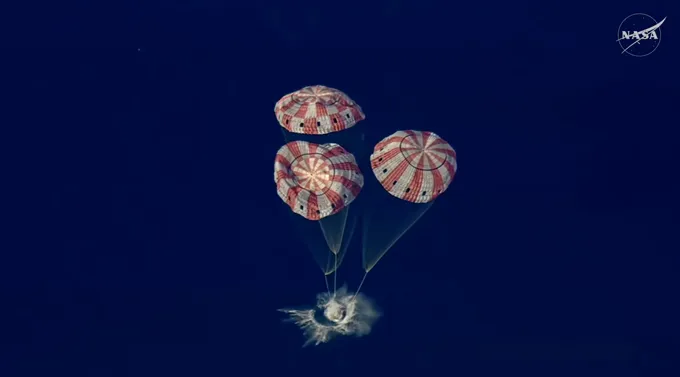
At an altitude of 7.6 kilometers, Orion deployed a series of 11 parachutes to slow it down to about 30 km/h for splashdown. Once in the water, five orange airbags filled with helium to help the capsule stay upright and let the astronauts emerge onto a large raft called the front porch. From there, the astronauts are making their way back to Houston by helicopter, boat and airplane.
“From the pages of Jules Verne to a modern day mission to the moon, a new chapter of the exploration of our celestial neighbor is complete,” commentator Navais said. “Integrity’s astronauts back on Earth.”