
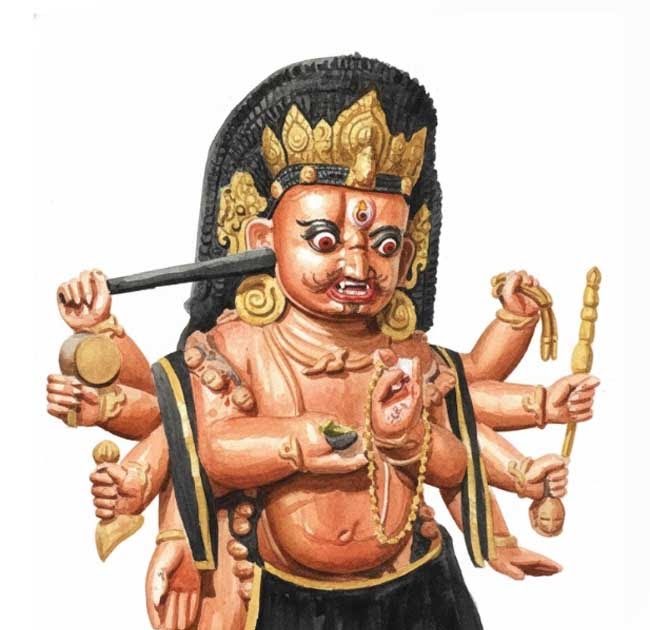
Unmatta Bhairava: The Divine Madness of Shiva’s Transcendent Form
The Essence of Divine Madness
In the vast pantheon of Hindu religious traditions, Unmatta Bhairava stands as one of the most profound and enigmatic manifestations of Lord Shiva. The term ‘Unmatta’ translates to “uncontrolled,” “intoxicated,” or “mad,” yet this apparent madness conceals deeper spiritual truths about the nature of consciousness, liberation, and ultimate reality. Far from representing chaos or disorder, Unmatta Bhairava embodies the supreme state of consciousness that transcends all conventional boundaries, social norms, and mental limitations.
This fierce form of Bhairava represents the aspect of Shiva that has moved beyond all dualities—pleasure and pain, attachment and aversion, honor and dishonor. The divine madness is not the madness of ignorance but the intoxication of supreme wisdom, where the enlightened soul dances in absolute freedom, unbound by the chains of karma, desire, or worldly existence.

Symbolism and Iconographic Significance
Unmatta Bhairava is typically depicted with features that emphasize his wild, untamed nature. His disheveled hair, fierce expression, and unconventional posture all point toward liberation from societal conventions and mental conditioning. The matted locks represent the accumulation of spiritual power, while his wild appearance symbolizes complete detachment from worldly concerns about appearance, status, or reputation.
The intoxication associated with this form is not merely physical but represents the divine ecstasy of self-realization. When consciousness recognizes its true nature as infinite and eternal, it experiences a bliss so overwhelming that it appears as divine madness to ordinary perception. This state is beautifully captured in the concept of ‘ananda’ or supreme bliss, which transcends all ordinary human experiences of happiness.
Philosophical Interpretations
From a philosophical standpoint, Unmatta Bhairava represents the Advaitic principle of absolute non-duality. In this state, the distinction between the observer and the observed dissolves completely. The apparent madness is the natural expression of consciousness that has recognized its identity with Brahman, the ultimate reality.
The Vigyan Bhairava Tantra, a significant text in the Shaiva tradition, explores various meditation techniques leading to this state of supreme awareness. While it doesn’t specifically detail Unmatta Bhairava, it describes the state of consciousness where all mental constructs dissolve, and pure awareness remains. This aligns perfectly with what Unmatta Bhairava symbolizes—the destruction of all limiting concepts and the emergence of unlimited consciousness.
The Path of Transcendence
Unmatta Bhairava’s form teaches that true spiritual liberation requires the courage to abandon all conventions, including those considered spiritually significant. This doesn’t advocate for reckless behavior but points toward an inner state where one is no longer bound by external rules and regulations because one’s actions flow spontaneously from inner purity and wisdom.
This concept resonates with the teachings found in the Ashtavakra Gita, which emphasizes that the truly liberated soul is beyond all practices, rituals, and even the concept of liberation itself. The enlightened being appears mad to worldly people because their frame of reference is entirely different—they operate from a space of complete freedom and unity with the divine.
Creative Power and Destruction
As a form of Bhairava, Unmatta also embodies tremendous creative and destructive power. The Shiva Purana describes various Bhairava forms as guardians of different directions and aspects of cosmic energy. Unmatta Bhairava’s uncontrolled nature represents the raw, primordial energy that exists before it is channeled into specific forms and manifestations.
This energy is both creative and destructive—it destroys ignorance, ego, and all limiting identifications while simultaneously creating the possibility for genuine transformation and spiritual awakening. The madness is the breaking down of old structures within consciousness, making space for divine wisdom to emerge.
Modern Day Relevance
In contemporary times, the symbolism of Unmatta Bhairava holds particular significance. Modern society often values conformity, control, and predictability, yet true creativity and spiritual growth often require breaking free from these constraints. Unmatta Bhairava reminds us that authentic spiritual experience cannot be contained within neat categories or controlled through pure willpower.
For spiritual practitioners, this form teaches the importance of surrendering control and allowing divine grace to work through us. It challenges the notion that spirituality must always be orderly, peaceful, or socially acceptable. Sometimes, the spiritual journey requires what appears as madness—the courage to question everything, abandon security, and leap into the unknown.
The form also speaks to the importance of transcending the ego’s need for approval and validation. In a world obsessed with image and reputation, Unmatta Bhairava represents the freedom that comes from complete indifference to others’ opinions, rooted not in arrogance but in the deep recognition of one’s divine nature.
Liberation Through Divine Intoxication
Ultimately, Unmatta Bhairava symbolizes the highest state of spiritual attainment—sahaja samadhi or the natural state of enlightenment. This is not a state that one enters and exits but a permanent recognition of one’s true nature. The apparent madness is simply how this supreme state appears to those still bound by conventional perception.
This form invites devotees to move beyond fear, embrace the transformative power of divine consciousness, and recognize that true freedom lies not in controlling life but in surrendering to the infinite intelligence that governs all existence. Unmatta Bhairava stands as an eternal reminder that liberation is not found in perfecting our worldly persona but in transcending it entirely, dissolving into the mad, ecstatic dance of divine consciousness itself.