
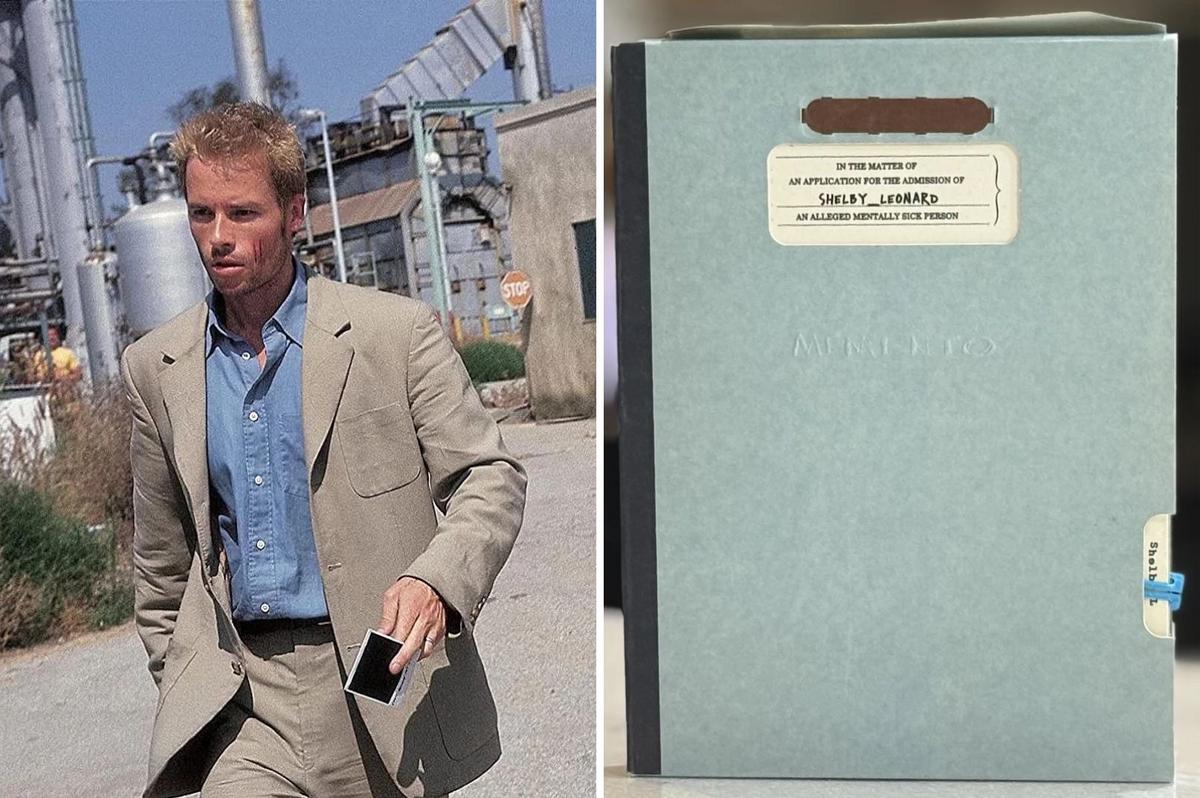
On March 16, 2001, Christopher Nolan’s Memento opened in movie theaters. Its ingenious non-linear narrative forced viewers to completely rethink every unwritten rule about cinematic story structure.
On May 21, 2002, Christopher Nolan’s Memento came out on a limited edition DVD. Its complex web of onscreen menus forced viewers to completely rethink every unwritten rule about home video formats — in the most annoying and least user-friendly way possible.
On paper, at least, the concept made some sense. Memento — directed and written by Nolan from a story by his brother Jonathan — is a movie told out of chronological order. Its protagonist, Leonard Shelby (Guy Pearce) suffers from a form of amnesia. After a violent attack, he loses the ability to form new memories. Every few minutes he forgets whatever has recently transpired and can only recall his life up until the moment he was beaten and his wife was killed.
That event not only permanently warped Leonard’s mind, it refocused his life toward a singular purpose: Revenge. Despite his condition, Leonard uses an elaborate system of photos and messages to lead himself through an investigation into his wife’s murder.
Most of Memento is presented in reverse, with each new scene transpiring chronologically prior to the one that preceded it. But it’s even more complicated than that; Nolan tells Leonard’s story along multiple timelines that he frequently jumps between. As a result, Memento’s story is as disorienting on the 50th viewing as it is on the first.
In that sense, Nolan’s bold formal gambit is more than a gimmick; it imparts the audience with a taste of Leonard’s addled subjective experience of the world. Inside Memento, moviegoers are always just as lost as Leonard is in his everyday life.
In this video, Nolan attempts to explain Memento’s temporal trickery.
READ MORE: 20 Essential Criterion Collection Discs Every Movie Lover Should Own
From the moment Memento hit theaters 25 years ago — and boy does that sentence make me feel like I have anterograde amnesia because I would swear it was just, like, a decade ago — fans tried to deconstruct and reassemble its jumbled timeline into a straight-forward chronology. They made charts and graphs, and analyzed Leonard’s journey step by befuddled step. But even when you see Memento assembled as an infographic — like this one on its Wikipedia page — it’s still confusing.
That’s why there was such fervent demand for a chronological cut on DVD, something that Nolan actually provided about 14 months after Memento’s first release to theaters. But he and the team at Columbia TriStar Home Entertainment who produced the limited edition Memento set decided that anyone who wanted to watch the reconstructed cut was going to have to work for it.
In honor of Memento’s 25th theatrical anniversary, I dusted off my old Memento DVD and popped it into my PlayStation to see how it holds up all these years later.
The Impenetrable Memento Limited Edition DVD
In 2002, Memento was released on a limited edition DVD filled with all the coolest special features a fan of the movie could — if they could figure out how to access them.
There are uglier box sets from back in the 2000s, but none that I know of that���s harder to navigate or more useless without access to the internet than this one. Your best bet is to print out the menu instructions from a website like this one so you always have them handy. Well, that or tattoo them on your body with a ballpoint pen.
Memento’s limited edition DVD wasn’t as annoying as I remembered; it was actually far more aggravating. But maybe that was the point to this absurd exercise. After all, Memento teaches us that nothing is more deceptive than our own memories.

DVDs That Sold For Shocking Amounts of Money
These DVD discs and box sets recently sold for hundreds of dollars eBay.