
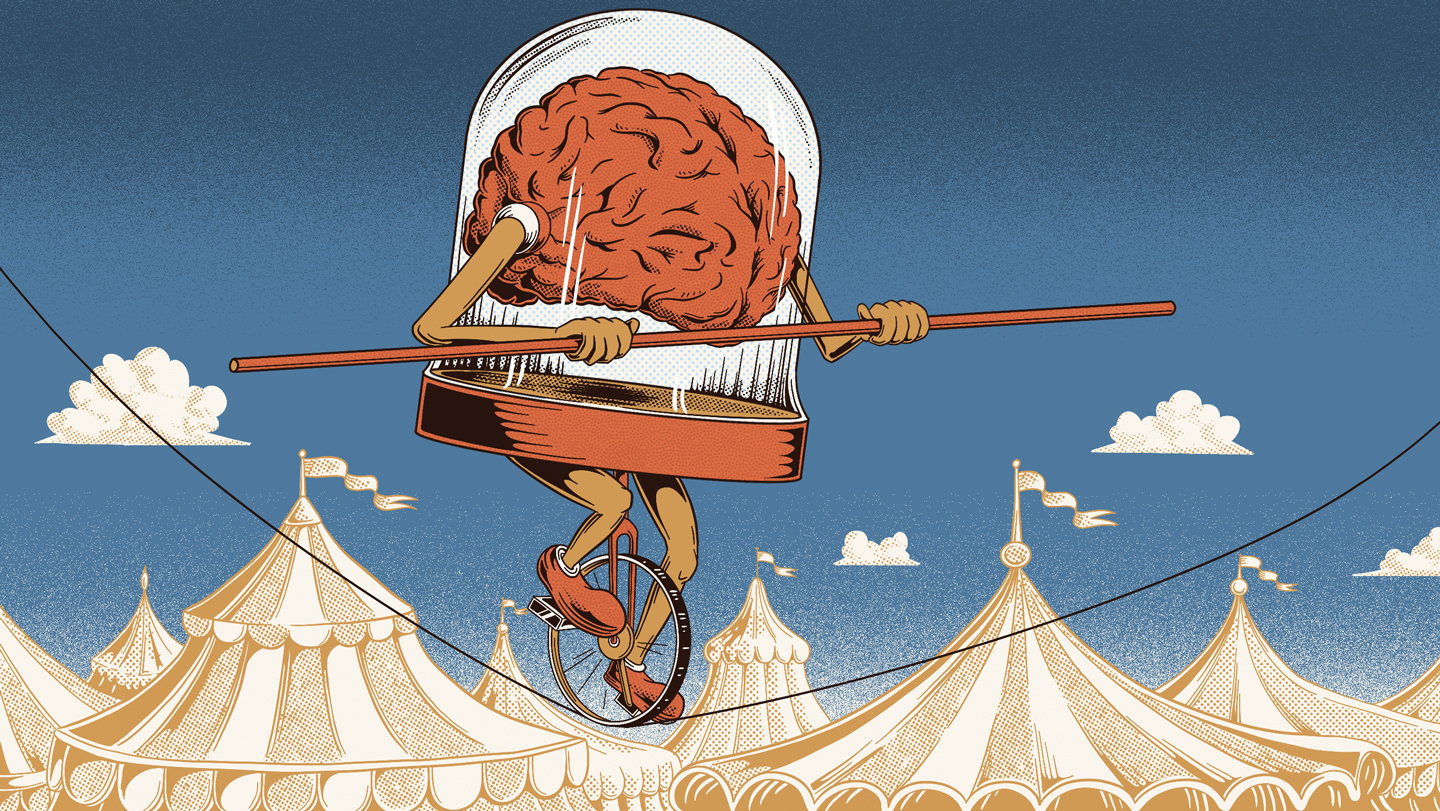
Clumps of mouse brain cells about the size of peppercorns can gain the knowhow to perform a virtual circus trick.
With some coaching, these mouse brain organoids learned to keep a pole upright on a virtual moving cart — the video game equivalent of balancing a ruler vertically on your palm — researchers report in the Feb. 24 Cell Reports.
The organoids didn’t retain that knowledge for long, says cognitive neuroscientist Ash Robbins of the University of California, Santa Cruz. But ultimately, researchers hope that brain organoids can help them understand how healthy human brains learn, as well as how cognitive disorders such as Alzheimer’s disease impair this capacity.
To get to that point, the organoids need to show long-term learning memory, but “short-term memory is a very good step towards that,” says neurobiologist Lena Smirnova of Johns Hopkins University. Her team has shown that organoids have the building blocks to learn. Other research has also suggested that human brain organoids can send and receive information but not necessarily use feedback to improve on specific tasks in real time.
In the new study, Robbins and colleagues gave mouse brain organoids a task that demands constant control and has very little room for error. Solving the classic cartpole problem requires wheeling a virtual cart left and right to keep the vertical pole on it as steady as possible. The cell clumps must constantly react as if they were playing a video game, Robbins says. And to keep the pole standing, they have to make the right choice not once, not twice, but every single time.
The mouse organoids sat on a computer chip that allowed them to communicate with the video game’s virtual environment. As an algorithm delivered feedback in the form of electrical stimulation to specific cells within the organoid that seemed to struggle with the task, the researchers could see the pole stand straight, wobble or fall over on a screen.
“It’s literally like watching a friend play a game,” Robbins says.
Organoids that got this coaching, called reinforcement learning, could balance the pole for at least 20 seconds nearly half the time. In contrast, organoids that received random training signals or none at all passed this threshold less than 5 percent of the time.
The organoids played in 15-minute periods and took 45-minute breaks in between, after which they needed retraining. This suggests that long-term learning memory probably requires more complex signals that the organoids lack, such as the dopamine “reward” pathway, says David Haussler, a neuroscientist also at UC Santa Cruz. More elaborate systems in which multiple organoids work together, called assembloids, might retain the skills they gained during training, he says. For example, one organoid could try to learn while another supplies dopamine, rewarding and reinforcing the behavior.
This was not the first time researchers have watched disembodied brain cells play video games. In 2022, single sheets of human neurons learned to play the table tennis simulation game Pong. More recently, the same group of researchers got the brain cells to play Doom, a first-person shooting game, though this work is not yet published. But in both cases, the cells were not coached, so did not demonstrate their ability to learn.
Getting brain organoids to play video games — as cool as it sounds — is not really the point, Robbins says. Rather, the cell clumps give researchers the opportunity to “explore how learning happens and how things [like diseases] change or mess with it,” he says.
And when brain organoids are made from human cells, they are probably a better proxy of learning and memory than lab animals, Smirnova says, because the organoids mimic human physiology and disease more closely. Replicating the experiment with human brain organoids would be a good next step, she says.