
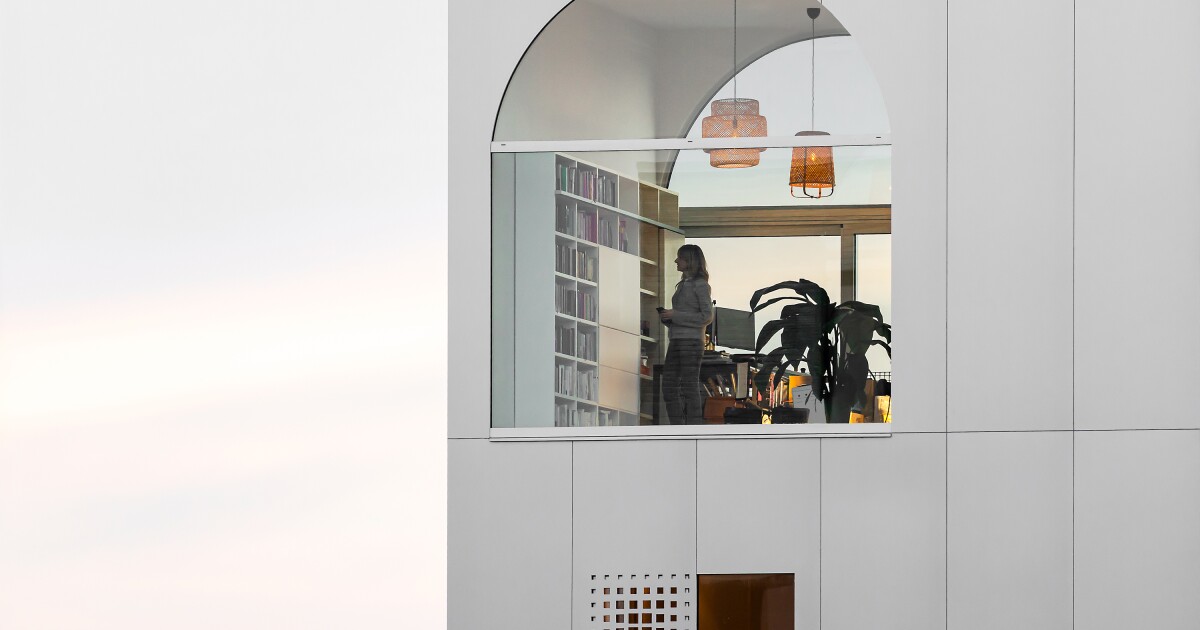
When a couple with two children approached the Amsterdam-based architecture and design firm Studioninedots to design a home that would foster their connection, the company reimagined what a family home could be by throwing out the trasitional floor plan entirely.
Most houses try to cram as much as possible into the ground floor, with bedrooms stacked above. To solve the couple’s particular design puzzle, the studio came up with Light House, a vertical home that places each of the family’s major activities in its own dedicated box and playfully stacks them on top of one another. It was built in Amsterdam’s new Centrumeiland artificial island neighborhood, where the couple lives.

Sebastian van Damme/Studioninedots
How the boxes are arranged matters. They’re positioned inside, above, and below one another, creating open, dynamic spaces that connect with one another while still maintaining their own identities. The family can eat in one box or gather in another. They can even retreat individually to do yoga, watch a movie, or read a book in a box right above the kitchen, which Studioninedots describes as the “beating heart of Light House.”
“Moving through the space that naturally opens among the boxes, you’ll find intimate nooks fit for relaxation or work – or dramatic voids, that trigger maximum interaction and create a stronger sense of the surroundings,” says studio partner Metin van Zij. “This interplay of open and enclosed space inspires new, unexpected ways of use and connection.”

Sebastian van Damme/Studioninedots
The journey ends with a family room situated 14 m (45.9 ft) above everything else. It has tall arched windows and an outdoor terrace where the family can all enjoy stunning views of the lake IJmeer. The studio calls this room the “extroverted holiday home,” and it’s not hard to see why, since this rooftop feels like a destination in itself.
The facade is built to handle privacy quite well. The front has square glass block masonry on the lower half, which lets light in while reducing what’s visible outside by distorting the view. The rear uses steel grating and reflective grey surfaces with the same square geometry as the front. The structure uses a lightweight steel frame infilled with prefabricated timber, which is in line with Centrumeiland’s sustainability requirements.

Sebastian van Damme/Studioninedots
Centrumeiland is a self-building district where residents commission their own homes. Because of this, the couple was able to give Studioninedots a ton of leeway compared to a typical development project. And it shows, with Light House being the product of such freedom. The layout is not fixed either and can change as children grow, priorities shift, and new preferences arise. Its modular design ensures it can adapt to whatever the family needs over time. Light House has not yet achieved its final form.
Other architects are working along similar lines. The pencil-thin DQ Tower squeezes a full home into a very slender footprint, while the EONE XL takes a wider prefab approach to the same basic challenge.
Source: Studioninedots