

A new embedded computing platform integrates a CPU, GPU, and NPU to accelerate industrial AI workloads at the edge.
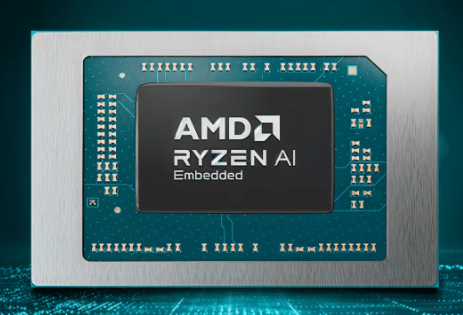
A new embedded processor lineup by AMD aimed at accelerating edge AI and industrial automation workloads has been expanded with higher-performance variants offering increased CPU cores and AI compute throughput. Designed for always-on embedded systems, the processors target applications such as factory automation, robotics, machine vision, and medical imaging, where real-time processing and low-latency AI inference are critical.

The expanded platform integrates CPU, GPU, and neural processing capabilities on a single chip, enabling developers to run complex AI workloads directly at the edge without relying on cloud processing. The new variants increase processing capability while maintaining the same compact footprint used in embedded and industrial systems.
The key features are:
- Up to 12 Zen 5 CPU cores for high embedded compute performance
- Integrated RDNA 3.5 GPU and XDNA 2 NPU for heterogeneous AI acceleration
- Up to 80 TOPS AI performance for edge inference workloads
- ROCm software stack support for scalable AI deployment
- Designed for industrial automation, robotics, machine vision, and medical systems
The processors feature up to 12 “Zen 5” CPU cores, combined with RDNA 3.5 integrated graphics and an XDNA 2 neural processing unit (NPU). Together, the heterogeneous architecture delivers up to 80 TOPS of AI performance, enabling high-throughput AI inference for robotics perception, machine vision, and edge analytics applications.
Compared with earlier embedded platforms, the new processors can provide up to 39% higher multithreaded CPU performance and over twice the total AI compute throughput, enabling developers to consolidate multiple workloads on a single platform. This allows industrial PCs to run machine vision, PLC control, and human-machine interface (HMI) tasks simultaneously.
The architecture is optimized for mixed-criticality edge systems, supporting virtualization frameworks that allow Linux, Windows, Ubuntu, and real-time operating systems to run in isolated domains on the same hardware. This capability is particularly important for industrial environments where safety-critical and AI workloads must coexist without interference.
Support for the ROCm open-source software stack also enables developers to accelerate AI deployments and run advanced models, including large vision-based AI workloads, directly on embedded systems.
The processors are currently sampling to customers, with production shipments expected from mid-2026, and are already being adopted by embedded hardware vendors building computer-on-modules and industrial edge platforms.