
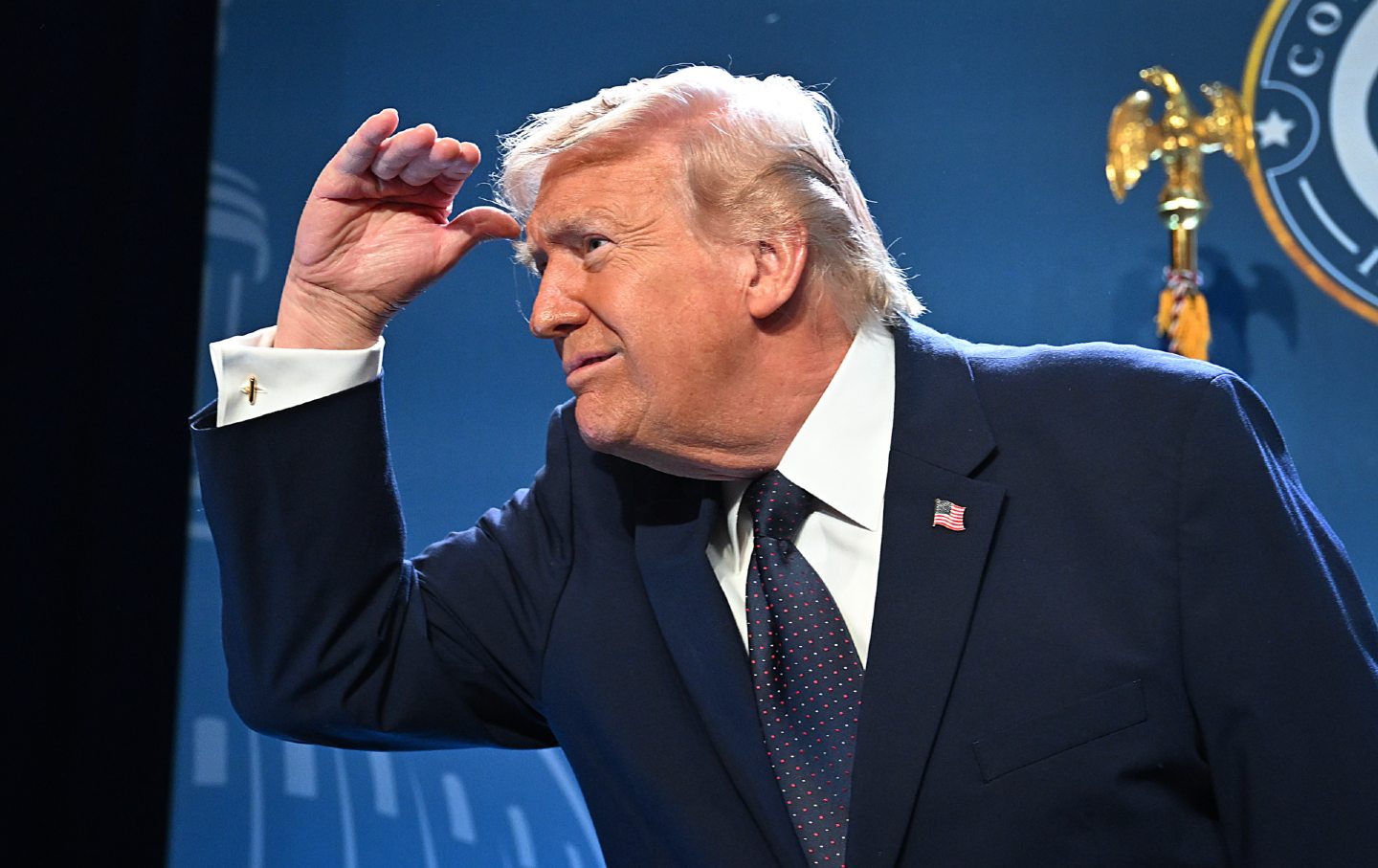
Trump’s press conference dedicated to stabilizing global markets was filled with delusions and wish-fulfillment fantasies about a peaceful, compliant planet.

President Donald Trump leaves the stage after speaking to the Republican Members Issues Conference at Trump National Doral Miami on March 9, 2026, in Doral, Florida.
(Roberto Schmidt / Getty Images)
After declaring from his Doral, Florida, golf resort that the war he launched with Israel last week is “very complete,” President Donald Trump held a press conference dedicated to stabilizing global financial markets that tanked for much of Monday amid spiking oil prices. In between, he hosted a confab of top Republican Party donors and a gathering of the party’s congressional conference that kicked off with a North Korean–style minute-and-a-half-long standing ovation for the Maximum Leader. Trump’s frantic pronouncements on the historically unpopular and ecologically catastrophic Iran war were no more convincing than the symbolism of an announcement that economic conditions would be trending upward after the Iran “excursion” in America’s already inflation-battered, job-starved economy from a private golf club.
Yet, as Trump declared earlier in the day to CBS News, wrapping up the Iran war “is all in my mind, nobody else’s”—and the same glorified mind-cure formula holds for his declarations on the war’s calamitous economic fallout. This is, after all, the president who continually hails the onset of an economic golden age for the country as the cost of living spirals, new hiring flatlines, and trade policy has devolved into a long pratfall.
Trump’s press conference was basically an extension of the delusions and wish-fulfillment fantasies that studded his interminable State of the Union address last month. He began with a litany of the war’s achievements—the disabling of Iran’s navy and air force, the immobilization of 90 percent of its missile program, and ongoing US and Israeli bombing raids. Then, without missing a beat, he declared that the political objective behind the war was to install a new “head of the country who would be able to do something peacefully for a change”—since, as we all know, the way to ensure a country’s peaceful compliance is to bomb the shit out of it and kill more than 1,000 civilians, including some 160 students at a girls school.
He segued awkwardly from last June’s bombing assault on Iranian nuclear facilities—which he likewise claimed at the time to be a devastating blow to the country’s nuclear ambitions on a par with the Hiroshima attack—to the specter of a lethally armed Iran poised at any moment to “take over the Middle East” and wipe out Israel. Trump’s performance didn’t call to mind a composed commander in chief spelling out objectives, tactics, and exit strategies so much as a jumpy cable viewer clicking from Fox News to a History Channel segment on the Six-Day War.
Current Issue

The same edgy, self-contradicting outlook shaped his comments on the war’s economic disruptions. “We’re also focused on keeping energy and oil flowing to the world,” Trump announced, and then toggled back into reveries of maximum military damage—which hardly seems like a formula for smooth oil transport from the Persian Gulf. “If Iran has anything to do with” disrupting the flow of oil, he threatened, “they’ll get hit at a much much harder level,” without of course noting that the bombing campaign is what’s caused oil prices to spike and investors to panic. Somehow, he insisted, the end result of all the bombing, the deliberate targeting of oil reserves and desalination plants, and the war’s mass civilian casualties would be a more stable oil supply “in the long run.”
In depicting the effort to keep ships moving through the Strait of Hormuz—which is a vital chokepoint not only for oil but also other basic staples such as fertilizer for American farmers at the start of planting season—Trump deployed the same stereopticon account of utmost security alternating with utmost carnage. “The Strait of Hormuz is going to be safe,” he started out, citing anti-mining operations there. But before you knew it, he was back to the admiring accounts of America’s vastly superior military might: Iran couldn’t threaten the strait’s commercial operations, after all, since “most of their ships are down at the bottom of the sea.” With the United States calling the shots in the region, he continued, “it will not be possible for [Iran] or anybody else helping that section of the world to recover.” And once again, the jarring segue to the ideal takeaway for US consumers: “The result will be lower oil and gas prices for American families.” Because what says minimal economic disruption like a massive regional attack on a major Gulf power without any clear rationale or plan of exit?
Indeed, what was missing from all of Trump’s word-pictures evoking a stabler, more compliant Middle East in the wake of the US-Israel war was any accounting for the agency of Iran—a country of 90 million whose military is in fact far from destroyed—or the neighboring powers being rapidly drawn into the widening conflict. Israel has used the Iran war as a rationale for resuming attacks on Lebanon, forcibly displacing more than half a million civilians as it claims to be targeting Hezbollah’s financial network. Iran’s decision to replace the country’s supreme leader, Ayatollah Ali Khamenei, killed in the conflict’s initial bombing campaign, with his more hard-line son, Mojtaba Khamenei, is but the most telling recent development indicating that Iran’s leaders don’t remotely intend to keep to the hastily drafted and serially revised script that White House war planners are forcing on them. It’s stunning that in the horrific aftermath of the forever wars launched during the George W. Bush years, the notion of imperial blowback remains unthinkable in the sanctums of US diplomatic and military power.
But that’s par for the course in a presidency that continues operating as if it were immune to the forces of history, economic gravity, or indeed consensual reality. Fielding questions from reporters after his remarks, Trump spoke of American designs on Cuba—a prospect that sent Trump lapdog Lindsey Graham into unseemly heat on a weekend cable hit—again in argot of the bored TV viewer: “They’re going to make a deal or else we’ll do it—just as easy anyway.” That’s evidently just how the world looks when you believe you’re empowered to dictate its fate “all in my mind, nobody else’s.”
Even before February 28, the reasons for Donald Trump’s imploding approval rating were abundantly clear: untrammeled corruption and personal enrichment to the tune of billions of dollars during an affordability crisis, a foreign policy guided only by his own derelict sense of morality, and the deployment of a murderous campaign of occupation, detention, and deportation on American streets.
Now an undeclared, unauthorized, unpopular, and unconstitutional war of aggression against Iran has spread like wildfire through the region and into Europe. A new “forever war”—with an ever-increasing likelihood of American troops on the ground—may very well be upon us.
As we’ve seen over and over, this administration uses lies, misdirection, and attempts to flood the zone to justify its abuses of power at home and abroad. Just as Trump, Marco Rubio, and Pete Hegseth offer erratic and contradictory rationales for the attacks on Iran, the administration is also spreading the lie that the upcoming midterm elections are under threat from noncitizens on voter rolls. When these lies go unchecked, they become the basis for further authoritarian encroachment and war.
In these dark times, independent journalism is uniquely able to uncover the falsehoods that threaten our republic—and civilians around the world—and shine a bright light on the truth.
The Nation’s experienced team of writers, editors, and fact-checkers understands the scale of what we’re up against and the urgency with which we have to act. That’s why we’re publishing critical reporting and analysis of the war on Iran, ICE violence at home, new forms of voter suppression emerging in the courts, and much more.
But this journalism is possible only with your support.
This March, The Nation needs to raise $50,000 to ensure that we have the resources for reporting and analysis that sets the record straight and empowers people of conscience to organize. Will you donate today?