
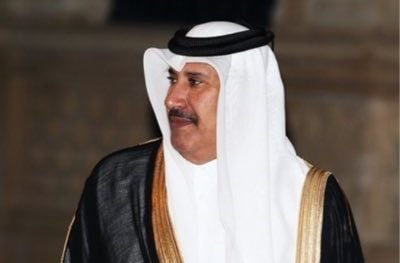
Sheikh Hamad commended Qatar’s efforts to repel the attacks and ensure the safety of the country’s population.
In an interview with BBC Arabic on Monday, former Qatari Prime Minister Sheikh Hamad bin Jassim bin Jaber Al Thani said the current war between Iran, the United States, and Israel will see no “decisive victory” by any party, adding that Israeli Prime Minister Benjamin Netanyahu sought to drag the Gulf into the escalation.
“If anyone believes that there will be a decisive victory, that person is mistaken[…]There has certainly been damage to Iran, and also to neighbouring countries, but Iran will not surrender in the sense of the surrender that the Israelis and Americans want,” he said.
Sheikh Hamad’s remarks came amid heightened regional escalations following the outbreak of war between the U.S., Israel, and Iran. The war began on 28 February when the U.S. and its ally, Israel, launched strikes on Iran despite negotiations taking place to calm tensions between Washington and Tehran.
The war caused regional instability, with Iran launching attacks on Gulf countries, including Qatar, which it claimed were aimed at U.S. interests.
Commenting from his point of view as an analyst, Sheikh Hamad said the operations “began without proper calculations”.
“The objective seemed to be a quick victory or even a swift internal uprising in Iran, but none of these things happened,” he explained.
U.S. President Donald Trump repeatedly outlined his goals for the war, including destroying Iran’s missile capabilities and preventing it from developing a nuclear weapon. He also framed the strikes as bringing “freedom” to the Iranian people.
The attacks on the first day of the war killed Iran’s Supreme Leader Ali Khamenei. However, his son, Mojtaba Khamenei, was appointed as his successor a week later — a move that was seen as a major blow to Israel and the U.S.
Meanwhile, Iran’s attacks on the Gulf were met with rejection from the region and beyond. Sheikh Hamad said that dragging the Gulf countries into the war was among Netanyahu’s objectives.
“We are neighbours and we’ll remain neighbours forever,” Sheikh Hamad said about Iran. “But I repeat: this is what Netanyahu wanted, to drag us into this confrontation with Iran and place us in this situation. Iran must reconsider this matter and look at its interests,” he told BBC.
Qatar has repeatedly condemned the Iranian attacks on its territory and the region as unjustified. This was echoed during a phone call on 4 March between Qatar’s Prime Minister and Minister of Foreign Affairs, Sheikh Mohammed bin Abdulrahman Al Thani, and Iranian Foreign Minister, Abbas Araghchi.
On Monday, Qatar’s Ministry of Defence announced that the country was subjected to an attack involving 14 ballistic missiles and several drones launched from Iran.
Qatar’s Armed Forces intercepted all drones and 13 of the missiles, while one missile landed in an uninhabited area without causing any casualties.
Sheikh Hamad commended Qatar’s efforts to repel the attacks and ensure the safety of the country’s population.
“We see that Qatar is repelling the attacks through the efforts of its own people and its armed forces, which have performed an honourable role. I cannot fully describe the fear that existed during the first three days and the confidence that now exists among Qatari citizens and residents,” he said.
The war has had a significant impact on the global economy, particularly following Iran’s closure of the vital Strait of Hormuz. Iran maintains that the strait was not completely closed but barred to American and allied ships, while others are allowed to pass.
The Strait of Hormuz, located between Oman and Iran, is one of the world’s most critical routes for crude oil shipments.
Sheikh Hamad said he believed that “there will be uncomfortable consequences economically” globally if the war continues for more than two weeks, noting that matters concerning the strait would be essential in potential negotiations.
“If the [Strait of Hormuz] is opened militarily and goods and fuel pass through it, the negotiations will take a different direction. If the strait is not opened,” he said, noting that the war would take place for at least two more weeks.
“I do not expect to see a quick end. I think the situation may continue for at least two weeks before we hope the U.S. declares victory and stops the fighting,” he explained.
The former Qatari prime minister stressed that the issue is now “finding [a finish] line” to the war.
“The issue now is finding [a finish] line. How will the U.S. president announce the end of this crisis? And whether the other side, Iran, will respond or not to ending the operations as we or the Americans want,” Sheikh Hamad said.
“The responsibility lies with whoever started this operation to end it as quickly as possible and without causing harm to the countries that did not cause this crisis,” he added.