
The very first motorcycle from a relatively new company is often a stepping stone. More often than not, it would likely be a small displacement street bike made for the masses with white-labeled components, barebones tech, and definitely not a liter-class engine.
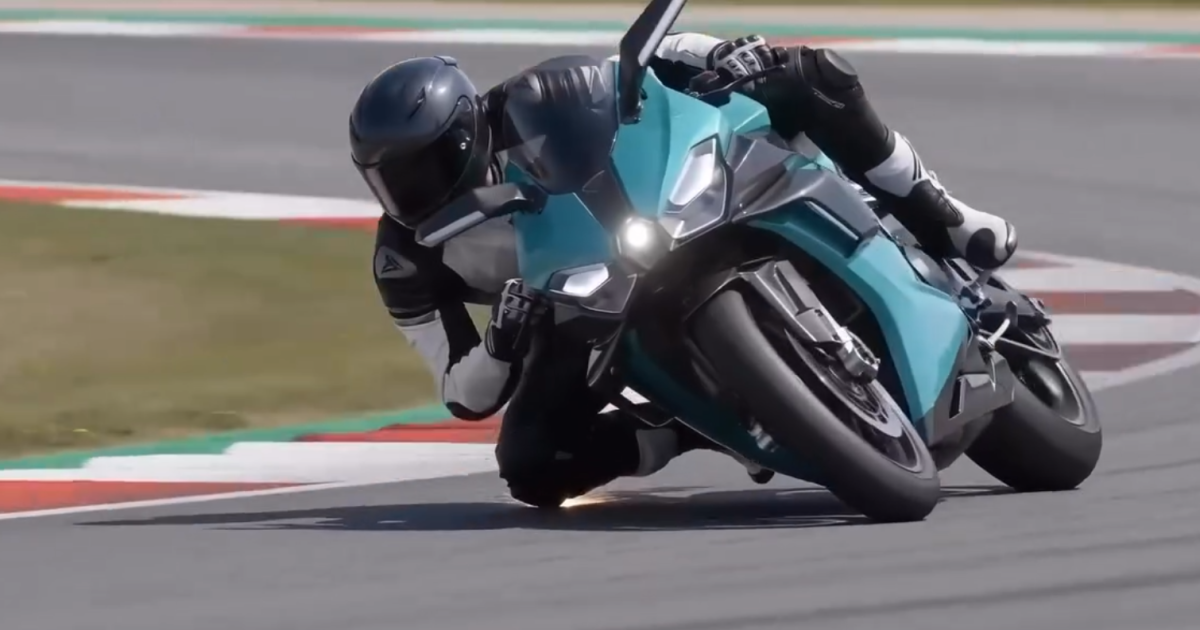
Guruma, a relatively new name in the automotive sector, doesn’t follow that roadmap. At the recently-concluded AWE (Appliance & Electronics World Expo) in Shanghai, the Chinese company presented the 1000 RR.
Before we dive into the motorcycle, here’s something about the brand. Guruma is actually a new mobility technology sub-brand of the Chinese business conglomerate Fengxun. AWE saw not just the premiere of the motorcycle, but Guruma as a brand in itself, alongside its very first vehicles that included a ”smart” aircraft. Wild, right?
But many ‘new motorcycles’ that come out of China follow the imitation route. They’re often like-for-like copies of successful European and even Japanese models in affordable, low-displacement packages. I hate to say it, but it looks like the Guruma 1000 RR follows exactly that route. Except it takes from a fellow Chinese brand.

Guruma
As Motorrad first pointed out, the 1000 RR borrows from QJ Motor, right from its design to the motor used. Yup, the same QJMotor that itself borrow a lot from MV Agusta. Does that make the 1000 RR a copy of a copy? In many ways, yes. But there’s also more than meets the eye.
Sure, the 1,051cc inline-four engine seems to be the same as the one on the QJMotor SRK 1051 RR, which produces 150 hp, 77.4 lb.ft (105 Nm) of peak torque, and a top speed of 161 mph (260 km/h). That engine is itself a reworked old MV Agusta 921 motor with double overhead cams.
And sure, that design looks similar to not just the QJMotor SRK 1051 RR but a lot of QJ Motor’s models, which are themselves inspired by original MV Agusta designs. The quad exhaust pipes, the frame, and the single-sided swingarm all scream MV Agusta. Right then … it is in fact a copy of a copy of a copy.

Guruma
So why am I covering another Chinese copy? The answer is the tech in there. The superbike comes equipped with a six-axis IMU and millimeter-wave radar alongside front and rear cameras. These sensors and cameras, boosted by AI, offer complete 360-degree coverage. Yes, even detecting blind spots.
That’s technically the same sort of tech you’ll find on autonomous cars, but on a motorcycle. This system monitors approaching obstacles and analyzes road conditions for you. Guruma claims that the AI on board even goes as far as “predicting the curvature of the curves and how the grip of the asphalt changes.” But ‘monitoring’ isn’t all that this system does.
The bike knows at all times if you approach an obstacle too quickly or if the tarmac is more slippery than usual, and warns you in real time. All of this is made possible by a mainframe that gets updates wirelessly. The motorcycle apparently receives OTA software updates to improve the accuracy of its driving aids. For the motorcycle sector, this is a true revolution that creates previously unheard-of opportunities for active safety and accident avoidance.

Guruma
Elsewhere, I can spot a fresh front fascia with LED lights that thankfully does not look lifted off of QJMotor/MV Agusta. The photos also suggest that the motorcycle comes fitted with a large screen (sizing unknown) to tinker with the electronics. I can also spot adjustable upside-down telescopic forks and a steering damper from Marzocchi. And that’s about it for now.
As for availability, we still don’t know when or where the bike will launch. As of right now, the 1000 RR is only meant for the Chinese market. There’s zero news about a price, launch timeline, or any plans to export to other countries. And even if that were to happen, the bike would have to go through all the homologation processes, certifications, and so on and so forth.

Guruma
But the real question is, do we really want this kind of tech in motorcycles? There’s a thin line between assistance and interference, and motorcycles have always lived right on that edge.
What works for autonomous cars may not work as intended for liter-class superbikes, too. The appeal of these kinds of motorcycles isn’t just the speed – it’s the responsibility that comes with it.
As motorcycle riders, we want to feel the road, read the surface, and judge grip with our own instincts. So when something like the Guruma 1000 RR starts promising to “think ahead” for you and adjust to road conditions in real time, it raises a slightly uncomfortable question: are we still riding the bike, or just supervising it?
Because for a lot of us, that unpredictability is the whole point. The tiny corrections mid-corner, the way you roll off slightly when the tarmac looks sketchy, the split-second decisions – that’s the craft of riding. Strip too much of that away, and you risk turning something visceral into something … curated. Sure, the tech could make you faster and safer on paper, but it might also flatten the learning curve that makes motorcycling so addictive in the first place.

Guruma
That said, it’s not entirely black and white. There’s a case to be made for smart systems acting as a safety net rather than a crutch. Motorcyclists would rather have a bike that steps in only when things go wrong instead of one that does everything for them.
Because at the end of the day, if a motorcycle stops demanding your attention, it also stops giving you that sense of reward – and that’s a trade-off many of us wouldn’t be too happy making.
Source: Guruma via Motorrad