
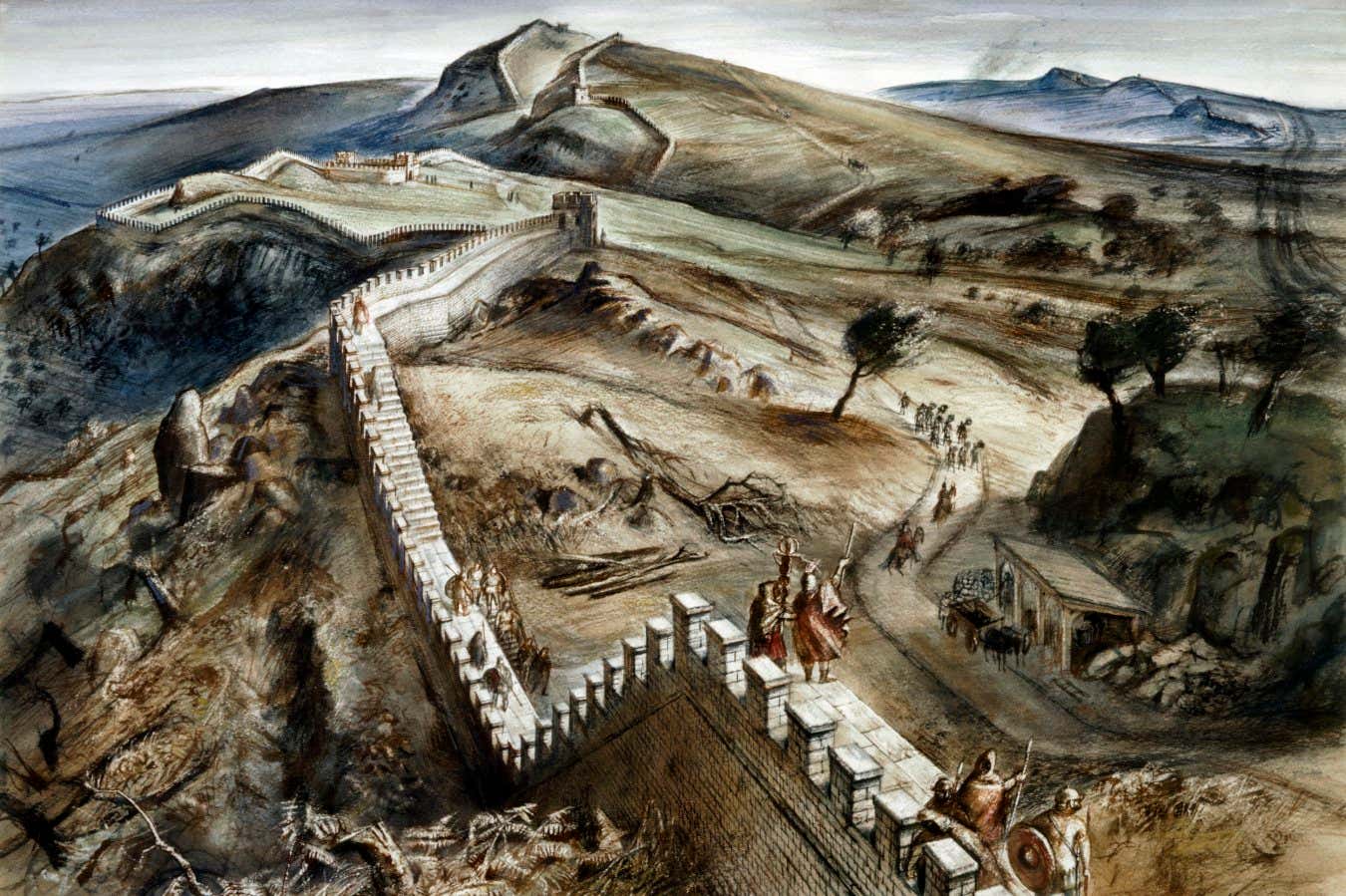

Hadrian’s Wall marked the northern border of Roman territory in ancient Britain
HISTORIC ENGLAND/HERITAGE IMAGES/SCIENCE PHOTO LIBRARY
Researchers are at odds over a claim that droughts helped trigger conflicts in late Roman Britain. Climatologists identified evidence of drought coinciding with unrest and battles, but historians say they have misread key written sources.
The dispute highlights the ongoing difficulties researchers face when trying to integrate data on past climates into the historical record. “You see this time and time again,” says Dagomar Degroot, a climate historian at Georgetown University in Washington DC.
In a study published last year, a team led by Ulf Büntgen, a geographer at the University of Cambridge, analysed tree ring data from oak trees from southern Britain and northern France to reconstruct the climate between AD 288 and 2009.
The researchers identified a series of severe summer droughts in southern Britain between the years 364 and 366. They linked this to the so-called “Barbarian Conspiracy” of 367, when warriors from Britain and Ireland inflicted a series of defeats on the Roman Empire, including kidnapping a senior commander. Although the empire did reassert control, it gradually withdrew from Britain over the next 50 years. Büntgen and his colleagues argued that the drought caused poor harvests, provoking local leaders to rebel against the Romans.
They also expanded their findings to the wider Roman Empire. Using a dataset of 106 battles, combined with tree ring records from across Europe, they found that battles were more likely in the years following dry summers and exceedingly hot years.
The findings were widely covered in the media, including by BBC News, The Guardian and The Telegraph.
Now, though, another group of researchers has published a critical response in the same journal, Climatic Change. “We felt that there were so many issues with the paper that it shouldn’t go unchallenged,” says Helen Foxhall Forbes, a historian at the Ca’ Foscari University of Venice in Italy.
She says the data on past climates is “very interesting”, but the team’s interpretations of historical and archaeological sources are often wrong.
The only source about the Barbarian Conspiracy is Ammianus Marcellinus, a Roman author who lived sometime between 330 and 400. Several decades after the events, he wrote a history of Rome called the Res gestae, only parts of which survive.
Some of the sections describing the Barbarian Conspiracy are “fragmentary” and even “gibberish”, says James Harland, a historian at the University of Bonn in Germany. It isn’t clear what Ammianus meant by “barbarica conspiratio”: while a coordinated uprising is one possible reading, it could also mean raiding, social unrest or many other things.
Likewise, Ammianus describes the British as being in a state of “ultimam… inopiam”. This means something like “utter helplessness”, which could refer to a famine or something else entirely. Crucially, Ammianus says the inopiam was a consequence of the barbarica conspiratio, not a cause. “They simply cannot argue that drought caused a famine, which, in turn, caused a barbarian conspiracy, if they’re relying on what Ammianus says, because that isn’t what he says,” says Foxhall Forbes.
Büntgen and his colleagues have responded, also in Climatic Change. They cite a 1984 paper that interprets “inopiam” as meaning “famine”. However, Foxhall Forbes and her colleagues highlight an in-depth re-analysis published in 2009, which reconsiders the language and historical context of Ammianus’s work.
A further problem is that the conflicts in the battle database aren’t alike, says Dan Lawrence, an archaeologist at Durham University in the UK. While some are pitched battles, others seem to be urban unrest. A food shortage caused by drought might well lead to riots if poorly handled and might even spiral out of control into war, but such narratives would need to be demonstrated somehow.
“They didn’t have a historian on their team who could have told them some of this stuff,” says Foxhall Forbes. While two of the authors are archaeologists, neither specialises in late Roman Britain.
Büntgen says he always works in multidisciplinary groups and his team did include archaeologists of the Roman Empire. He says he would like to see “a constructive debate” where other researchers re-analyse the data or add to it, building on his team’s work. Büntgen adds that most studies of climate and history, including his own, often leave out ecologists, who play a key role in understanding how climatic anomalies influence agriculture. “That’s where most of the studies are very vague,” he says.
Degroot, who wasn’t one of the authors of the critique, says the lack of historical expertise is “a real weakness” of the study. However, he says the study’s core – the tree ring data – remains valuable for historians. “We still do see, now, that droughts probably did happen,” he says. “You can try and clarify in specific case studies whether drought really did have an impact on violence.”
There is always a tension between “minimalist” and “maximalist” interpretations of history, says Degroot. Minimalists tend to focus on the detail of specific events and are reluctant to generalise, so they struggle to generate larger narratives. “They’re better at saying what didn’t happen than what did happen,” he says. “That’s not very interesting.” In contrast, maximalists try to identify overall patterns in fragmentary datasets. “They can create these really impressive narratives, sometimes identifying forces that haven’t been considered before,” he says, but those ideas sometimes turn out to be “built on sand”.
Follow in the footsteps of the Romans on this immersive walking tour along Hadrian’s Wall, one of Britain’s most iconic, ancient landmarks and a UNESCO World Heritage Site. Topics:
Walking Hadrian’s Wall and Roman innovation: England