
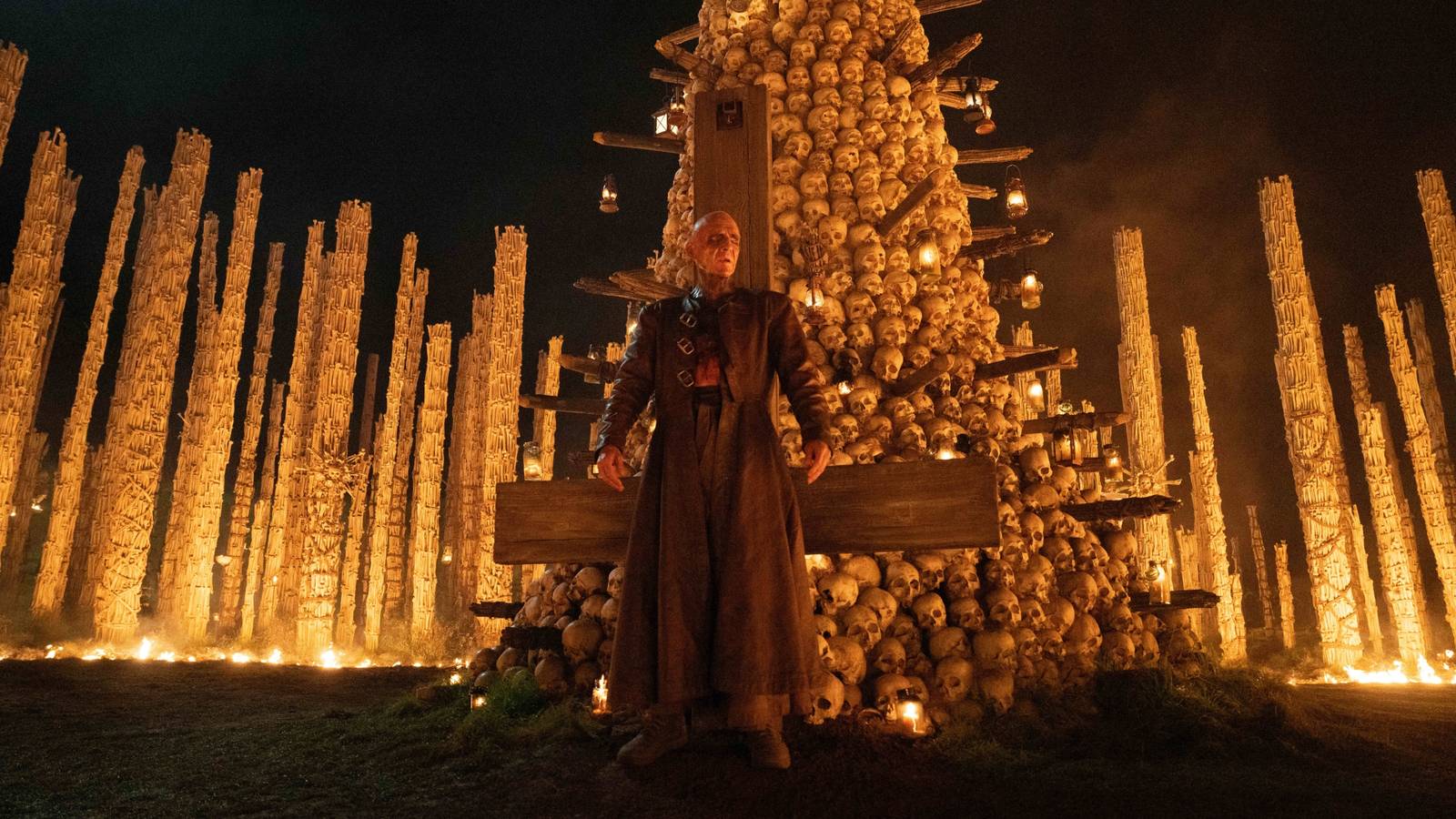
The following contains spoilers for 28 Years Later: The Bone Temple28 Years Later: The Bone Temple uses the symbolism and concept of Satan, otherwise dubbed “Old Nick,” in a way that speaks to the central moral of the film. The second modern sequel to 28 Days Later, The Bone Temple shifts focus slightly to focus more on Dr. Kelson and his moral opposite, Sir Jimmy Crystal.
While Crystal is a vocal champion of Old Nick and among the most horrendous characters in the franchise, Kelson is a noble figure despite his initially horrifying introduction, stripping bodies of their skin to craft his memorials to the dead. Throughout both of their perspectives and actions, the film’s use of “Old Nick” as a thematic throughline is powerful..
The Role Of “Old Nick” In 28 Years Later: The Bone Temple

“Old Nick” is one of the major motifs in The Bone Temple, fitting into the film as the primary motivator for Sir Jimmy Crystal and his Fingers — playing an important thematic showcase for the film’s views on empathy and humanity. Inspired by his father’s ravings during the outbreak, Jimmy believes the Rage Virus is demons escaping into the world.
This supernatural belief is amplified by his faith in Satan, whom he seems to believe was working through his father during the chaos of the Rage Virus outbreak. This is one of the main ways Jimmy can justify his horrifying actions, all while giving him a “royal station” to lord over his followers by being Old Nick’s son.
More than just an extension of Jimmy’s worldview, Old Nick comes to play a very important thematic role in The Bone Temple, especially in contrasting Jimmy against Kelson. Whereas Jimmy has an air of grandeur that he amplifies through his religious ramblings, Kelson is a soft-spoken and self-aware atheist.
Their conversation is one of the most surprisingly low-key moments in the entire film, a chance for both men to recall their past and remember simpler times before the outbreak changed the world. For Jimmy, though, Old Nick has come to represent the ethos of a Rage ravaged United Kingdom.
In Jimmy’s view, the world was beyond repair and needed to be torn apart. Now, he just wants to share that “charity” with anyone he encounters, a cheerful brutality that makes him scarier than even the Infected. By contrast, Kelson has a blunt view of the world and the afterlife.
Kelson also has a deep well of empathy and humanity that allows him to make bonds with people like Spike and his mother in the previous film. He even pulls the humanity out of Jimmy, if only briefly. It’s a far cry from the image he initially presents, with everyone first seeing him from afar as a monster.
Notably, even in a world ravaged by the Rage Virus, Kelson is almost pleasantly surprised at the reminder of Stan. He hasn’t considered the devil as a part of the Rage Virus. Kelson doesn’t see the infected as monsters; he doesn’t see Jimmy as the antichrist. Kelson — and ultimately the audience — just see people.
Why Jimmy’s Final Vision Is So Important To Bone Temple

The concept of Old Nick comes to a head in the finale of Bone Temple. With Jimmy threatening his life, Kelson pretends to be Satan, all so Jimmy can convince his followers to fully commit to him. Allowing Jimmy to escape and be given carte blanche to slaughter more innocents is potentially Kelson’s only selfish act in two films.
However, even then, Kelson can’t go through with it and instead throws off the plan (dooming himself in the process) so that he can save Spike. Despite the themes of the series about the horrors hiding within people — whether assisted by the Rage Virus or not — Kelson proves himself humane and heroic.
This leads to his final moments, comforted by Spike and then visited by Samson, who reveals that Kelson’s cure worked. Because Kelson never gave up on people and saw them as monsters, he found a way to beat back the virus. Through his humanity, Kelson pulled “the devil” out of Samson.
Similarly, for all his posturing and bravado, Jimmy Crystal is still just a traumatized boy acting out of his anger and fear. His final moments, crucified by his former follower, have the monstrous murderer calling out to his mother for help. He’s not the antichrist born to wipe the world clean, he’s a scared boy.
This is exemplified in Samson’s arrival. Appearing to Kelson as a cured friend, Samson gives Kelson peace in his final moments. By contrast, Jimmy hallucinates Samson as Satan, and is left crying in grief when “his father” comes to take Kelson but leaves him behind for the infected to claim.
The images we place on ourselves and on others dictate how we act in the world. The Rage Virus is revealed to cause psychosis, driving the violent outbursts by making the world appear monstrous. Jimmy took his dying father’s ravings to heart and started a faith rooted in murder.
In both cases, “Old Nick” can be taken as justification for their actions, an infection that causes people to lash out wildly. Kelson is the opposite, a man who appears horrifying but proves to be arguably the most moral character in the series. Old Nick is more than just a plot device in The Bone Temple.
The belief in Old Nick gives Jimmy and his compatriots agency to slaughter innocents. It, in essence, lets them see the other people of the world the same way the infected see survivors. Kelson counters that, all while singing Iron Maiden. 28 Years Later: The Bone Temple argues humanity can still shine through, greater than “Old Nick’s” influence.