
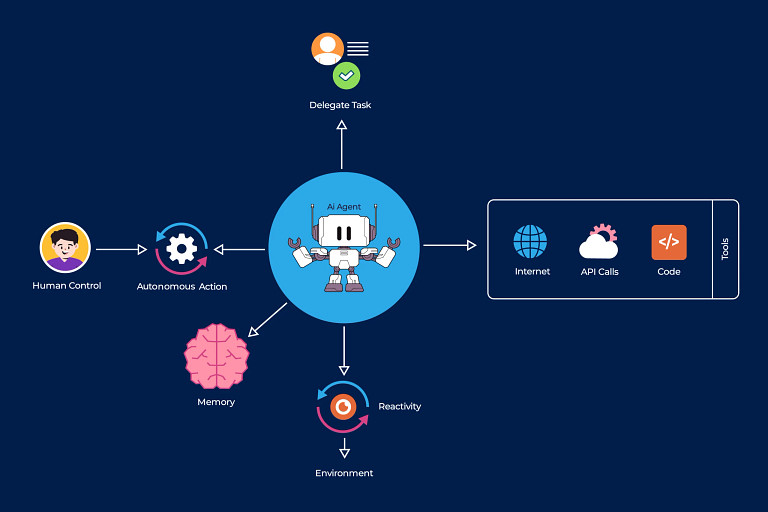
The investment management industry stands at an evolutionary crossroads in its adoption of Artificial Intelligence (AI). AI agents are increasingly used in the daily workflows of portfolio managers, analysts, and compliance officers, yet most firms cannot precisely describe the type of “intelligence” they have deployed.
Agentic AI (or AI agent) takes large language models (LLMs) many steps further than widely used models such as ChatGPT. This is not about just asking a question and getting a response. Agentic AI can observe, analyze, decide, and sometimes act on behalf of a human within defined boundaries. Investment firms need to decide: Is it a decision-support tool, an autonomous research analyst, or a delegated trader?
Each AI adoption and implementation presents an opportunity to set boundaries and ring-fence the tools. If you cannot classify your AI, you cannot govern it, and you certainly cannot scale it. To that end, our research team, a collaboration between DePaul University and Panthera Solutions, developed a multi-dimensional classification system for AI agents in investment management. This article is an excerpt from an academic paper, “A Multi-Dimensional Classification System For AI Agents In The Investment Industry,” which was recently submitted to a peer reviewed journal.
This system provides practitioners, boards, and regulators with a common language for evaluating agentic systems based on autonomy, function, learning capability, and governance. Investment leaders will gain an understanding of the steps needed to design an AI taxonomy and create a framework for mapping AI agents deployed at their firms.
Without a shared taxonomy, we risk both over-trusting and under-utilizing a technology that is already reshaping how capital is allocated, which can lead to further complications down the road.