
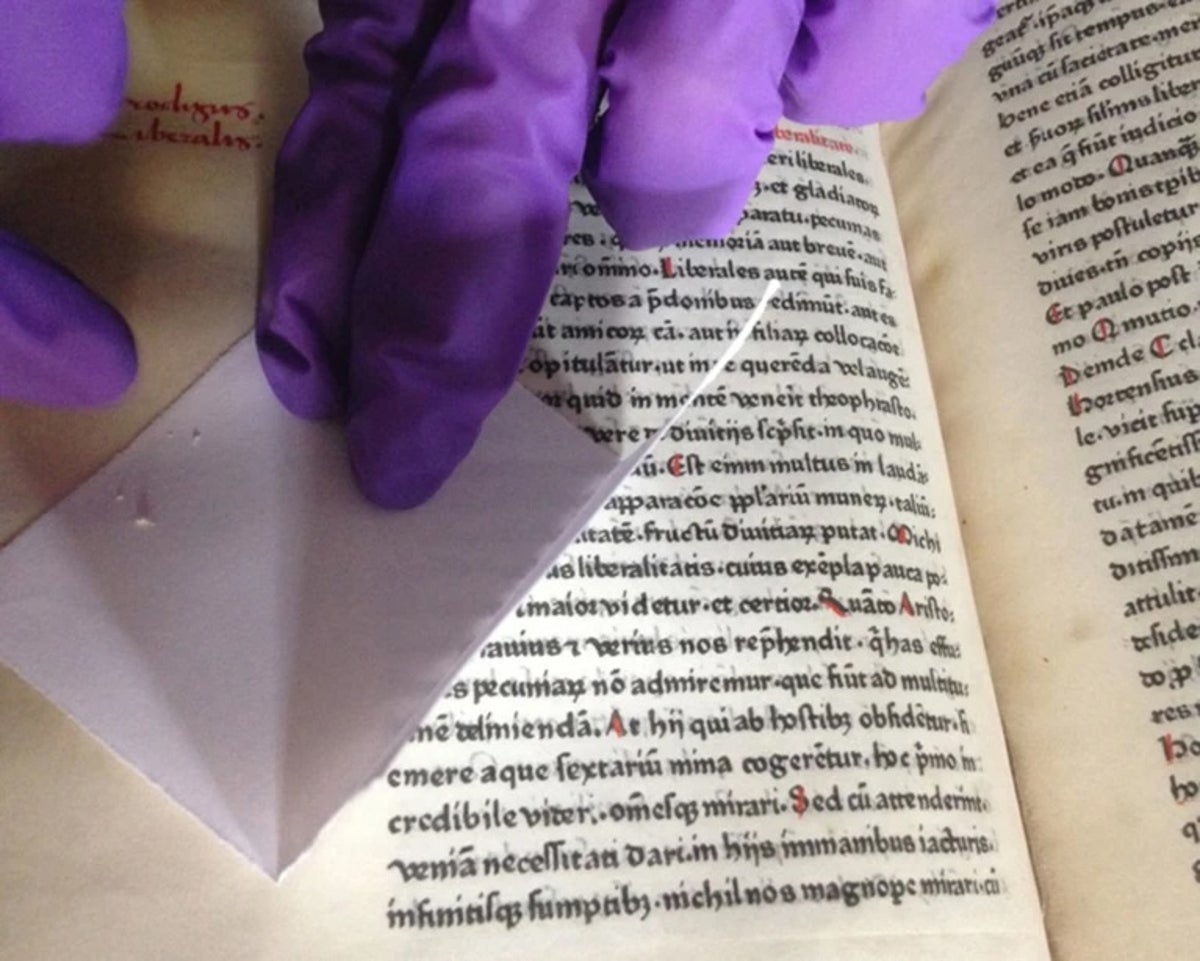
In May 2006, Tim Stinson travelled to England to tour the libraries of London, Oxford and Cambridge. At the time, he was editing a fourteenth-century poem for his PhD at the University of Virginia in Charlottesville, and after months of poring over grainy microfilm copies, he was eager to get his hands on an original. During a visit to Oxford’s Bodleian Libraries — a place so magical that scenes from the Harry Potter films were shot there — he was finally handed one of the manuscripts he had travelled all that way to see. But he found himself so riveted by the physical book that the text it contained became secondary.
The volume was about six centuries old, bound in worn brown leather and composed of 266 yellowed leaves of carefully crafted parchment. It bore the marks of heavy use — faint stains marked the pages and the edges were worn from repeated handling.
“It had its own biography, its own deep history. It seemed like an archaeological site between covers,” recalls Stinson, who is now a medievalist at North Carolina State University in Raleigh. “The parchment even had a vaguely animal smell, albeit a pleasant one.”
On supporting science journalism
If you’re enjoying this article, consider supporting our award-winning journalism by subscribing. By purchasing a subscription you are helping to ensure the future of impactful stories about the discoveries and ideas shaping our world today.
Stinson wondered whether DNA might survive in the animal skins used to make the book’s pages, and whether that DNA could offer fresh ways to date and contextualize manuscripts beyond the conventional markers of handwriting and dialect. His brother, a biologist, said that this was possible theoretically, but warned that the technological obstacles were daunting. The technologies needed — next-generation sequencing methods and associated computational tools for deciphering the data — were still in their infancy. Even if workable techniques existed, conservators were unlikely to allow destructive sampling of irreplaceable cultural artefacts.
Nearly two decades later, that curiosity has helped to give rise to a new field. The development of non-destructive sampling methods, alongside advances in genomics and proteomics, have made it possible to extract biological information from ancient parchments without visibly damaging them. The emerging discipline — known as biocodicology — combines molecular biology with codicology, the study of books as material objects.
The results are transforming how scholars understand human history. By analysing parchment, researchers are uncovering evidence of trade networks, animal husbandry, medical and ritual practices, climate change, epidemics and floods.
In the process, they have found that ancient parchments preserve more than just words.
A biological archive
During medieval times, parchment was Europe’s dominant writing material, used for everything from legal records to sacred texts. It was made by soaking animal skins in lime, stretching them on frames and scraping them thin as they dried. Even after hundreds of years, parchment bears subtle traces of that process: follicle patterns on the hair side, smoother textures on the flesh side and variations that experienced scholars can read almost intuitively. Its durability has long made medieval manuscripts prized historical objects.
In a 2009 article, Stinson argued that parchment manuscripts represent a year-by-year record of animal life and human–animal interactions spanning a millennium. Why, he asked, were zooarchaeologists focused on excavating bones when a vast, precisely dated, faunal archive has been sitting on library shelves for centuries?
The idea caught the attention of Matthew Collins, a biomolecular archaeologist jointly based at the University of Copenhagen and the University of Cambridge, UK. Collins had pioneered a technique known as zooarchaeology by mass spectrometry (ZooMS) to identify the animal species of old bones. ZooMS works by analysing fragments of type I collagen, the predominant structural protein in skin, teeth and bone. Species-specific variations in collagen produce distinctive molecular ‘fingerprints’ when measured in a mass spectrometer.
Collins recalls one excavation project in Scotland for which his team analysed more than 1,000 bone fragments. After three years, they could confidently identify just 29 individual animals. “That was a really disappointing project,” he says. When he realized parchment was made from a similar collagen-rich material — and that manuscripts usually announce when and where they were made — Collins was eager to explore its scientific potential.
Without a trace
Sarah Fiddyment was finishing a PhD in cardiovascular proteomics at the University of Zaragoza in Spain when a chance lecture about applying scientific techniques to cultural heritage inspired her to pursue a postdoc with Collins. Collins asked her to develop a method for identifying the animal species in parchment. Fiddyment planned to obtain samples by shaving a thin strip from the manuscript’s edge. But when she arrived at the Borthwick Institute for Archives in York, UK, the conservators refused to let her bring a knife near their documents. “I was effectively faced with a two-year project that was not going to happen.”
The impasse reflected a long-standing divide between the sciences and the humanities — what British novelist and physicist C. P. Snow called the two cultures problem. Scientists are accustomed to drilling into fossil cores or snipping feathers, whereas scholars typically consider even the smallest injury to a medieval page anathema. Any method of sampling the biological material in parchment would therefore have to clear an unusually high bar: its effects would need to be effectively invisible, even under a microscope.
Collins recalls that tense moment in the Borthwick archives as a turning point. “‘No’ is a really powerful word for scientists,” he says, “because it makes you kind of think around corners.” Fiddyment spent a month at the archives observing the conservators. She noticed that they routinely cleaned parchment using blocky white erasers, the kind that grace many a primary-school desk. So, she asked whether she could have the eraser crumbs. “Those little fragments you generate that you blow away, those are the bits I collected, and we found that that worked beautifully.”
The crumbs, which they later called ‘erdu’ for eraser dust, turned out to be molecular gold. When a polyvinyl chloride eraser is pushed across parchment, static electricity lifts microscopic particles from the surface, including collagen and traces of DNA. Fiddyment analysed the crumbs she’d collected using a version of the ZooMS protocol she called eZooMS.
Fiddyment tested her approach on thirteenth-century ‘pocket Bibles’, the tissue-thin pages of which had long been thought to be derived from the skins of animals such as squirrels and rabbits. Her analysis showed otherwise. The parchment was made from the usual suspects: calf, goat or sheep skins. This finding highlighted not that unusual materials were used, but that extraordinary craftsmanship was involved.
But other studies have raised more questions than answers. Stinson recalls the first book he worked on with Fiddyment and Collins: a glossy twelfth-century copy of the Gospel of St Luke. To his practised eye, the manuscript seemed to be made entirely of calfskin. “When the results came back, it blew everyone’s mind,” he says. Testing revealed a deliberate alternation between calfskin and sheepskin. Goatskin was also present, but only immediately after the parable of the prodigal son, which includes the text’s lone mention of a goat kid. “Now, it could be a coincidence, we don’t know,” Stinson says. “But this book is deeply weird.”
Reading residues
Although effective, the method is laborious. It involves rubbing the same patch of parchment until enough crumbs pile up to fill the bottom of a microcentrifuge tube. In the rare-books library at Duke University in Durham, North Carolina, Stinson spent days sampling a single volume. “Honestly,” he says, “it’s like tennis elbow after two days of that.”
While looking for less-punishing alternatives, Stinson partnered with his colleague Kelly Meiklejohn, a forensic scientist whose background includes a postdoc at the FBI Laboratory in Quantico, Virginia. There, she developed methods to identify toxic plants and fungi that had been used as potential biological weapons. These were often in a powdered form and stripped of obvious identifying features.
The team tried a range of non-destructive methods on old manuscripts purchased online. Some ideas were ruled out quickly: the dull edge of a butter knife, forensic fibre-lifting tools used at crime scenes, and even gecko tape, which has microscopic bumps that enables it to adhere to surfaces without the use of chemical adhesives. Although technically non-destructive, the tape kept sticking to the laboratory tweezers and tubes, and contained traces of cow DNA, presumably from the manufacturing process.
Ultimately, the researchers zeroed in on two non-destructive approaches: erasers and soft cytology brushes, the disposable tools used for cervical-screening tests. Comparisons showed that the brushes were easier to use and recovered DNA as effectively as the erasers did.
DNA extracted from parchment is typically fragmented into tiny pieces and present in amounts that are too low to be detected using standard assays. But “we proceed with every sample”, Meiklejohn says, because her lab uses a forensic-style workflow designed for such genetic material.
Her team converts the DNA into sequencing libraries and uses a technique known as hybridization capture to fish out animal sequences of interest. Magnetic RNA ‘baits’, designed to match the mitochondrial genomes of species commonly used in parchment, bind to the target DNA, even when sequences differ by as much as 20% from modern genome references. The enriched material is then sequenced and mapped against a panel of 16 reference genomes, including those of human, dog, pig and various species of deer.
On a computer screen, the results appear as a dense, laddered stack of brightly coloured horizontal bars — short stretches of ancient DNA aligning imperfectly but convincingly with modern references. In repeated tests, results using the brush method matched known species identifications and often exceeded expectations.
However, the approach has its logistical quirks. When Meiklejohn had trouble sourcing the right cytology brushes before a planned research trip to the United Kingdom, she took advantage of the opportune timing of her annual gynaecological exam to ask where they were purchased. The clinic offered to provide her with a few bags, but another supplier eventually came through.
Beyond species
In a collaboration with Duke, the team applied its cytology-brush technique to documents across a vast range of time and space, sampling parchments from the eighth to the twentieth century and originating from Europe, North Africa and the Middle East. The results, yet to be published, draw on 351 samples taken from 91 manuscripts. The researchers identified the source species in 58% of cases. Most samples were from sheep, followed by cattle and goats, with a single curious sample indicative of pigskin. They found that species choice mostly tracked regional patterns; for instance, sheep were the main species used in England and goats in Mediterranean regions.
One thirteenth-century Greek New Testament produced a tantalizing near-match to red deer (Cervus elaphus hippelaphus), but the signal fell just short of the threshold required for a definitive identification.
During a visit to Duke, I joined Stinson as he collected extra samples from that mysterious manuscript. In a quiet reading room, Andrew Armacost, the curator of rare-book collections, had laid out several volumes of medieval manuscripts along a long table beneath clear, even light. The book pages were dense with elegant script in black and red ink — some bound in dark, cracked leather, others reduced to single, orphaned sheets. As we watched, Stinson donned gloves, set a timer and gently swept a brush in slow circles across a blank spot of parchment for one minute before snapping the brush head off into a tube.
Armacost has had to turn down requests for destructive sampling from otherwise promising projects, unwilling to see even one centimetre cut from the collection. He is excited to see non-destructive methods take hold and curious about what they might reveal. “We’ve always sort of thought of [parchments] as textual resources,” he says, “but maybe they have lots of other stories to tell as well.”
An expanding field
Those stories are beginning to come to light. Today, scientists can work out the sex of source animals, classify specific breeds and detect pathogens. For example, researchers have detected sheep pox in numerous parchment samples. Because the virus evolves slowly — about one mutation every two years — scientists can use phylogenetic analyses to date a given strain to within a roughly 50-year window.
Biocodicology can also enable scientists to reconstruct how ancient manuscripts were handled and the environments in which they circulated.
Salt, for example, was essential to medieval parchment production. Because various regions relied on distinct types of salt, the salt-loving — or halophilic — bacteria left on the skins can serve as geographical signatures9. Even insect damage tells a story. ‘Bookworms’ are actually the larvae of various furniture beetles that burrow into medieval book bindings. The exit holes and the DNA the larvae leave behind reveal where the insects — and books — existed. Remarkably, the distribution of these beetles closely tracks the geographical boundaries of the Protestant Reformation. “We call them the Protestant and Catholic beetles,” says Stinson.
Non-destructive methods can also reveal practices that are rarely documented in text. Fiddyment used eZooMS to sample residues from a medieval birth girdle, a religious talisman worn to protect women during pregnancy and labour. From one late-fifteenth-century girdle, she recovered traces of cervico-vaginal fluid as well as evidence of goat’s milk, eggs, honey and various plant species — ingredients drawn from medieval childbirth recipes. “It was the first sort of direct evidence,” Fiddyment says, “that people were actually wearing it.”
Some scientists are even using biocodicology in climate science. To reconstruct historical rainfall patterns, Collins’s group has developed a solvent-based suction technique to extract lipids from ancient parchment. Oxygen isotopes preserved in the lipids record past rainfall and temperature levels, allowing researchers to detect global climate events such as the 1816 ‘year without a summer’, which followed the 1815 volcanic eruption of Indonesia’s Mount Tambora. Taken at scale, Collins suggests, parchment could rival tree rings as a climate archive.
The future
But the ability to pursue such expansive questions varies widely. Whereas researchers in the United States have faced abrupt funding losses, Europe has committed more than €20 million (US$23 million) to biocodicology through European Research Council initiatives such as Beasts to Craft and CODICUM. Collins says that some funding agencies value pushing technologies to their limits, in part because methods developed for ancient manuscripts can have broader applications to modern problems such as food security, medicine and forensic science.
Stinson lost his grant from the US National Endowment for the Arts, but he managed to take another research trip to the United Kingdom last June using funding from his university. This time, he visited the Norfolk Record Office in Norwich, where he collected 100 brush samples from historical manor court rolls. The volume of biological materials available was staggering: the archive holds 1.7 million parchment items, much more than he could hope to sample in a lifetime. “This is just one county,” he says. The UK National Archives in London “have miles and miles” of shelves of parchment. “We’re talking about a massive, massive faunal archive. No one’s ever conceived of it that way.”
At the Norfolk office, Stinson was given a badge that allowed him to wander the facility freely, with the stark warning that if an alarm were triggered, he would have only moments to leave before the fire-suppression system would suck all of the oxygen from the room.
He needs no reminder to be careful. These ancient artefacts are precious, not just because of the text inscribed on their pages, but also because of the biological histories they contain, waiting to be read.
This article is reproduced with permission and was first published on April 7, 2026.