
Choosing the right frontend framework for business projects is one of those decisions that looks simple on the surface but carries real weight once development is underway. The wrong pick can mean slower load times, higher developer costs, limited scalability, or a product that’s harder to maintain a year down the road.
This post breaks down what actually matters when evaluating frameworks, so your team or your development partner can make a call grounded in business reality, not just developer preference.
What Is a Frontend Framework and Why Does It Matter for Business?
A frontend framework is a pre-built collection of tools, libraries, and conventions that developers use to build the visual, interactive layer of a web application. It handles how your product looks and behaves in the browser. For non-technical stakeholders, think of it as the structural blueprint a construction crew uses before pouring concrete. Without it, every project starts from zero.
For businesses, the choice of framework affects how fast the product ships, how much it costs to hire and retain developers, how well the application performs under traffic, and how easily new features can be added.
According to the Stack Overflow Developer Survey 2023, React remains the most widely used frontend framework at around 40 percent adoption, followed by Angular and Vue.js. (source)
That kind of market share translates directly into talent availability and community support, both of which matter when you’re running a business, not a research lab.
How Do You Pick the Right Frontend Framework for Your Business Project?
This is where most businesses go wrong. They let the development team decide based on personal familiarity rather than project requirements. That approach works sometimes, but it leaves business-critical factors off the table. Here is a more structured way to think through it.
Define the type of product you are building
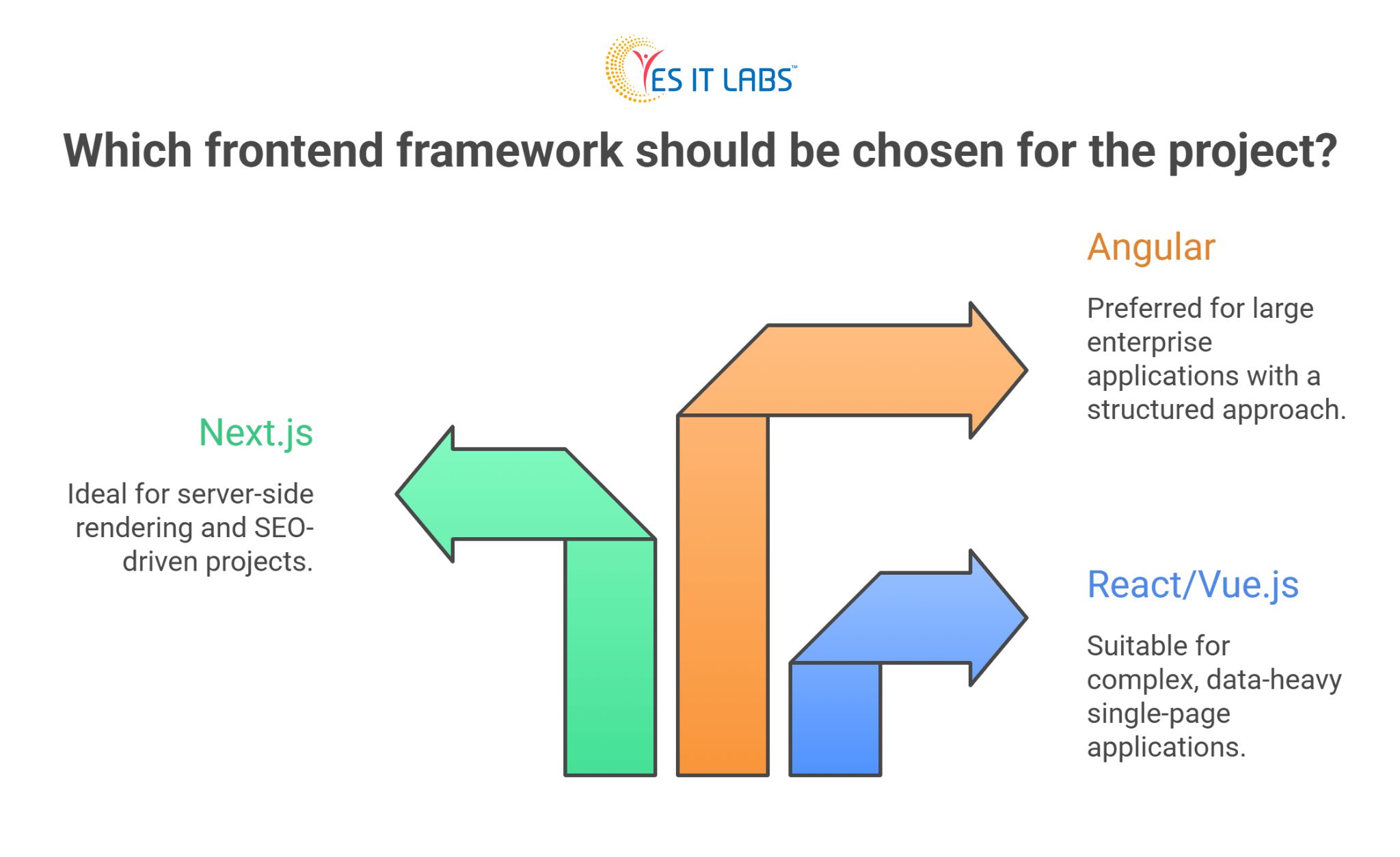
A marketing website, a SaaS dashboard, a customer portal, and a mobile-first application each have different technical demands. React and Vue.js handle complex, data-heavy single-page applications well. Next.js, which is built on React, is particularly strong for server-side rendering and SEO-driven projects. Angular is often preferred for large enterprise applications that need a more opinionated structure out of the box.
Learn more about what makes Angular a strong choice for complex projects, in our blog titled What Is the Advantage of Angular JS?
Consider your team’s existing skills
Switching frameworks mid-project is expensive. If your current team or your outsourced partner already has depth in a particular framework, that familiarity reduces ramp-up time and lowers risk. If you are starting fresh, factor in how large the talent pool is for that framework in your target hiring region.
Think about long-term maintenance
Frameworks with large communities and corporate backing tend to have longer shelf lives. React is backed by Meta. Angular is backed by Google. Vue.js is community-driven but widely supported. Smaller or newer frameworks carry more uncertainty about long-term support, which matters if you plan to maintain the product for five-plus years.
Key Factors to Evaluate Before Making a Decision
Beyond the technical specs, several practical factors should shape your final choice.
Performance requirements
If your application needs to handle high-frequency data updates in real time, like a trading dashboard or a logistics monitoring tool, framework rendering performance becomes critical. Vue.js and React both offer virtual DOM implementations that handle this well. Angular’s change detection model can be optimized but requires more configuration.
SEO and content visibility
For businesses where organic search traffic matters, server-side rendering is a priority. Next.js has become the default recommendation for React-based projects that need strong SEO. If you are exploring alternatives, Nuxt.js serves the same purpose for Vue-based projects.
Many agencies now recommend that businesses hire Nuxt.js developers specifically when the project involves content-heavy sites or e-commerce storefronts where search visibility directly affects revenue.
Integration with existing systems
Your frontend does not operate in isolation. It needs to connect with your backend APIs, your CRM, your payment processors, and potentially your content infrastructure. If your business relies on custom CMS development services to manage digital content at scale, the frontend framework needs to be headless-friendly, meaning it can pull content from a CMS via API rather than being tightly coupled to a specific platform.
Design and no-code flexibility
Some businesses, particularly those with fast-moving marketing teams, need the ability to update pages without developer involvement. In those cases, tools like Webflow have become increasingly relevant. Webflow sits in an interesting middle ground between a visual page builder and a frontend development platform.
For businesses that need rapid landing page deployment alongside a more robust web application, it often makes sense to hire Webflow developers for the marketing layer while keeping the core application in React or Vue.
Here’s what to look for when hiring a Webflow developer for your project through our blog titled- How to Find and Hire the Best Webflow Developers
Framework Comparison: A Practical Breakdown
|
Framework |
Best For | Learning Curve | Talent Availability |
SEO Capability |
|
React |
SPAs, dashboards, large apps | Moderate | Very High | Good with Next.js |
|
Vue.js |
Mid-size apps, fast prototyping | Low to Moderate | High |
Good with Nuxt.js |
|
Angular |
Enterprise apps, complex systems | High | Moderate | Moderate |
|
Next.js |
SEO-driven React apps | Moderate | High |
Excellent |
| Nuxt.js | SEO-driven Vue apps | Moderate | Moderate |
Excellent |
| Webflow | Marketing sites, content pages | Low | Growing |
Good |
This table is not meant to declare a winner. It is a starting point for narrowing options based on your specific situation. A fintech startup building a customer-facing dashboard has different constraints than a manufacturer building an internal operations tool.
Still torn between React and Vue? Here’s a deeper breakdown to help you decide- React JS vs Vue JS
Common Mistakes Businesses Make When Choosing a Framework
1. Choosing based on hype rather than fit
A framework trending on developer forums is not automatically the right choice for your project. Svelte, for example, has generated significant buzz in the developer community, but its talent pool is still relatively small compared to React or Vue, which means higher hiring costs and longer timelines.
2. Ignoring total cost of ownership
The cheapest framework to start with is not always the cheapest to maintain. A framework with a steeper learning curve might require more senior developers, higher hourly rates, and longer onboarding for new team members. Factor in the three-to-five-year horizon, not just the initial build.
3. Skipping the prototype phase
Before committing to a framework at scale, building a small proof-of-concept can surface integration issues, performance bottlenecks, or developer friction early, when changes are cheap. This step gets skipped more often than it should.
4. Treating the frontend choice as isolated
The frontend framework decision ripples into your hiring strategy, your DevOps setup, your testing approach, and your content management workflow. A business that later discovers it needs Vue js developers for hire to maintain a system that was built in Angular faces a real operational problem that a bit of upfront planning could have avoided.
5. Practical Advice for Moving Forward
Start by documenting your product requirements, your expected user base, and your team’s current skill set. Then map those against the framework characteristics covered above. If you are outsourcing development, ask your partner to walk you through their framework recommendation with specific reasoning tied to your project, not a generic sales pitch.
If your project involves significant content publishing, explore headless CMS options early in the process. The combination of a headless CMS with a modern frontend framework like Next.js or Nuxt.js gives you the flexibility to scale content operations independently from application development.
If speed to market is the priority, Vue.js tends to have a lower onboarding barrier for mixed teams. If you are building something complex and enterprise-grade with multiple developers working in parallel, Angular’s opinionated structure can actually be an advantage because it enforces consistency.
FAQ: Right Frontend Framework for Your Business Project
What is the most popular frontend framework for business applications?
React is the most widely adopted frontend framework for business applications, used by approximately 40 percent of developers globally according to recent industry surveys. Its large ecosystem, strong community support, and backing from Meta make it a reliable choice for a wide range of business use cases, from customer portals to SaaS platforms. That said, popularity alone should not drive the decision without considering your specific project requirements.
How does the frontend framework affect website SEO?
Single-page applications built with frameworks like React or Vue can struggle with SEO if not configured correctly, because search engine crawlers may not fully render JavaScript-heavy content. Using server-side rendering solutions like Next.js for React or Nuxt.js for Vue resolves most of these issues by delivering pre-rendered HTML to both users and crawlers, which improves indexing and page speed scores.
Should a small business care about which frontend framework is used?
Yes, even if the technical details feel out of scope. The framework choice affects how quickly updates can be made, how easy it is to find developers if your current team changes, and how well the product scales as your business grows. A small business that launches on an obscure or poorly supported framework may face significant rebuilding costs within a few years.
When does it make sense to use Webflow instead of a traditional frontend framework?
Webflow works well when the primary need is a marketing website or content-driven pages that need frequent updates without developer involvement. It is less suited for complex application logic, user authentication flows, or data-heavy dashboards. Many businesses use Webflow for their public-facing site and a framework like React or Vue for their actual product, which is a practical split that keeps marketing agile without compromising application quality.
How do I evaluate a development partner’s frontend framework recommendation?
Ask them to explain why they are recommending a specific framework based on your project’s requirements, not their team’s comfort zone. A good partner will reference factors like your expected traffic, content strategy, integration needs, and hiring plans. If the recommendation does not connect to your business context, that is a signal worth paying attention to.
Conclusion
There is no universal answer to the frontend framework question, but there is a right process for finding the answer that fits your situation. Start with your product requirements, layer in your team and budget constraints, and think beyond the initial build to what maintaining and scaling the product actually looks like.
The businesses that make this decision well are usually the ones that treat it as a product decision first and a technical decision second. Bring your business context to the table, ask the right questions of your development team or partner, and the right framework will become reasonably clear.