
The courts are issuing rulings that the Trump administration just ignores. And the Supreme Court is going along with it. The federal government is captured, and the resident of the White House is running amok. Worse could well be coming, but something else is happening, too. One of my guests calls it the largest coordinated campaign of state-level opposition in modern American history. States are using the tools that they have in the federal system to oppose what they see is as wrong. Some are considering new legislation that would add to that toolbox. Organized people, meanwhile, are acting defiantly, making clear demands, electing new leaders, and staying engaged in ways that could strengthen our democracy and our economy. What happens next is crucially important, and that depends largely on what people believe can be done.
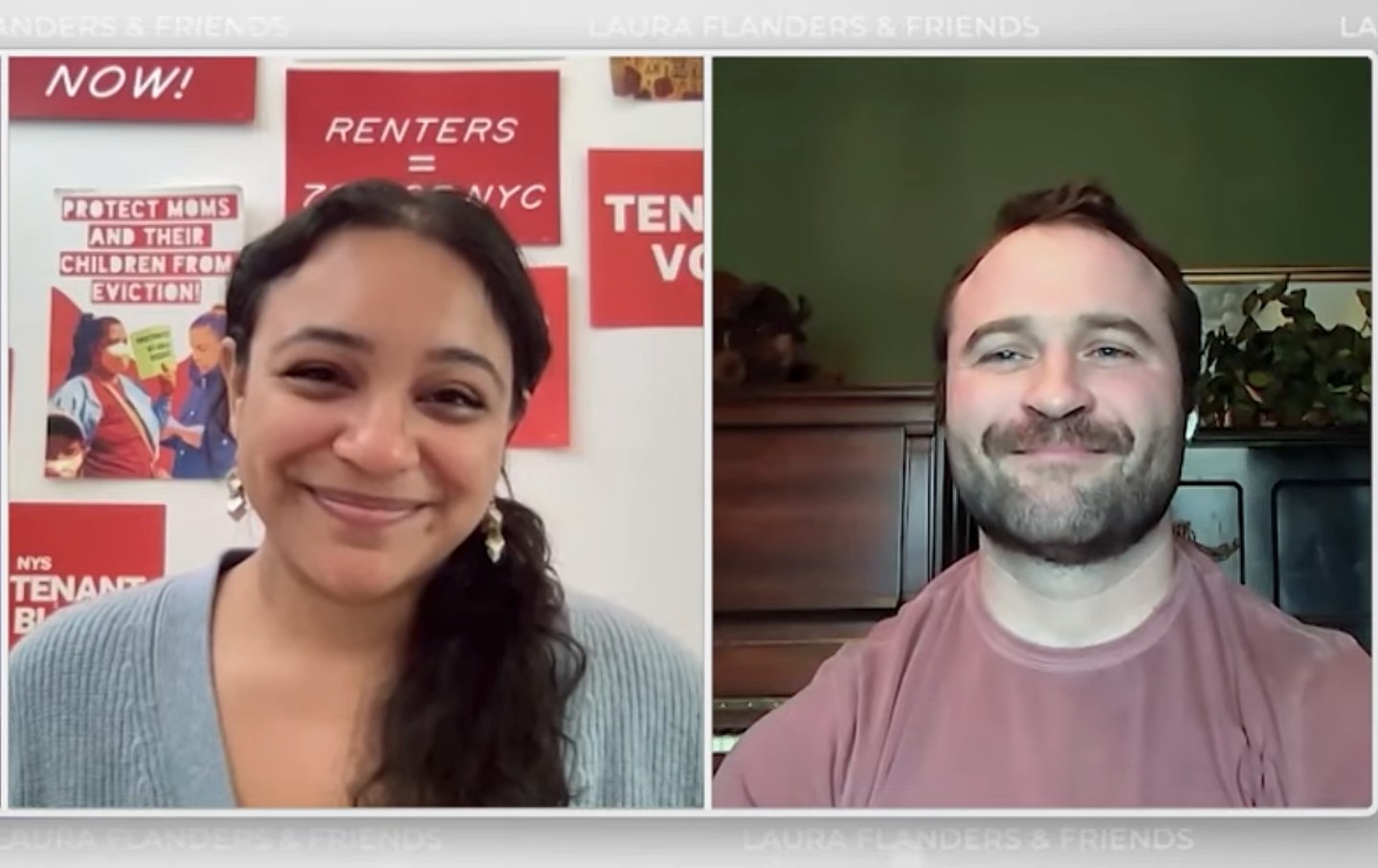
Christopher Armitage is the founder of The Existentialist Republic on Substack. His handbook, Oppositional Federalism and You, offers a framework for what he calls soft secession. Sumathy Kumar is the executive director of Housing Justice for All and the New York State Tenant Bloc, and former co-chair of the New York City Democratic Socialists of America chapter. Under her leadership, she saw six socialist legislators elected to the New York State legislature, including Zohran Mamdani.
Laura Flanders: How do you describe where we are?
Christopher Armitage: The United States has been taken over by a transnational criminal organization called the GOP.
LF: Well, that’s pretty straightforward. How about you, Sumathy?
Sumathy Kumar: I think that’s accurate. There are these two visions. A criminal organization that is stripping people of their wealth, of their dignity, and then a different vision of what life could be like if the government actually worked for people, if they’d put working-class people first. The best example of that is in New York City with the election of Zohran Mamdani.
LF: For many, they hear the word “secessionist,” Chris, and they think of the Southern strategy to defeat federal civil rights legislation. When you use the term, what are you referring to?
CA: I really appreciate this question because it’s one of my favorites to answer, because for so many Americans, secession means defending racism, states’ rights means defending racism. But there is no reason that we should lose the greatest tool that our founders gave us for fighting back against authoritarianism. States’ rights can protect reproductive rights. It can make sure everybody has healthcare. States’ rights can make sure that we have everything that we’ve been fighting for and struggling to win at the federal level. We can have that at the state level, and it doesn’t have to be opposition because at the federal level, there’s a structural imbalance that makes it very easy to regress and very difficult to progress. But at the state level, you can get ahold of your state representatives. You can say, “We want universal single-payer healthcare in this state.” That can happen where you have the most influence, and that’s locally.
SK: Exactly what Chris is saying. This is an opportunity in New York City to build that alternative, structures that give people the things they need, even when the federal government is stepping away. New York is a very progressive state. We have the political power to do this if tenants and people across the state really push their elected officials. We have a lot of billionaires in New York. They could be paying a lot more money in taxes, and if we did tax the rich, we would have money to fill the gaps around Medicaid cuts, housing, food stamps, things that are getting cut right now.
LF: Mayor Mamdani, when he was a state assemblyman, appeared on this program talking about his “Not on Our Dime!” bill, which had to do with reining in charitable status benefits from businesses or charities that supported illegal settlements in the West Bank. You have a model of using state-level fiscal power and corporate benefit power in your toolkit, Chris. You want to lay that out, especially the Corporate Benefit Accountability Act, which seems to get at a whole lot of sins with one piece of legislation?
CA: Absolutely. Originally, I was reviewing the Montana Plan, which many people are enthusiastic about. Other states like Minnesota are looking at promoting it. It says, “If you incorporate in Montana, you can’t contribute to political campaigns that benefit ExxonMobil, who isn’t incorporated in Montana but hurts the local bakery.” So I aimed to make something that could address overturning Citizens United at the state level. If you have the money to give to political action committees, then you do not need our tax dollars. That is oppositional federalism, which is another level above soft secession by saying, “We are going to actively work against the unjust laws that have been decided at the federal level.”
LF: Another aspect of your model legislation, Chris, has to do with elections. That’s the State Fiscal Sovereignty Act, which would give states a certain amount of power to withhold funds for the federal government if it doesn’t obey election law. How would that work?
CA: This law was actually proposed by Republicans in three different state legislatures during the Obama administration. Originally, it just said, “The federal government is doing unconstitutional things. So we’re going to order all employers in the state to divert their federal tax withholdings to an escrow account.” Now, that model legislation I put out says, “If you try to cancel our elections, or do not respect the results, or send federal troops into our polling places without the explicit permission of our governor and/or mayor, then we will order all employers to stop sending tax dollars to you until our democracy is restored.” This is not an extreme measure. This is actually a very rational, nonviolent response to the social agreement of the US Constitution being violated so extremely.
LF: Sumathy, if tenants and others see lawbreaking happening where they are, and we’ve heard local officials declare that they will take action, what do you do if they don’t take action?
SK: They need to see that popular support behind them so that they can do the brave and the right thing in that moment, and be creative and forceful in resisting what’s going on at the federal level. It’s not all on them. It can’t be. We are just not going to win that way. It has to be about a mass movement that is demanding that our elected officials stand up, that our local electeds do what they can to resist.
LF: Is that what you mean by “mass governance”? I saw you co-authored a piece in Jacobin magazine recently with that title.
SK: Yes, mass governance to me is that we have to all work together to build something that can get us out of this mess. There are a lot of oppositional forces. There’s the real-estate industry. There’s billionaires. There’s right-wing MAGA forces all trying to zero in, especially on the mayor of New York City. He can’t do it alone, and he shouldn’t. He needs thousands of people to knock on doors, to call their legislators, to go to Albany to make sure that the legislature does its job, and he needs thousands of people to talk to their city council members. He needs thousands of people to organize against their landlords and hold their landlords accountable. All of this is about a mass movement that’s not just fighting on the outside but actually working with a champion city government to deliver for people.
CA: We need to take power away from the Trump administration and from the GOP. That means taking that power and putting it locally. The work that Sumathy is doing, and that Mayor Mamdani’s doing is crucial to that. For example, being able to provide a good quality of life in an affordable environment for your residents is soft secession. You’re quietly taking care of business. And if you disagree with something going on in the federal government, you ignore it until they make you do something about it. That strategy, it needs to, again, exploit something that the right has succeeded in doing. We need to flood the zone with good policy that takes care of people. You should know the name of your state legislative representative. You should know the name of your city council representatives. They should know your name, and they should know what you care about.
LF: What is Housing Justice for All actually working on at this moment, Sumathy?
SK: We are working on creating a social-housing development authority that would both build new housing that people could afford and control and take existing housing from landlords who aren’t taking care of their buildings, who don’t want to take care of their buildings anymore. Renovating and giving it to the tenants. It is one piece of the puzzle. There’s rent control. Then there’s social housing and building housing that is deeply, permanently affordable, a dignified and decent place to live. The Mamdani administration is committed to building 200,000 new units of rent-stabilized, deeply affordable housing. Over the next few years, we’re going to be building that alternative. The right doesn’t have a real answer for how to make your life better. It just has distractions. It just has cruelty. The more that we can say, “We built something in New York State, it actually makes your life easier,” the more we can shift people away from right-wing politics and towards something that is life-giving and hopeful.