
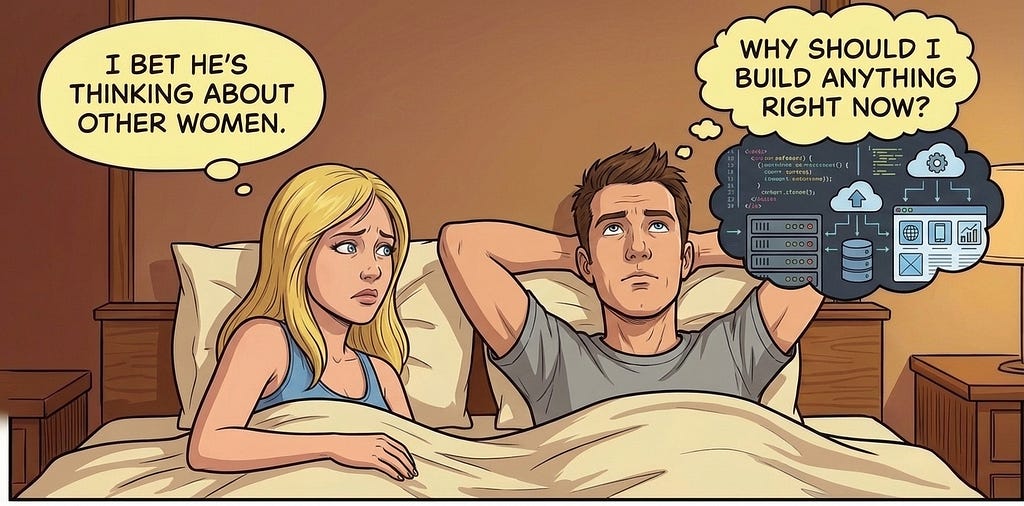
I’ve been staring at this question for weeks and I can’t shake it.
Why should I build anything right now?
Salesforce lost 7% in a day because Anthropic shipped a plugin. The biggest SaaS companies in the world watched $285 billion evaporate because investors decided AI agents will eat their lunch. If the giants can’t figure it out, what chance does anyone else have?
And then I open Twitter and someone shipped in a weekend what used to take a team months. Cursor is at $2 billion in revenue. Lovable crossed $200 million ARR (or $16M*12 MRR) in under a year. If everyone can build a product now, what’s the point of being the person who builds products?
Every growth playbook we’ve ever trusted feels wrong. Self-serve signup into what? Viral loop around something that’s obsolete next month?
If you’re feeling this too, it makes sense. Everything that used to be stable isn’t.
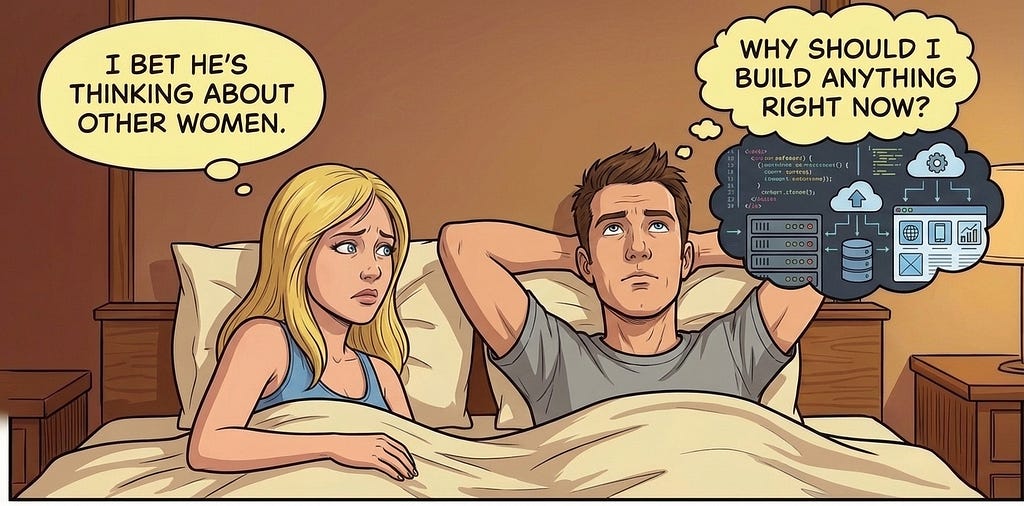
The way I’ve been trying to make sense of it is by going back to one of the biggest lies founders tell themselves about growth. It’s a lie I believed too, and I think it’s the reason so many of us are stuck right now.
Product-led growth literally means the product drives the growth
The lie is that PLG is about distribution. Self-signup, no demos, viral loops, removing sales from the process. Founders hear “product-led growth” and think it means a go-to-market strategy. It’s not. Those are tactics.
The whole idea behind PLG is that the product itself is what makes people stay, expand, and bring others in. The product IS the growth engine. That’s the entire point.
And for PLG to actually work, the people doing GTM need to think like product people. Distribution is a product problem. Onboarding is a product problem. Pricing, retention, expansion, all product problems. When your GTM team operates separately from the product, you don’t have PLG. You have a signup form.
This is where so many startups I’ve seen fail. They get early traction with a product-led motion. It works. Then a big customer shows up. Suddenly all the energy shifts to closing that deal, supporting that account, building what that one customer wants. The product motion stops evolving. And once it stops, the growth loop breaks. You can’t restart it later. It’s not a switch you flip back on.
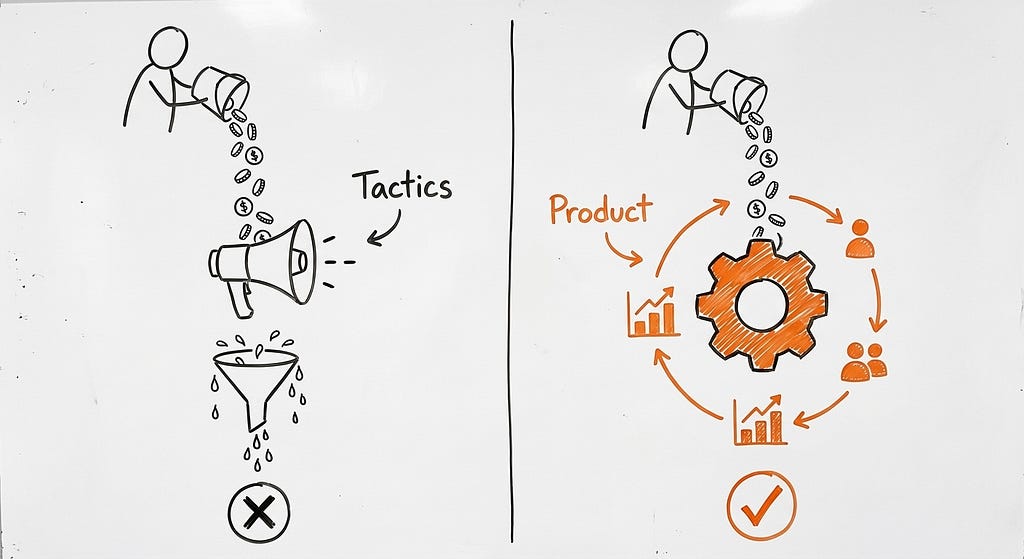
Real PLG means you keep investing in making the product deeper. Not wider. Not more features for more personas. Deeper value for the people already using it. The moment you stop doing that, you don’t have PLG anymore. You just have a product.
Now try doing that when “product” changes every week
Here’s the part that breaks everything.
What even is a product in 2026?
Three years ago I knew the answer. SaaS app. Login, dashboard, features, pricing tiers. Stable enough to build a growth motion around.
Now? A product might be an agent. A skill. An API that lives inside another platform with no UI. A capability embedded inside Claude Code that users interact with but never see your brand. It might be something you ship today that a foundation model update makes trivial tomorrow.
And it’s not just what you build. How do you charge for it? What’s the subscription model? How do you keep retention for more than a month when someone can vibe-code a replacement over the weekend? Bessemer documents the chaos: AI companies running 50–60% margins instead of the 80–90% SaaS enjoyed. Every inference costs real money. Nobody has figured out pricing yet.
When the definition of product shifts daily, and the pricing model shifts with it, PLG becomes a zero or a hundred. Either your product creates such obvious, compounding value that nothing else matters, or it creates no value at all and disappears instantly. There’s no middle ground anymore. You don’t get to coast on a decent product with a decent growth loop. That world is gone.
You’re either the solo founder who made a bot and sold it to OpenAI, or you’re a public SaaS company watching your value get stripped away by an AI announcement you had nothing to do with.
The thing that doesn’t change
So where does that leave the rest of us?
I keep coming back to the same place. Enterprises. Boring, slow, real enterprises.
They don’t move at the speed of Twitter (or X?). They have millions of actual customers depending on them. They need things to work on on Monday morning.
And they don’t care about your product. They really don’t. They don’t care if the solution is an agent, a SaaS tool, a custom build, or a person on the phone. The product is just the vehicle. They care about whether their problem gets solved. They need a service, not a product. They need someone to make shit work.
This hit me when I realized: you can build a really great product in one day now. Capabilities that would have taken years. But the product is worth nothing. You need to deliver value. The product is what you deliver it with, but the value is the thing people pay for.
And the value is: did you solve my problem? Can I depend on you? Does this work inside my systems, my compliance, my procurement, my existing mess?
Forrester still projects SaaS spending hitting $512 billion by 2028. The money isn’t disappearing. It’s flowing to whoever can deliver outcomes inside real organizations.
So the move that makes sense to me: start with the service. Find an enterprise with a problem. Sit with them. Solve it. Get paid for the outcome. Then take what you learned and turn it into product, and because building is fast and cheap now, the time between “I solved this for one customer” and “I have a product that works for a hundred” is weeks.
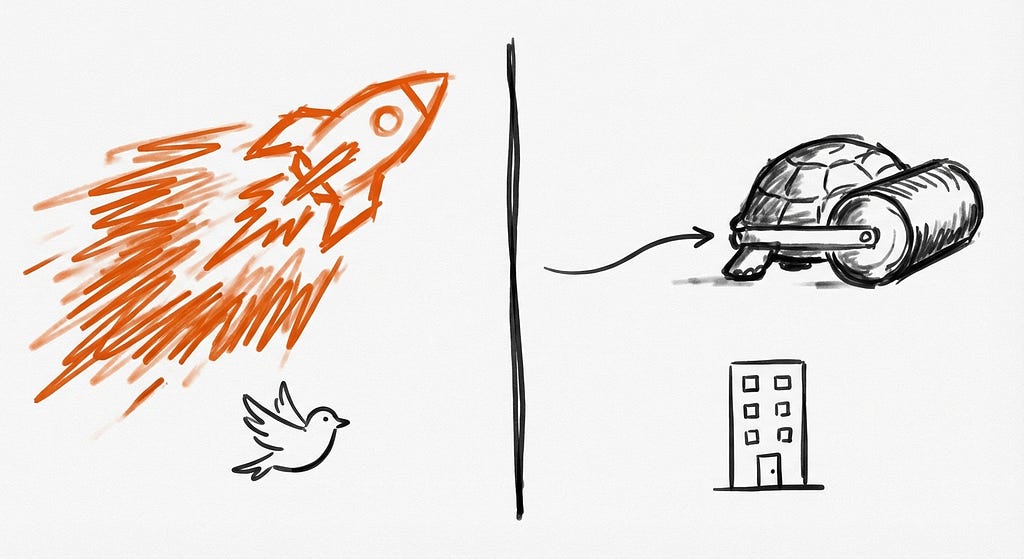
This isn’t services as a fallback. This is services as the growth engine. The service is how you learn what to build. The product is how you scale what you learned. And AI-driven development is what makes the loop fast enough to actually work.
The part that flips this from depressing to exciting
Here’s where it turns around for me.
If building is cheap, it’s not just engineers who build anymore. PMs can ship real things. GTM people can build integrations. Solutions engineers can turn a customer conversation into a working feature the same day.
The core product, architecture, data model, infrastructure, that’s still engineering work. Developers own that. But all the value layers around the core, the workflows, the integrations, the agents, the customizations, those can come from anyone on the team. The people who are closest to the customer, who just got off a call, who just saw where the product breaks in the real world, they can now actually build the thing the customer needs instead of writing a ticket and waiting.
This is the real opportunity hiding inside the chaos. Everyone can contribute to the product now. The core stays with developers, but the value belongs to the whole company. And if you’re running a PLG motion, that means the product gets deeper every day because everyone who touches a customer is also building the product.
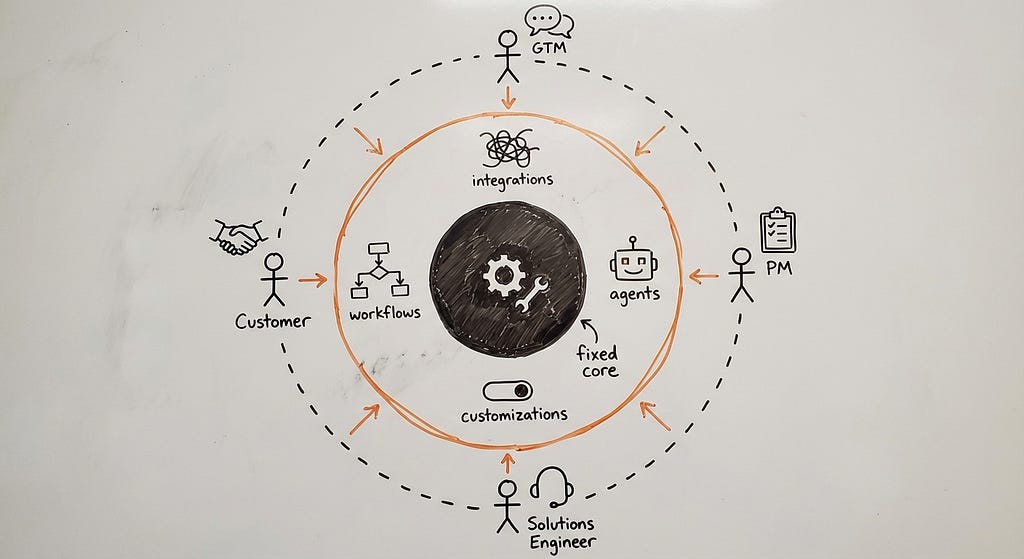
Growth comes from depth, not breadth. More value layers for the people already using you, not more signups from people who won’t stick around.
The FOMO is a lie
I need to say this for myself as much as anything.
Every time Anthropic drops something, I feel the pull. New model, new plugin, new capability. It feels like the future is happening and I’m standing still.
But Anthropic is playing really well on our FOMO. They’re taking advantage of our common sense of what a product is supposed to be, and they do it great. Every announcement is designed to make you feel like you need to react.
The reality is their value, right now, is limited. They’re playing the value that would be great in five years. But for now there are billions of customers who want to buy your real value, not Anthropic’s means to get there.
Don’t get the FOMO from “see what I built in one night” or another announcement. The product is just the means. The end is delivering value. It was always delivering value. We just forgot that for a while because building the product used to be the hard part.
It isn’t the hard part anymore.
Do things. Do grit. Learn how to code with these tools. Take advantage of this moment. The ground is shaking, but underneath it, there are real customers with real problems, willing to pay real money for someone who will actually solve them. That hasn’t changed. That’s not going to change.
Let’s go deliver.
I Don’t Know What a Product Is Anymore. And I Don’t Think You Do Either. was originally published in The Startup on Medium, where people are continuing the conversation by highlighting and responding to this story.