

Politics
/
March 16, 2026
In a union of religion, culture, sports, and politics, a rookie for the New York Knicks broke bread with the youngest mayor in the city’s modern history.

New York Knicks rookie Mo Diawara and New York City Mayor Zohran Mamdani share an Iftar dinner at Saint Louis Restuarant Keur Yayou Dara before shooting hoop at the basketball courts at Marcus Garvey Park in Harlem on March 14, 2026.
(Kara McCurdy)
On Saturday night, Mohamed Diawara, the 20-year-old rookie for the New York Knicks, sat down with 34-year-old New York City Mayor Zohran Mamdani for Iftar.
Iftar is one of the most spiritually significant meals in Islam. Each night, it breaks the dawn-to-dusk fast during the holy month of Ramadan. Over plates of steaming chicken, lamb, and fish at a 12-table Senegalese restaurant in Harlem called Saint Louis Restaurant Keur Yayou Dara, two of the city’s most prominent Muslims broke their fasts together.
In a country awash in anti-Islamic bigotry—where a GOP member of Congress can post “Muslims don’t belong in American society” without a single member of his party condemning his words—and amid the US and Israeli war on Iran, Diawara and Mamdani’s Iftar meal was a political act, even if it did not announce itself as such. It was a celebration of not just religion but visibility. Given the incredible challenges progressive and radical movements face, representation and visibility won’t be enough. But in the face of state erasure that’s both political and violently physical, it remains a necessity.
“I was sharing earlier with Mo,” Mamdani said, “that it means so much to so many young Muslim kids to know that someone on the team we love is fasting the same way.”
Current Issue

Diawara, who turned pro in Paris at just 17, has a maturity and sense of self that belies the fact that he was born in 2005. He is aware of his status as a Muslim, an immigrant from France, and a Knick. Living in the United States, he quickly learned that young fans would be looking up to him and understood that he would be a role model. And as a New Yorker, Diawara was excited to meet the mayor.
As for Mamdani, dining with a member of the Knicks was clearly a thrill. “What’s so exciting is that we are seeing one of the strongest Knicks teams in a long time,” he said, his voice animated. “When the Knicks do well, you can feel it in a way you can’t quite describe. You know when it was 70 degrees the other day? That’s how it feels like when the Knicks do well. People are happier. More excited. I remember during Linsanity”—the time when Jeremy Lin, another Knick, went on a one-month jag of greatness in 2012—“I was watching the games on my phone, in college and in class. That’s what it feels like right now. That feeling of excitement is what I want every New Yorker to feel like every day.”
When they were asked whether it is more difficult to run City Hall or play NBA basketball while fasting, the mayor responded quickly: being a Knick. But Diawara disagreed: Fasting didn’t make playing more difficult. “It’s not really hard at all, because I know why I’m doing it and I know the strength of my religion,” he said. “With fasting comes focus, clarity, and makes me feel closer to God.”
It also helped that the Knicks organization and his teammates had been, as Diawara reported, “extremely supportive throughout Ramadan and the fasting.”
“If you’re in a job where you’re talking all the time, you feel the lack of water even more than food,” Mamdani added. “But this isn’t something we are being forced to do. This is something I look forward to—because with the fast comes, as Mo said, a focus and also comes reflection.”
After eating, the five-foot-11 mayor and the six-foot-nine Knick walked nine blocks to the famed Marcus Garvey courts. The mayor’s trademark rapid steps kept up with Diawara’s broad strides, as security and mayoral aides gulped air trying to catch up. Mamdani has faced vocal critics from the right (most recently for sharing an Iftar dinner with former Columbia activist turned political prisoner Mahmoud Khalil) and the left, but as we walked down Lennox Avenue that evening, people on the streets shouted their encouragement. A group of men outside a bodega cheered. After one bystander took a selfie with the mayor, he looked up at Diawara and asked, “You play for the Knicks, right?”
In a time when politics feels like the place where hope goes to die, it was striking to see a Muslim democratic socialist being effusively supported in the city’s streets. This excitement transcends his mayoralty and his policies. It speaks to how New York City feels having elected someone much of the country—and both political parties—would have deemed unelectable, and in doing so the joy of giving a resounding rejoinder to the country’s anti-Muslim bigots. On these corners on this night, Mamdani’s election was a point of pride.
Ibrahim Douf, co-owner of the Senegalese eatery, agreed. “It proves the reason why I am in New York City,” he told me. “It’s because I feel like I belong here. I am West African, born and raised, and I was welcomed. I don’t feel neglected or rejected here. And that the mayor is a Muslim as well and still able to be elected proves that we have the best population around.”
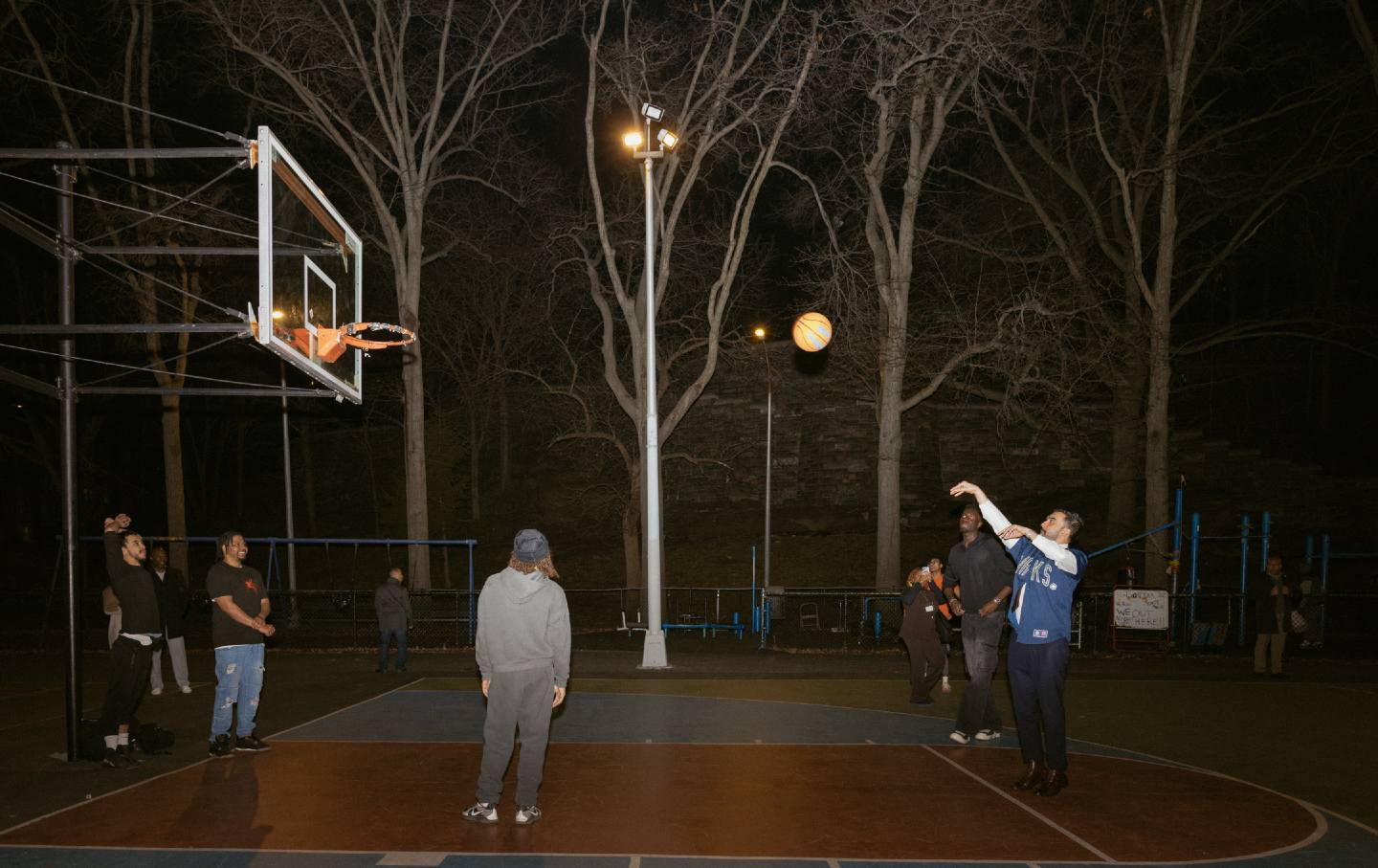
At the courts, Diawara and Mamdani hoisted a few shots with some locals out in the chill for some hoops. The Garvey Courts are lit up at night, and all the six baskets were occupied. The City Game was well-represented—most players were too into their games to notice the mayor and the Knick (Zo and Mo?) take the court. One group took up the mayor’s invitation to play H-O-R-S-E—although they called it H-O-M-E—and in a tie and dress shoes, the mayor took his shots with mixed results, but credit to him for being game and having fun. The smile was affixed, swish or brick.
When Diawara won the game of H-O-M-E (he’s shooting nearly 40 percent from three this season), the three other players said they hoped it was a good omen for the Knicks as they enter the stretch run of the season.
From the beginning of his second term, Trump has tried to bend the (men’s) sports world to his influence. From football to the Olympics to the World Cup to the world of mixed martial arts, little has escaped his greasy grasp. Together with his attacks on media and education, it’s clear that his regime is engaging in a hostile takeover of cultural spaces, where ideas rooted in resistance like the embrace of Black Lives Matter, the fight for women’s rights, the entrance of activists into electoral races, and the initial inclusion of transgender athletes held sway just a few years ago. Diawara and Mamdani’s evening together showed that these ideas are still powerful. At dinner, Mamdani had touched on the role of athletes in dire times like today. “When athletes speak the truth, it carries a different kind of resonance,” Mamdani said. “Growing up and having these incredible figures who you admire not only for athletic ability but precision of their intellectual analysis of the world around them… it matters.”
Many of the country’s most outspoken athletes have also been Muslims—Muhammad Ali, Kareem Abdul-Jabbar, and Mahmoud Abdul-Rauf—and Diawara is well aware of that tradition and draws upon the pride that comes with it. Saturday was a night of hoops and heritage: Two Muslim New Yorkers celebrated a holy meal together as the city cheered on their team and an election. It was also a rebuke to all the people telling us whom we can love and whom we should hate.
Even before February 28, the reasons for Donald Trump’s imploding approval rating were abundantly clear: untrammeled corruption and personal enrichment to the tune of billions of dollars during an affordability crisis, a foreign policy guided only by his own derelict sense of morality, and the deployment of a murderous campaign of occupation, detention, and deportation on American streets.
Now an undeclared, unauthorized, unpopular, and unconstitutional war of aggression against Iran has spread like wildfire through the region and into Europe. A new “forever war”—with an ever-increasing likelihood of American troops on the ground—may very well be upon us.
As we’ve seen over and over, this administration uses lies, misdirection, and attempts to flood the zone to justify its abuses of power at home and abroad. Just as Trump, Marco Rubio, and Pete Hegseth offer erratic and contradictory rationales for the attacks on Iran, the administration is also spreading the lie that the upcoming midterm elections are under threat from noncitizens on voter rolls. When these lies go unchecked, they become the basis for further authoritarian encroachment and war.
In these dark times, independent journalism is uniquely able to uncover the falsehoods that threaten our republic—and civilians around the world—and shine a bright light on the truth.
The Nation’s experienced team of writers, editors, and fact-checkers understands the scale of what we’re up against and the urgency with which we have to act. That’s why we’re publishing critical reporting and analysis of the war on Iran, ICE violence at home, new forms of voter suppression emerging in the courts, and much more.
But this journalism is possible only with your support.
This March, The Nation needs to raise $50,000 to ensure that we have the resources for reporting and analysis that sets the record straight and empowers people of conscience to organize. Will you donate today?