
Kendra Pierre-Louis: For Scientific American’s Science Quickly, I’m Kendra Pierre-Louis, in for Rachel Feltman.
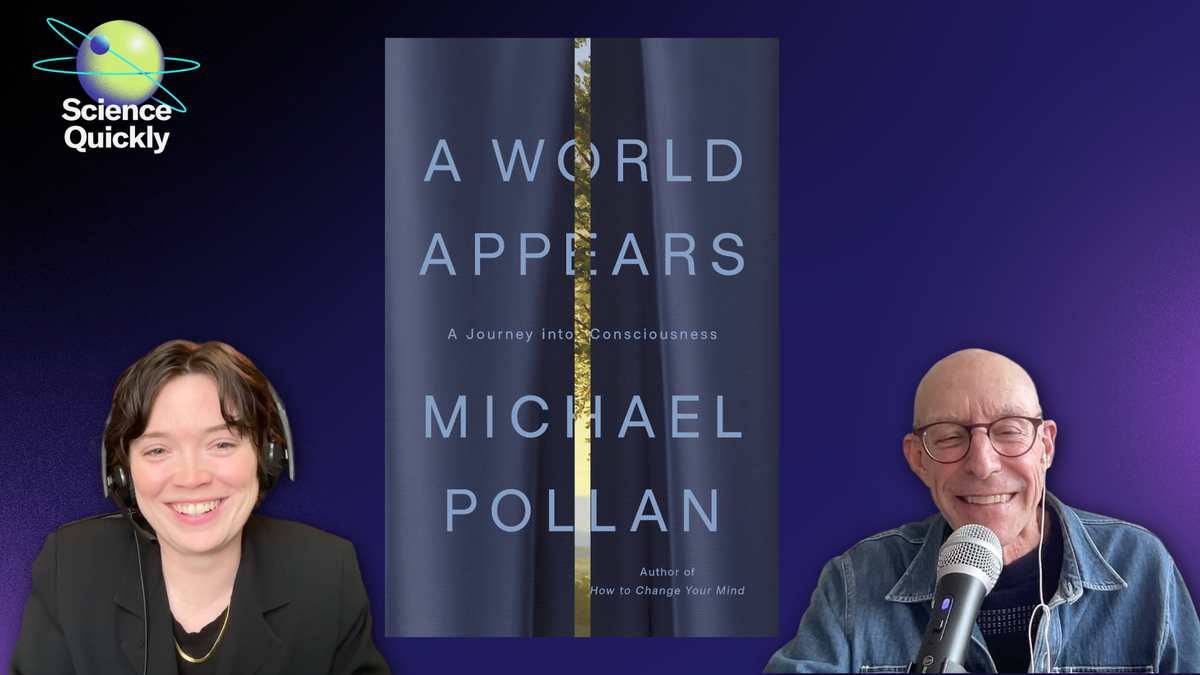
Over the past three and a half decades, journalist and author Michael Pollan has written about a dozen books, many of which are, in some way, a meditation on what it means to be human and how we interact with the natural world. In his latest book, A World Appears: A Journey into Consciousness, he tackles this subject head on with a deep exploration of what consciousness is—or is not.
SciAm’s associate books editor, Bri Kane, spoke with him about his new book. Here is their conversation.
On supporting science journalism
If you’re enjoying this article, consider supporting our award-winning journalism by subscribing. By purchasing a subscription you are helping to ensure the future of impactful stories about the discoveries and ideas shaping our world today.
In this episode of Science Quickly, journalist Michael Pollan joins Scientific American’s Bri Kane to unpack why consciousness is so hard to define in a discussion that explores what brain science, artificial intelligence experiments and even psychedelics might reveal about how awareness works.
Bri Kane: Just to get us going on something really easy I wanted to ask you, Michael Pollan: Are you conscious, do you know if I’m conscious, and are you 100 percent certain that this microphone is not conscious?
Michael Pollan: I can’t be sure you’re conscious. I have to infer that from the evidence: that you’re the same species as me, and our species can be conscious, and we have something called philosophy of mind, which is an imaginative faculty that allows us to imagine what other people are thinking.
I know I’m conscious, I think. That’s actually the thing we know with the greatest certainty. I mean, [René] Descartes told us that 400 years ago: The only thing we can be sure of is the fact that we exist, and we are conscious. Everything else is an inference. So I’m inferring you’re conscious, and I’m gonna operate on that basis, if it’s okay.
And then the microphone, the microphone hasn’t shown me any evidence of consciousness.
Kane: So I mean, like you’re saying, there’s only so much evidence to point to for consciousness; some of it is kind of just your gut understanding. And our February cover issue this year was about these 29 different theories of consciousness, which you’ve covered is further evidence that science is really floundering on finding some solid ground on: What is consciousness, and how can we provide evidence to prove this, to tackle this subject with science?
But your work seems to really discuss when science and philosophy start rubbing up against each other, which I think is why you get into some really interesting questions in this book. So I wanted to ask you: What theory, out of those 29, do you find yourself leaning towards that seems like the most probable understanding of consciousness?
Pollan: Well, you know, it’s funny. You guys came up with 29. I was operating on the assumption that there were 22 theories; there was a review article that found 22. So flailing is a pretty good word for—or floundering—for what’s going on. I mean, I don’t know of another scientific area where there are quite so many different theories.
And, you know, I, I looked at a bunch of them and focused on a couple that I found kind of, not necessarily—well, yeah, I guess I would say most persuasive, and I was very drawn to the theories that looked at the question of feeling. And normally, when we’ve looked at consciousness we think in terms of thought. We assume it’s a cortical process, you know, that in the part of the brain that is most distinctly human and most recent in terms of evolution, where we have executive function and rational thought and logic, surely that’s the home of consciousness.
But there’s been a very interesting kind of line of inquiry looking at feelings as perhaps where consciousness starts and, therefore, in the upper brain stem and not in the cortex. This begins with Antonio Damasio’s work back in the ’90s; he’s a neurologist. And he wrote a book called Descartes’ Error where he floated these ideas and has had a bunch of books since then. And then I was very interested in a protégé of his named Mark Solms, who is also exploring feeling as the basis of consciousness.
When you accept that, a lot changes because these structures in the upper brain stem where our feelings generate are common in the animal kingdom, and it would suggest, if true, that a great many more species are conscious than if it were a cortical process. So I found that very interesting, too, but I have to say, all the theories arrive at a moment of hand-waving, where they can’t quite get over the gulf from a physiological process to subjective experience: Why is it that any physiological process, any brain operation, should feel like anything? And that’s, of course, classically, the “hard problem” of consciousness, and it remains really hard. But I found that this emphasis on feelings opened up a lot of interesting doorways. We’ll see how it develops.
The exciting thing is, though, that so many more people are working on it. This was a complete backwater of science until, really, Francis Crick in the late ’80s, you know, decided, having cracked heredity with his co-discovery of [DNA’s double helix], that now he was gonna crack consciousness, incredibly arrogant man, and the same reductive science that yielded DNA surely would yield—you know, he was looking for the particular group of neurons responsible for conscious experience.
We’ve since learned that it was a lot harder than he imagined and that, you know, there’s some real questions whether the scientific method we have works in this particular case. Science has achieved amazing things reducing complex phenomenon to matter and energy, and it just doesn’t seem to work here. And consciousness seems like maybe it’s different; consciousness may be a, a real challenge to scientific materialism. So far it is, but whether it will remain so remains to be seen.
Kane: I mean, one of the biggest obstacles in understanding consciousness is that, as you explain in the book, we’re stuck inside our own consciousness, which is an obstacle that other fields of science really struggle with, like quantum physics, which I didn’t expect to get into quantum physics in discussing consciousness with you, Michael, but I thought your connection between the two fields seems really relevant: that we are stuck studying the cosmos while we’re inside them, and we are stuck trying to understand consciousness while stuck inside ourselves.
So you talk about this idealed “view from nowhere” and how a lot of people are attempting to find that perfectly objective view, and if only we could reach that, then we could solve these problems. But do you actually think that’s true? Do you think if we were to achieve this view from nowhere, the answer would fall right into our hands?
Pollan: Well, it would help. I think it’s just a fantasy that we ever can. The only tool we have with which to explore consciousness is consciousness itself. And you’re right—people doing astronomy have the same problem: they’re writing about everything that is from within the universe. Yet they’ve still made some really interesting discoveries in measurements, in rate of inflation, in all these kind of things you can do from inside.
But the view from nowhere is a conceit; it’s not really possible, you know, unless you’re God, to have that view. Every view is a perspective. Every view is the product of consciousness. And we have to realize that. And so where do we stand, and what do we do about subjectivity? I mean, our science is based on, you know, measurable, objective facts, and, we’re talking about a phenomenon that is about things like familiarity, nuance, quality, subjectivity, and we just might not have the proper tools. And one of the speculations in the book is that it may take a scientific revolution to really help us.
Another book that had a big influence on me, it was a book called The Blind Spot by Evan Thompson, a philosopher, and Adam Frank and Marcelo Gleiser, who—both of whom are physicists and astronomers. And they’re arguing that the blind spot of science, as we’ve organized it—and again, it didn’t have to be organized this way; that’s just a historical legacy of Galileo [Galilei], mostly—does not take adequate account of subjective experience.
And so the science we have looks at red and sees this frequency of light, right, and that red is an illusion of brains—it’s how brains construct that particular frequency—and they ignore the experience of red. Yet, as [Thompson, Frank and Gleiser] would argue, the experience of red in the minds of human beings is a phenomenon of nature, and it deserves the same kind of attention that the spectrum does. So we may have to just figure out other ways to do science. It’s hard to understand consciousness without experiencing it in the other person. It may take a kind of mind meld to get at it, rather than this fictional view from nowhere.
You know, the more we look at it, I think the arrogance with which we started when Crick and Christof Koch set out to do this has been tempered by a lot of humility. And so, you know, some may find it disappointing that you can’t argue for a definitive theory, and we’ve had various efforts to pin down that theory. You know, the Templeton Foundation did this “adversarial collaboration” where they took two leading theories and pitted them against one another and predicted certain brain areas would be active if one theory was true and not the other. And in the end it was equivocal: neither theory was proven; nobody changed their mind.
So that was the last attempt to kind of, you know, get some kind of definitive answer. We’re not there yet, but as time went on, you know, I found that kind of frustrating, and then I found it interesting.
Kane: It is—it’s right at the intersection there of the frustration but [also] the curiosity, especially because this field of consciousness and research into consciousness is exploding, arguably, right now with the development of AI and a lot of other technologies that have become rapidly available to the public.
There have been some very big claims made. I was so surprised to see the different ways that AI researchers are trying to determine the level of sentience or consciousness, specifically in the example of the AI agents plausibly developing sentience by being tempted by drugs. Can you tell me about that experiment that you observed?
Pollan: So Mark Solms is the researcher I mentioned earlier who’s focused on feelings, and you would think that someone focused on feelings and biology to the extent he is would not believe a conscious AI is possible. But in fact he thinks one is, and he’s actually assembled a team in South Africa—it’s an international team—and they’re trying to design an AI that will be conscious.
And the basic premise is that he believes consciousness arises when we have conflicting feelings and that they can’t be automatically adjudicated; they have to be sorted by a conscious being. He defines consciousness as “felt uncertainty.” And, so as an example, if your agent is both hungry and, and tired, there are some conflicting needs, and a decision has to be made: “Well, should I rest first or eat first?” And I mean, that’s a very simple example.
So he’s created this avatar, really, in a kind of video game, and he gives it conflicting needs, and the idea is: as these needs come into conflict it should generate consciousness. So far those needs are very simple, and I don’t think he would say it’s generated any consciousness, but one of his tests will be to give it the simulated equivalent of a drug, which would be an irrational behavior but still, if you had feelings, would be a very appealing behavior. And …
Kane: Feels good but isn’t …
Pollan: Right.
Kane: You know, perpetuating your own stasis.
Pollan: Exactly. So one of his tests will be to test his avatar with drugs. I don’t know exactly what they’ll be in the context of what is, essentially, a video game.
You know, I asked him, “If you think that these conflicting needs will generate feelings, or feelings of uncertainty, are these feelings real or simulated?” And he said they’re sort of both. He said it’s true that they won’t have any causal power in our world; they won’t make things happen in our world. But in the world of the video game, or the AI, they will make things happen.
And, you know, that goes to this point that a lot of people in, especially in Silicon Valley, believe that if you simulate something, it’s as good as the real thing. And that has to do with the fact that maybe we already live in a simulation, and I find that’s a big assumption to accept. I really do think that computer simulations of some things are real, like the ability to play Go or chess or something. Like, that’s real thinking and real game playing, and it does have an effect in the world. But then you have simulations of, like, storms, you know, which don’t get you wet, or black holes, which don’t suck you in. And so I think we have to be very careful with this idea that if we can simulate something, we’re halfway or all the way toward actually creating it.
Kane: I mean, there are a lot of ways to, as you’re saying, simulate things that we have never experienced or probably will never experience, hopefully, like getting sucked into a black hole. I hope to not know what that experience is. [Laughs.]
Pollan: Me, too.
Kane: And just because we can create those circumstances, maybe, on Earth doesn’t mean that we are actually understanding that experience, like you were saying with the color red—just because we know where it falls on the light frequency doesn’t mean we understand the quality of seeing something red. And I thought the way that you kind of differentiate between those is really interesting in the book, and you talk to a lot of different researchers who are really interested in that kind of space in between, some of which, I thought was very interesting, share something in common with you, which is they have done psychedelics …
Pollan: Yeah.
Kane: And that has changed their view on that view from nowhere and has given themselves a different view and given their research a different lens as well.
So I wanted to ask you about your experience with psychedelics; if you think they have informed your understanding of consciousness or your curiosity about it; and if we just need to give the AI some LSD, and then they’ll figure it out from there. [Laughs.]
Pollan: [Laughs.] Well, there’s a proposal. I explored psychedelics for my 2018 book, How to Change Your Mind, and I had a series of experiences that were, most of them, very interesting, and a couple of them helped inspire this book.
One thing a psychedelic does is distort or smudge the glass pane through which we look at reality, which is to say consciousness. For most of the time it’s completely transparent. We don’t even have to be aware; there’s just a world out there. But when you smudge it with psychedelics—and you can do this with meditation, too; the same effect happens—you suddenly realize, “Well, there is this pane of glass, and it is this way and not that way, and it can be distorted.” And suddenly you’ve defamiliarized consciousness, your consciousness. And that’s really interesting and makes you wonder, and suddenly, you can’t think about anything else. It becomes kind of obsessive.
The other insight, if we can call it that, that I had during one of my psychedelic experiences was the clear conviction that the plants in my garden were actually conscious and that they were aware, they were more alive than I had ever experienced them to be, and they were returning my gaze in some sense. It’s not that they had interiority or self-reflection, but they were animate beings. And I didn’t know what to do with that. I mean, my first instinct is—you know, I’m not a mystically minded person—was to dismiss this as a drug-addled insight.
But as time went on I was like, “Well, a better thing to do with it is test it against the science we have and see if it can hold up.” And I really got that idea from reading William James, who in [The] Varieties of Religious Experience, you know, wrote about lots of mystical experiences people had, and he was not prepared to dismiss them. He said we don’t know enough about the metaphysics of the universe to say this can’t happen or isn’t true, but we need to, one, see how useful these ideas are, and—’cause he was a pragmatist—and two, test them against other ways of knowing.
So that’s what I ended up doing with plants and exploring this whole field of what’s called plant neurobiology, even though there are no neurons involved—it’s kind of a trolling name for this field. And there are a lot of people doing incredible work to show that plants may indeed be, I wouldn’t use the word “conscious,” although some of them do; I would use the word “sentient” as a kind of more basement level of consciousness that implies awareness of your environment, the ability to recognize positive and negative valences in what you’re seeing and gravitate toward one and away from the other. I mean, it’s something that bacteria have with chemotaxis, and, you know, they recognize a nutritious chemical and a dangerous chemical and act appropriately. And the basic idea may be that sentience is a property of life and consciousness is a complexification of sentience that humans have developed because they have these specific needs that plants don’t have.
So in the end, yeah, my psychedelic experiences were helpful in inspiring me to undertake the book. But the other thing that really struck me about psychedelics was how many of the consciousness researchers I interviewed were using psychedelics—for a variety of reasons but also simply to break out of the box that they feel they’re stuck in. They recognize that the field is somewhat stuck too.
And Christof Koch has written about this—I’m not breaking any confidences—but he was the guy who started with Francis Crick and was very much a materialist scientist. He was head of the Allen [Institute for Brain Science] in Seattle for many years, you know, working on neural flesh and mapping it and prodding it and this and that.
He had an experience on ayahuasca that persuaded him that “mind at large,” which is a term Aldous Huxley used in The Doors of Perception, this idea that there is a mind outside of our brains and that we somehow channel it—I mean it’s a, an idealist view of consciousness, way outside the box. But he’s convinced this experience is as real as any experience he’s had, and it’s not the sole reason; it’s one of two or three reasons that he feels that scientific materialism is not gonna solve this problem and is not the proper way to look at the world.
So it’s very interesting to see the role that psychedelics is having on this field.
Kane: Across this book, which is not that long, you talk to a lot of different researchers. You have a lot of really deep and, like, continuous conversations with them—following up with them, observing experiments, participating in some of your own. But so I wanted to ask you, after your years of work as a science writer, your years of work thinking about consciousness, participating in experiments with psychedelics and thinking about—so deeply about this, why haven’t you solved the hardest problem in science yet?
Pollan: [Laughs.]
Kane: [Laughs.] Do you think you will? Do you think that humanity will solve this problem anytime soon?
Pollan: I don’t think anytime soon. I think it will be solved. I think it may take a new kind of science to do it. It’s certainly beyond me; I can tell you that. I mean, this is, this is an unusual nonfiction book in, in that you may know less at the end than you do at the beginning. But at least you won’t know things that are wrong.
There’s a kind of turn in the book from this classic Western scientific and, you know, forgive me, male point of view of, like, framing things in terms of “problem, solution”: “We’re gonna solve this problem.” As time went on I got more comfortable with not knowing, and I started finding the mystery really interesting, and that—I came to see that the problem of consciousness is one thing, but there is the fact of it. And the fact of it is so marvelous and so mysterious, and it fills me with awe and wonder and also a sense that we’re not taking care of this gift we have, that we squander it on things like social media and, you know, that consciousness is something to be treasured and defended.
Because right now, I think, consciousness is under siege. We happen to have a president now who dominates our headspace for a big chunk of every day, whether you like him or detest him. He has figured out a way to worm his way into our consciousness and stay there day after day after day—really unhealthy. We have social media that hacks our attention and is selling our attention, monetizing it, basically, to the highest bidder. And then now we have these chatbots that people are forming relationships with, and they’re not just hacking our attention; they’re hacking our deepest human ability to form relationships, attachments. I think that’s a really unfortunate development. I think we need to figure out a way to defend consciousness against all these intrusions.
You know, this book, I don’t just talk to scientists, as you know. I mean, I talk to poets, and I talk to novelists and philosophers and Buddhists because there are other ways of knowing and there are other ways of thinking about consciousness than the very narrow one that science has given us. I’m regarded as a science journalist, but I’m not just that. I find the most interesting nonfiction comes when you layer different perspectives or lenses and you layer science with culture or literature or the other arts and religion. And these are all different ways of knowing, and none of ’em has the last word, and that when you layer them you start getting a fuller picture of the phenomenon, and so that’s what I did here. And then also got more comfortable with not knowing.
Kane: Well, as you say in the book, I mean, people have been studying consciousness since they realized they were conscious. I mean, [Charles] Darwin was interested in the consciousness of bean plants …
Pollan: Yeah.
Kane: And [Jean-Paul] Sartre was interested in if we can prove if each other are conscious and what that means.
Thank you so much for trying to attempt to solve the hardest problem in science with us today and for this work. It’s a beautiful, beautiful book. I’m very happy to share it with our audience.
Pierre-Louis: That’s it for today! See you on Monday for our weekly science news roundup.
Science Quickly is produced by me, Kendra Pierre-Louis, along with Fonda Mwangi, Sushmita Pathak and Jeff DelViscio. This episode was co-hosted by Bri Kane and edited by Alex Sugiura and Kylie Murphy. Shayna Posses and Aaron Shattuck fact-check our show. Our theme music was composed by Dominic Smith. Subscribe to Scientific American for more up-to-date and in-depth science news.
For Scientific American, this is Kendra Pierre-Louis. Have a great weekend!