
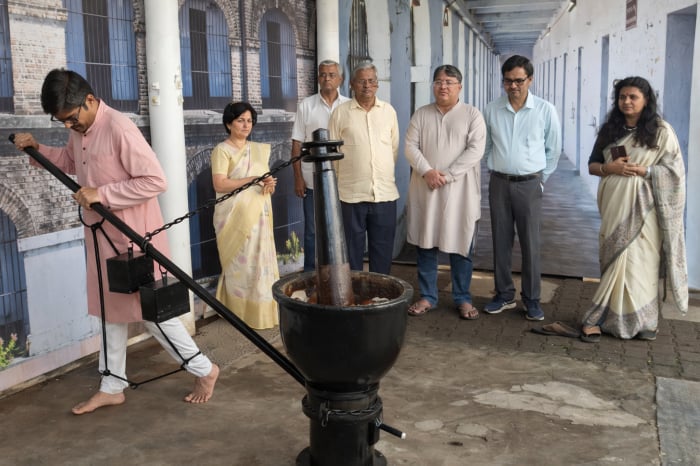
Many patriotic citizens experienced operating the Kolhu

Mumbai, Maharashtra – Swatantryaveer Savarkar, along with many other revolutionaries who fought for India’s independence, was imprisoned by the British in the Andaman Cellular Jail, where they were subjected to inhumane torture. As part of this, revolutionaries were harnessed to an oil-extracting kolhu in place of bullocks and forced to extract around 30 pounds (approximately 14–15 kg) of oil daily.
🇮🇳 Awakening Patriotism Through Experience
An impactful initiative by Swatantryaveer Savarkar National Memorial to highlight the brutal atrocities faced by revolutionaries in the Andamans 🌊
Live demonstration of the oil mill (Kolhu)
Participants operated it under harsh… pic.twitter.com/JEj47eqL4V
— Sanatan Prabhat (@SanatanPrabhat) April 4, 2026
To create awareness among the present generation about the hardships endured by these revolutionaries, Swatantryaveer Savarkar Rashtriya Smarak organised a live kolhu demonstration on 4th and 5th April. The programme was inaugurated on 4th April at 11 a.m. in the presence of dignitaries.
On this occasion, Shri. Ranjit Savarkar (Executive President of the Smarak), Advocate Smt. Siddha Vidya (Mumbai High Court), Shri. Narendra Surve (Spokesperson, Hindu Janajagruti Samiti), Shri. Rajendra Varadkar (Secretary of the Smarak), sculptor Shri. Nilesh Dhere, and several patriotic citizens were present.
During the event, participants operated the kolhu with chains placed on their hands and feet. Notably, people from all age groups, from children to elderly individuals, took part and experienced the demonstration. Dignitaries from various fields also participated and raised slogans such as “Vande Mataram” and “Bharat Mata Ki Jai”.
Citizens experience pperating the Kolhu
A kolhu similar to the one used in the Andaman prison has been recreated at the Smarak. Participants were asked to operate it by placing dried coconut pieces inside. Just as revolutionaries were shackled, similar chains were placed on the hands and legs of participants during the demonstration. Certificates were awarded to registered participants.
“Sacrifices of revolutionaries were minimised for political gain” – Shri. Ranjit Savarkar
Shri. Ranjit Savarkar stated that people often compare Gandhi’s spinning of the charkha with revolutionaries operating the kolhu, but the two are not the same. In Andaman, revolutionaries were forced to operate the kolhu for eight hours daily, leading some to take their own lives and others to suffer mental breakdowns.
He said such inhumane treatment was intended to break their morale and discourage participation in revolutionary activities. This demonstration has been organised to help people realise their responsibility to preserve independence.
He further stated that while Jawaharlal Nehru reportedly received comfortable treatment in prison, including access to fruits, honey, cigarettes, a European cook, and facilities to play tennis, revolutionaries in Andaman were given burnt rotis and tasteless vegetables while undergoing Kala Pani punishment.
He alleged that after independence, the sacrifices of revolutionaries were downplayed, while others were portrayed more prominently for political reasons.
“Revolutionary contributions have been marginalised through narratives” – Advocate Smt. Siddha Vidya
Advocate Smt. Siddha Vidya said that when she operated the kolhu, it was in a safe environment with a fan and no fear; however, the revolutionaries worked under harsh conditions with chains on their legs. They also had to peel coconuts manually before operating the kolhu.
Through this experience, she understood the extent of sacrifices made by revolutionaries. She added that in present times, narratives have been created that give secondary importance to their contributions.
“We are shown the charkha, but not the Kolhu” – Shri. Narendra Surve
Shri. Narendra Surve said that when he tried operating the kolhu with chains, he could not continue for more than 3–4 minutes, whereas revolutionaries had to do so for eight hours daily and extract around 15 kg of oil.
He added that people are often shown the charkha, but not the kolhu, and are told that independence was achieved without struggle. He emphasised that the youth must understand the sacrifices made by revolutionaries and experience it themselves by visiting the Smarak.
“Understanding the value of freedom is essential to preserve It” – Smt. Manjiri Marathe
Smt. Manjiri Marathe, Treasurer of the Smarak, stated that the country gained independence after immense sacrifice and bloodshed by countless revolutionaries. Many people are unaware of these sacrifices, and it is important to understand the value of freedom to preserve it.
“It gives a sense of the sufferings endured for the nation” – Shri. Pradeep Kabre
Marathi actor and director Shri. Pradeep Kabre said that instead of merely calling oneself a Savarkar admirer, one should understand the sacrifices made by Swatantryaveer Savarkar. The process of operating the kolhu reflects the strength of his resolve and gives an idea of the hardships endured for the nation.