
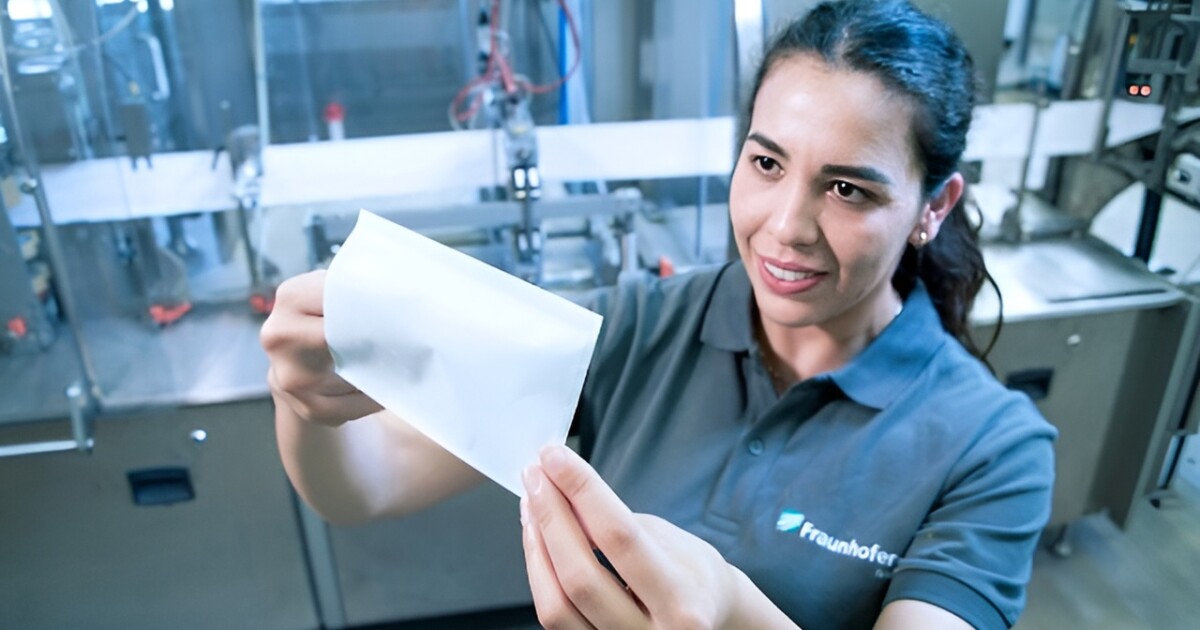
In the packaging war between paper and plastic, plastic has remained indispensable – even in paper products – through one vital aspect: sealing. Until now, reliable paper seals have required adhesives or plastic layers. Scientists may have found a way to eliminate both.
Despite all our efforts to curb plastic pollution by using paper packaging, we often inadvertently end up using it anyways. This happens because paper packages still require plastic to provide leak-proof sealing. You see, paper is porous, allowing air to reach solid content and allowing liquids to leak out.
To address these limitations, paper packaging for food or chemicals still contains plastic. Examples of this are everywhere. Milk and juice cartons, even though they look like paper, are lined with plastic (often polyethylene) and heat-sealed at the seams to prevent leaks. Another example is paper packets for snacks like biscuits and chips. The edges are heat-sealed plastic films to keep air and moisture out so the food stays crisp. We also have “paper” coffee cups, takeaway boxes, and cosmetic bottles that all feature plastic seams or linings.
This plastic contaminates the paper, complicating recyclability and impacting biodegradability.
To solve this problem, researchers from four institutes at Fraunhofer, a German research organization, have come together to create the PAPURE project. According to a press release by the organization, the project aims to develop a laser-based heating process that enables adhesive-free packaging, completely eliminating the need for plastics.

Fraunhofer IVV
The project has developed a multistage process that begins with analyzing multiple paper types to determine their suitability for the heat treatment process. This stage determines the biocellulose content of the paper, including hemicellulose, cellulose, and lignin, as these components directly impact the paper’s adhesive properties. Using advanced analytical characterization techniques, this analysis also assesses for inorganic compounds that may adversely affect laser treatment.
“An excessive proportion of inorganic compounds, such as talc and calcium carbonate, has a negative effect on the adhesive properties and bond strength of the seams. It can also be said that thicker papers are more suitable for binder-free sealing,” says Fraunhofer research scientist Robert Protz.
The next stage is the actual innovation that results in adhesive-free sealing. Researchers irradiate the paper surface with a CO laser, rapidly heating it and converting its primary components: lignin, hemicellulose, and cellulose, into short-chain compounds. The irradiation process creates a fusible cleavage product that remains on the paper’s surface. When heat and pressure are applied to the paper, the fusible cleavage product seals the surface.
Essentially, the process uses a laser to convert biocomponents already existing in the paper into a glue-like product that can be heat-sealed!
“By irradiating the paper with a CO laser, we create refusible, sugar-like reaction products that we use instead of the synthetic materials or adhesives that would otherwise be required to seal the paper by the heat sealing process. In this way, we are essentially producing our own adhesive in the form of the cleavage products,” says Volker Franke, a member of the research team.

Fraunhofer IVV
Beyond the laser treatment, the researchers are also developing suitable sealing systems for the treated paper. They are also analyzing the effects of material properties, laser parameters, and the properties of the fusible reaction products on bond strength and leak-proofness.
“By measuring mechanical stability under different types of loads, we can demonstrate the effects of laser parameters and sealing parameters on the bond strength of the seams. Crucial sealing parameters are sealing time, sealing temperature, sealing pressure, and tool geometry,” says Marek Hauptmann, head of the joint project.
The research is already showing tremendous results. The researchers were able to easily lift 20 kg (44 lb) using a seal that was only 2 cm (0.4 in) long and 3 mm (1.18 in) wide.
The team is also developing an actual modular, albeit lab-scale, manufacturing unit for the technology. The current unit incorporates laser treatment and sealing and is capable of manufacturing a flat four-sided bag commonly used for packaging. What’s more, the unit can be integrated into existing production lines, allowing manufacturing to seamlessly switch to truly green packaging.
Source: Fraunhofer