

Live: NASA’s Artemis II moon mission launches
The U.S. space agency on Wednesday evening launched four astronauts on what may be a record-breaking trip around the moon—see the spacecraft live
NASA on April 1 launched four astronauts on a pioneering journey around the moon—the Artemis II mission. Follow our coverage here.
NASA’s Artemis II moon mission launched on Wednesday evening on a journey around the moon’s far side that may bring humans farther from Earth than ever before.
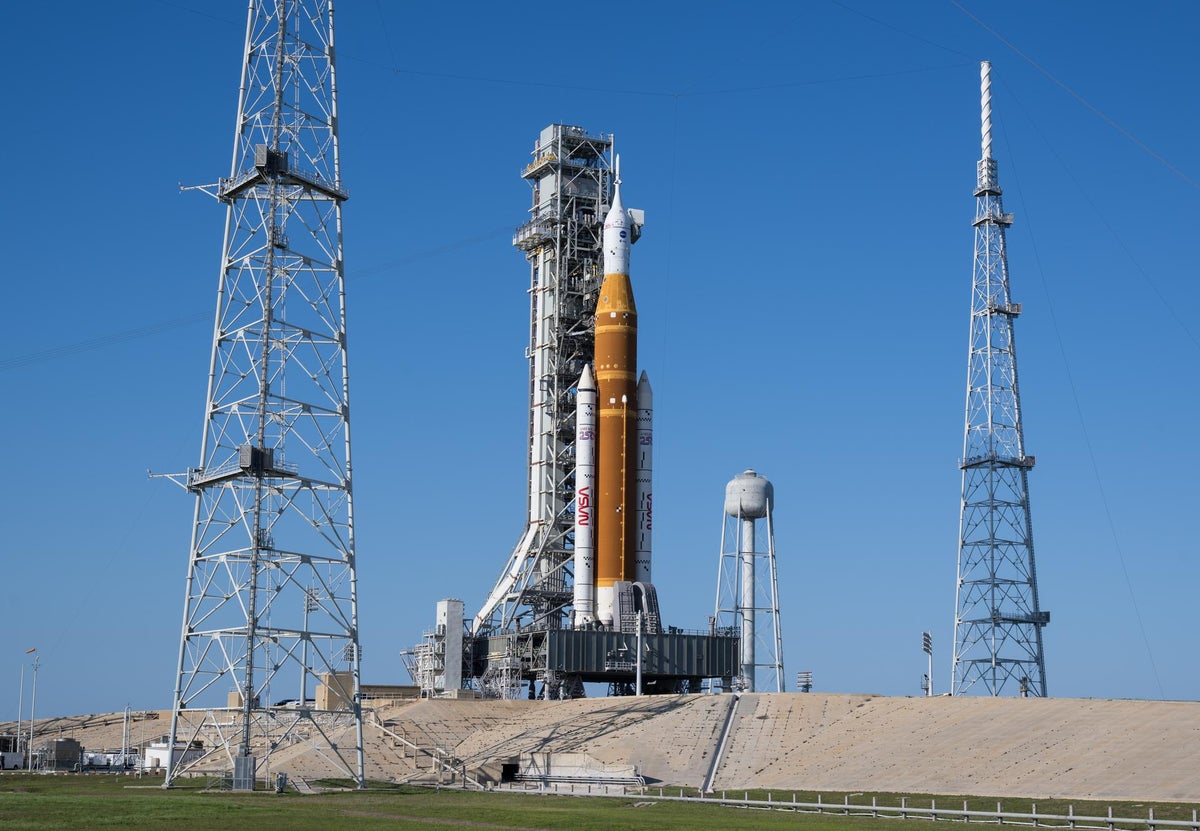
NASA launched the Space Launch System (SLS) rocket at 6:35 P.M. EDT from Launch Pad 39B at the Kennedy Space Center in Florida. The 212-foot-tall SLS is topped with the Orion capsule—a spacecraft which has an internal habitat about the size of two minivans, where the four crew members will spend the 10-day mission. The launch director’s final poll for launch at 6:19 P.M. heard the four astronauts on board affirm that they were ready to go.
The day for the the Artemis II astronauts—Reid Wiseman, Christina Koch, Victor Glover and Jeremy Hansen—began at 9:25, in what was a long day of preparation ahead of the lunar launch. The suited-up crew were later seen on the agency’s live stream getting fitted into their orange spacesuits and then walking to a van that will take them to the launch pad to prepared for liftoff—this path has been walked by every NASA astronaut since Apollo 7 in 1968, according to the agency. Wiseman, the mission’s commander, said that it was “a great day for us, a great day for the team.” Before they left for the spacecraft, the crew apparently played a game of cards, an agency tradition where crews play until the mission commander, Wiseman in this case, loses.
On supporting science journalism
If you’re enjoying this article, consider supporting our award-winning journalism by subscribing. By purchasing a subscription you are helping to ensure the future of impactful stories about the discoveries and ideas shaping our world today.
The astronauts are inside the Orion crew capsule, which sits atop the SLS rocket. NASA technicians began closing the hatch to the Orion spacecraft a little after 3 P.M., ensuring that it is pressurized and ready for the journey ahead. After it is closed and locked, the four astronauts are effectively sealed inside for the rest of the launch sequence.
A live feed of NASA’s Artemis II spacecraft on the launchpad.
As of 1:10 P.M., NASA had filled both the core and upper stage of the SLS with all the necessary liquid fuel, a major milestone in the run up to the launch. This process was closely watched, because the SLS had suffered technical problems such as fuel leaks in the past that had repeatedly delayed the launch. These issues also plagued the mission’s predecessor, Artemis I. The agency is confident that it has fixed the problem, officials have said.
At around 4:30 P.M., NASA commentator Derrol Nail said that engineers were working to fix an issue with the ground system for the SLS’s flight termination system—it was quickly resolved. The issue did not stop the countdown clock, but the rocket would not launch unless the system is working. The system is designed to remove the Orion capsule and astronauts to safety and then self-destruct the rocket in case it veers off-path should a problem arise. At around 5:30 P.M., an issue with a battery on the Launch Abort System arose and was quickly resolved.
On that journey, the astronauts hope to travel around the moon and back to Earth, a trip that would take humans farther into space than any person has gone before—more than 250,000 miles from Earth and 4,000 miles beyond the moon. They will also observe parts of the moon’s far side that humans have seen only through satellite photographs. At the same time, they will perform multiple tests of the spacecraft and other technology that will ultimately inform NASA’s future moon base ambitions.
In March NASA announced a revamped moon mission plan that will see humans land on the moon in 2028—the first time since 1972—in what would be an initial foray of many, with the aim of establishing a staffed research base on the moon within the next decade.
Editor’s Note (4/1/26): This is a developing story and will be updated.
It’s Time to Stand Up for Science
If you enjoyed this article, I’d like to ask for your support. Scientific American has served as an advocate for science and industry for 180 years, and right now may be the most critical moment in that two-century history.
I’ve been a Scientific American subscriber since I was 12 years old, and it helped shape the way I look at the world. SciAm always educates and delights me, and inspires a sense of awe for our vast, beautiful universe. I hope it does that for you, too.
If you subscribe to Scientific American, you help ensure that our coverage is centered on meaningful research and discovery; that we have the resources to report on the decisions that threaten labs across the U.S.; and that we support both budding and working scientists at a time when the value of science itself too often goes unrecognized.
In return, you get essential news, captivating podcasts, brilliant infographics, can’t-miss newsletters, must-watch videos, challenging games, and the science world’s best writing and reporting. You can even gift someone a subscription.
There has never been a more important time for us to stand up and show why science matters. I hope you’ll support us in that mission.