
Cloud ERP is no longer a “technology upgrade” that companies experiment with on the side. It has become the backbone of how modern businesses run operations, control costs, and make decisions faster than competitors.
But here is the honest part most vendors will not tell you clearly enough. Cloud ERP does not automatically improve ROI. It only improves ROI when the business behind it is ready to change how it works.
If the processes are messy, ERP will not fix them. It will just make the mess more visible.
When done right though, the impact is very real.
What ROI actually means in Cloud ERP (in real terms)
Most people think ROI is just saving money. That is incomplete.
In real business environments, ROI comes from a combination of financial and operational improvements.
Key areas where ROI actually shows up
- Less time spent fixing and reconciling data
- Faster decision-making at leadership level
- Reduced dependency on manual reporting
- Lower operational friction between departments
- Better forecasting accuracy
It is not one big win. It is many small wins stacking together every single day.
ROI breakdown in a practical structure
Here is how Cloud ERP typically impacts ROI across business layers:
| Area | What improves | Business impact | ROI outcome |
| Infrastructure | No servers or physical setup needed | Lower capital expense | Immediate cost reduction |
| Operations | Automation of daily workflows | Faster execution | Productivity gain |
| Finance | Real-time tracking of expenses | Better financial control | Reduced wastage |
| Data | Single source of truth | Fewer errors and confusion | Better decisions |
| IT management | Vendor handled maintenance | Less internal workload | Reduced overhead |
This table is important because ROI is not coming from one place. It is coming from multiple systems improving together.
Why businesses are shifting to Cloud ERP faster than expected
Older ERP systems worked, but they were heavy. Expensive upfront investment, long deployment cycles, and constant upgrade headaches.
Cloud ERP removes most of that friction.
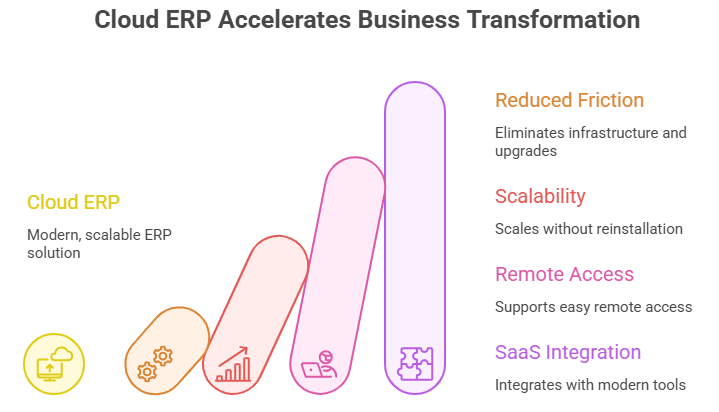
Companies are now moving toward systems that:
- Do not require physical infrastructure
- Can scale without reinstallation
- Support remote access easily
- Integrate with modern SaaS tools
But the deeper reason is flexibility.
Businesses today do not stay the same for five years anymore. They change faster, and ERP has to keep up.
Where cost savings actually come from
Cost reduction is usually the first visible benefit, but it is more layered than people assume.
1. Infrastructure elimination
No servers, no hardware rooms, no cooling systems, no maintenance contracts.
2. Reduced IT dependency
Internal teams stop spending time maintaining systems and start focusing on actual business problems.
3. Predictable pricing
Subscription-based models remove unpredictable upgrade costs.
4. Reduced downtime losses
Cloud systems are more stable, which means fewer interruptions in daily operations.
Each one may look small individually, but together they create strong financial ROI over time.
Operational efficiency is where ROI compounds quietly
This is where most companies underestimate Cloud ERP.
When all departments work in separate tools, inefficiencies are unavoidable. Data gets duplicated. Reports conflict. Teams spend time correcting mistakes instead of moving forward.
Cloud ERP changes that completely.
Operational improvements usually include
- Faster month-end closing cycles
- Real-time inventory visibility
- Reduced duplicate data entry
- Faster internal approvals
- Better coordination between teams
It is not dramatic at first, but over months, it changes how the entire organization feels.
Work stops being fragmented.
Real-time data changes decision-making completely
One of the biggest shifts Cloud ERP brings is timing.
Earlier, decisions were based on reports that were already outdated by the time they reached management.
Now, data is available almost instantly.
That means leadership can:
- Track performance as it happens
- React to supply chain issues faster
- Adjust pricing or inventory quickly
- Reduce financial blind spots
- Identify risks early instead of late
This is where ERP stops being an operations tool and starts becoming a decision-making system.
ROI comparison: Traditional ERP vs Cloud ERP
| Factor | Traditional ERP | Cloud ERP |
| Setup cost | Very high upfront investment | Low initial cost |
| Deployment time | Long (months to years) | Faster rollout |
| Maintenance | Internal IT required | Managed by provider |
| Scalability | Complex and expensive | Easy and flexible |
| Updates | Manual and disruptive | Automatic and continuous |
| ROI timeline | Slow | Faster realization |
This comparison makes one thing clear. Cloud ERP does not just reduce cost. It changes how ROI is generated in the first place.
Why implementation quality decides ROI success
Even the best ERP system fails if it is implemented poorly.
A lot of companies rush deployment and skip the most important step, which is fixing their internal processes first.
This is where working with an experienced ERP Development Company in USA becomes important. The value is not just technical setup. It is process mapping, workflow redesign, and aligning ERP with actual business operations.
Without this, companies often end up digitizing broken systems instead of improving them.
Cloud ERP as part of a larger SaaS ecosystem
ERP does not operate alone anymore. It connects with multiple tools like CRM, analytics platforms, HR systems, and inventory tools.
This ecosystem approach is where modern businesses are heading.
A Saas Development Company in USA typically builds systems that are modular and integration-friendly. That matters because businesses no longer want rigid software. They want systems that evolve as they grow.
This flexibility directly improves long-term ROI because companies do not need to rebuild systems every time they expand.
Infrastructure matters more than people realize
ERP performance is not just about software design. It depends heavily on the cloud infrastructure supporting it.
A Google Cloud Development Company helps organizations build systems that can handle large-scale data processing, maintain speed under heavy usage, and ensure uptime across global operations.
If infrastructure is weak, even the best ERP setup will feel slow and frustrating. And slow systems always reduce ROI because they affect productivity.
Where companies lose ROI without realizing it
Most ERP failures are not technical. They are behavioral.
Common issues include:
- Processes not cleaned before implementation
- Employees not trained properly
- Resistance to adopting new workflows
- Over-customization that makes systems complex
- Lack of usage tracking after deployment
These issues quietly reduce ROI even if the system is working technically.
The real ROI timeline (what actually happens over time)
Cloud ERP does not deliver full ROI instantly. It builds in stages.
Stage 1: Setup phase
System setup, data migration, and training. ROI is not visible yet.
Stage 2: Adjustment phase
Teams are learning. Some resistance and slowdowns happen.
Stage 3: Efficiency phase
Automation starts working. Manual effort reduces significantly.
Stage 4: Optimization phase
Businesses start using data for planning, not just operations.
Stage 5: Strategic phase
ERP becomes part of decision-making and growth strategy.
This progression is where long-term ROI becomes meaningful.
Practical ways to maximize Cloud ERP ROI
Here is what actually works in real businesses:
- Fix internal processes before digitizing them
- Train employees continuously, not just during launch
- Keep workflows simple and practical
- Use dashboards daily, not occasionally
- Track system adoption regularly
Nothing complex. Just disciplined execution.
Final thoughts
Cloud ERP is not a magic solution. It does not fix businesses on its own.
But when implemented properly, it changes how a company functions at every level.
Costs reduce, yes. But more importantly, efficiency improves, communication becomes smoother, and decision-making becomes faster and more accurate.
The difference between high ROI and poor ROI is rarely the software. It is how seriously a business treats the transformation.
Companies that approach Cloud ERP as a strategic shift, not just an IT upgrade, almost always see stronger long-term results.
And in today’s competitive environment, that operational clarity is often what separates growing businesses from struggling ones.