


NASA’s Artemis II ‘free return’ trajectory lets gravity do the work
An elegant mix of math and gravity powers the Artemis II “free return” trajectory from Earth to the moon and back
The far side of the moon emerging into the view of Artemis II on April 6, 2026.
NASA has launched four astronauts on a pioneering journey around the moon—the Artemis II mission. Follow our coverage here.
NASA’s Artemis II moon mission began the return leg of its historic voyage on Monday night, completing the first half of an elegant figure eight “free return” trajectory from the Earth to the moon and back again.
“We will continue our journey even further into space before Mother Earth succeeds in pulling us back,” said astronaut Jeremy Hansen, one of Artemis II’s missions specialists, as the team broke a distance record from Earth for space travel on Monday. “We most importantly choose this moment to challenge this generation and the next to make sure this record is not long-lived.” In marking the record, the Artemis II astronauts proposed that one crater be named Integrity, after their Orion spacecraft, and that another be named Carroll, for mission commander Reid Wiseman’s late wife, Carroll Taylor Wiseman, who died in 2020.
The spacecraft has performed as expected, despite some minor computer glitches and toilet trouble, according to NASA.
On supporting science journalism
If you’re enjoying this article, consider supporting our award-winning journalism by subscribing. By purchasing a subscription you are helping to ensure the future of impactful stories about the discoveries and ideas shaping our world today.
Launched on April 1, Artemis II is now in the seventh day of its mission to demonstrate a successful crewed trip around the moon—the first in more than a half-century. Around 7:02 P.M. EDT on Monday, the Orion capsule and its crew of four astronauts set a distance record for human spaceflight, reaching 252,756 miles from Earth as it arced around the moon before falling back home.
That’s right: falling. Artemis II’s homecoming is already baked into the voyage, courtesy of the moon’s gravity bending the Orion spacecraft’s trajectory to wing the capsule home without much, if any, help from Orion’s rocket engines. That’s the “free” part of the free return trajectory, says Samantha Kenyon, an assistant professor of aerospace engineering at Virginia Tech.
The choice, Kenyon says, was to either fire Orion’s engines as the spacecraft swooped over the far side of the moon and out of radio contact with Earth—or to fire them much earlier in the mission and closer to Earth. Choosing the latter course “means less risk for the astronauts in the capsule” if something were wrong with the rockets, she says. The free return trajectory also set up the spaceflight distance record that the crew set yesterday.
Last Thursday, the Orion capsule—officially named Integrity—fired its rockets for nearly six minutes in a “translunar injection burn” that consumed roughly 1,000 pounds of fuel, just enough to loosen Earth’s gravitational grip and set a course for looping around the lunar far side and free return. The maneuver went so well that the space agency skipped two out of three smaller corrective burns built into the mission’s schedule.
Aerospace engineers can plot such trajectories by thinking of the respective pulls of Earth and the moon as gravity “wells,” Kenyon says. Imagine these gravity wells as topographic maps of sorts, where Earth and the moon are two gravitational holes rotating around each other, surrounded by curving hills. The free return trajectory is essentially a marble trick of sending Integrity scooting along the curves mapped around the moon’s moving gravity well on a path that gets captured again by Earth’s gravity well. “Once you get to a certain height on that hill’s topographic map and get on that path, you stay on for free,” she says. “All the spacecraft is doing is just following the path that’s associated with the energy that it’s been given.”

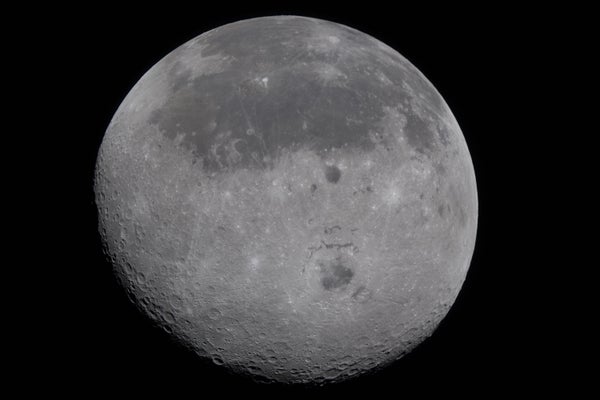
Artemis II crew photo of the Moon on April 6, 2026.
Pioneered in 1959 by the Soviet Union’s robotic Luna 3 mission, the first to photograph the far side of the moon, the distinctive figure eight shape of the free return trajectory has been well established early as an option for lunar missions. But the most famous use of the trajectory was for NASA’s Apollo 13 mission in 1970, which, after a near-fatal mishap on its journey to the moon for a planned lunar landing, aborted to a free return to ensure its three astronauts could get back to Earth.
Technically, the trajectory is referred to as a solution of the “three body” problem in orbital mechanics, where the bodies are Earth, the moon and a spacecraft, says Jay Warren McMahon, an associate professor of aerospace engineering at the University of Colorado, Boulder. (The sun’s gravity also perturbs the trajectory slightly, so it must be accounted for in calculations as well.) Solving the problem typically requires plotting the motion of a spacecraft from Earth’s gravitational “sphere of influence,” where our planet’s pull predominates, to the moon’s domain. For Artemis II, this handover happened at 12:41 A.M. EDT on Monday. “We kind of fly in front of the moon, and it catches up with us and then pulls us back and swings us around,” McMahon says. “So effectively we return faster and on an honestly different path than we would have if the moon hadn’t been there.”
Similar calculations power so-called gravitational slingshot maneuvers used by interplanetary probes such as NASA’s Voyager II to optimize transit times throughout the solar system. They all rely on the transfer of momentum via a gravitational tug from the larger body, whether moon or planet, upon a tiny spacecraft to alter the vehicle’s trajectory in a desired direction. In what is essentially a gravitational tug-of-war in space, a spacecraft passing in front of a moon or planet loses some of its angular momentum to the bigger object, changing its trajectory much like the moon-bound Artemis II. The opposite happens when the spacecraft passes behind the bigger object to gain some angular momentum. Either way alters the spacecraft’s path.
For Artemis II, that bit of physics will send its crew home, setting Integrity on a course to return to Earth on April 10 in an elegant demonstration of orbital mechanics.
It’s Time to Stand Up for Science
If you enjoyed this article, I’d like to ask for your support. Scientific American has served as an advocate for science and industry for 180 years, and right now may be the most critical moment in that two-century history.
I’ve been a Scientific American subscriber since I was 12 years old, and it helped shape the way I look at the world. SciAm always educates and delights me, and inspires a sense of awe for our vast, beautiful universe. I hope it does that for you, too.
If you subscribe to Scientific American, you help ensure that our coverage is centered on meaningful research and discovery; that we have the resources to report on the decisions that threaten labs across the U.S.; and that we support both budding and working scientists at a time when the value of science itself too often goes unrecognized.
In return, you get essential news, captivating podcasts, brilliant infographics, can’t-miss newsletters, must-watch videos, challenging games, and the science world’s best writing and reporting. You can even gift someone a subscription.
There has never been a more important time for us to stand up and show why science matters. I hope you’ll support us in that mission.