

How Artemis II is beaming back stunning video from the moon
A new laser system aboard NASA’s Orion spacecraft is sending sharper video and more data back to Earth
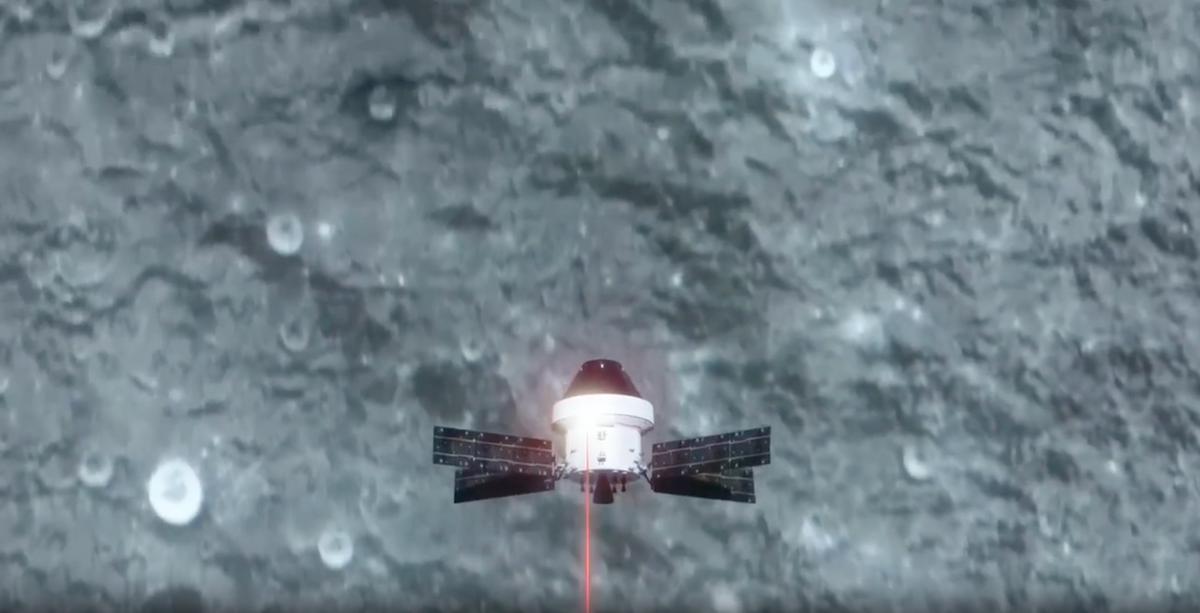
An artist’s visualization of the Orion Artemis II Optical Communications System (O2O) laser communications terminal sending data over infrared light links.
NASA has launched four astronauts on a pioneering journey around the moon—the Artemis II mission. Follow our coverage here.
As the Artemis II mission heads for a flyby of the moon, the Orion crew module is testing one of NASA’s most ambitious upgrades to space communications yet: a laser-based system called O2O. Short for Orion Artemis II Optical Communications System, O2O caps more than two decades of work by NASA and the Massachusetts Institute of Technology Lincoln Laboratory to build better high-bandwidth links for deep space. The system is designed to send data down to Earth at up to 260 megabits per second—far higher than the radio links earlier missions relied on. Scientific American spoke with some of the system’s developers about how it works.
Let There Be Light
“Since the start of NASA, we’ve used what’s called microwave communications, frequencies in the gigahertz region usually,” says Greg Heckler, a deputy program manager for NASA’s SCaN (Space Communications and Navigation) Program, which funded the O2O system. The Orion crew capsule will, in fact, use this older technology as its core communications system, connecting back to NASA’s Near Space Network and Deep Space Network of giant radio antennas spread across the globe.
On supporting science journalism
If you’re enjoying this article, consider supporting our award-winning journalism by subscribing. By purchasing a subscription you are helping to ensure the future of impactful stories about the discoveries and ideas shaping our world today.
NASA has spent the past two decades developing optical communications systems. By using bursts of infrared light—rather than microwaves—from a laser to encode data, these systems can move far more information than traditional systems and can often do so with a smaller and lighter device.
Key components of the O2O’s design have already been validated in a series of demonstrations dating back more than a decade. The Lunar Laser Communication Demonstration in 2013 showed record‑breaking moon‑to‑Earth download speeds, while more recent missions—such as the TeraByte Infrared Delivery (TBIRD) on a CubeSat in low Earth orbit and the Deep Space Optical Communications (DSOC) experiment on the Psyche spacecraft—have pushed laser links to higher rates and longer distances. For more than two years, an optical terminal nearly identical to Orion’s has been operating on the International Space Station. “In every case, we’ve set new data rate records,” Heckler says. “O2O is going to be our last crown jewel in the demonstration series.”
The O2O, which is about the size of a house cat, is expected to achieve data rates of up to 260 megabits per second down to Earth and 20 megabits per second back to Orion. “I think you would be happy if that was your home Internet connection,” Heckler says. The mismatch is a function of the considerably smaller optical receiver on Orion.
For two-way video conversations, this translates to about one second of round-trip lag. “It’s noticeable,” Heckler says, “but not what I would call an impediment.” The ability to have two-way conversations in real time will be key as the Artemis program moves to a more continuous human presence on and around the moon. “Think of what being able to video conference with your family means to an astronaut on the moon that may be in a stressful situation,” Heckler says.
An enhanced information pipeline will also allow scientists on Earth to regularly receive critical mission data from the flight recorder rather than having to wait for Orion to land to recover them. In the future, continuous two-way connectivity could also allow scientists to remotely pilot rovers and monitor critical lunar infrastructure.
Ready, Aim, Fire
The laser used in the O2O module is nothing particularly fancy, as lasers go. “We rely pretty heavily on what the fiber telecom industry uses for their lasers and transmitters,” says Bryan Robinson, group leader in optical and quantum communications at M.I.T. Lincoln Laboratory, which built the O2O terminal. In this case, it is a semiconductor laser in the same infrared, nonvisible wavelengths used in telecommunications. Erbium-doped fiber amplifiers boost that laser to about one watt of optical power emitted from the aperture.
By the time a laser beam from Orion reaches Earth, some 384,400 kilometers away, it is about 6 km in diameter. “Take a laser pointer, which has an aperture of a few millimeters,” Robinson says. “Over a distance of tens of feet [a few meters], it looks like a very small point on a screen. But if you were to propagate that through space, after going 400,000 kilometers like we are, it would be much bigger than the beam I just described.”
From the moon, a 6-km target is minuscule. “The most significant technical challenge for the mission is in pointing the laser with sufficient accuracy,” Robinson says. The O2O module transmits data to ground stations in New Mexico and California, where dry air and minimal cloud coverage help to preserve the link. “Ultimately to bring the link up, you need that pointing to be good to basically a thousandth of a degree.”
Hitting those targets precisely requires knowing exactly where the Orion spacecraft is and how it is oriented, which isn’t easy out in space. While star trackers mounted on Orion indicate where the vehicle is pointing, potential misalignments between the star trackers and the communications terminal can only be fully measured and corrected once in space. “We carefully measure how we’re aligned to the star trackers,” Robinson says. “But even the distance between the star trackers and the Orion terminal on the spacecraft can introduce distortions from temperature and other things that degrade our pointing ability.”
To point the laser, the O2O system uses a 10-centimeter telescope mounted on a two-axis gimbal, which can pivot through a full hemisphere of motion to acquire its target. Back-end optics—light-focusing lenses, tracking sensors, fast-steering mirrors and other components—fine-tune the laser beam. “As long as the spacecraft orients us in the right hemisphere, we should be good,” Robinson says. But there are wild cards, including potential obstructions from Orion’s solar arrays or the body of the spacecraft and uncertainty about how well the vehicle can maintain a consistent orientation. “We expect the first time we try to point the system, we’re going to learn something about the vehicle that you can’t really learn until you’re up there and navigating,” Robinson says.
There will be a brief blackout in all communications systems when Orion passes behind the moon. But on future Artemis missions, relay satellites could help close that gap on the lunar farside.
For the public, however, the clearest payoff is visible in the sharper video O2O is sending home from Orion’s 28 cameras. The system is transmitting 4K video alongside photographs, scientific data and voice communications. “The camera is the mission,” Heckler says. “We want to make sure we’re giving back to U.S. citizens with that 4K video.”