
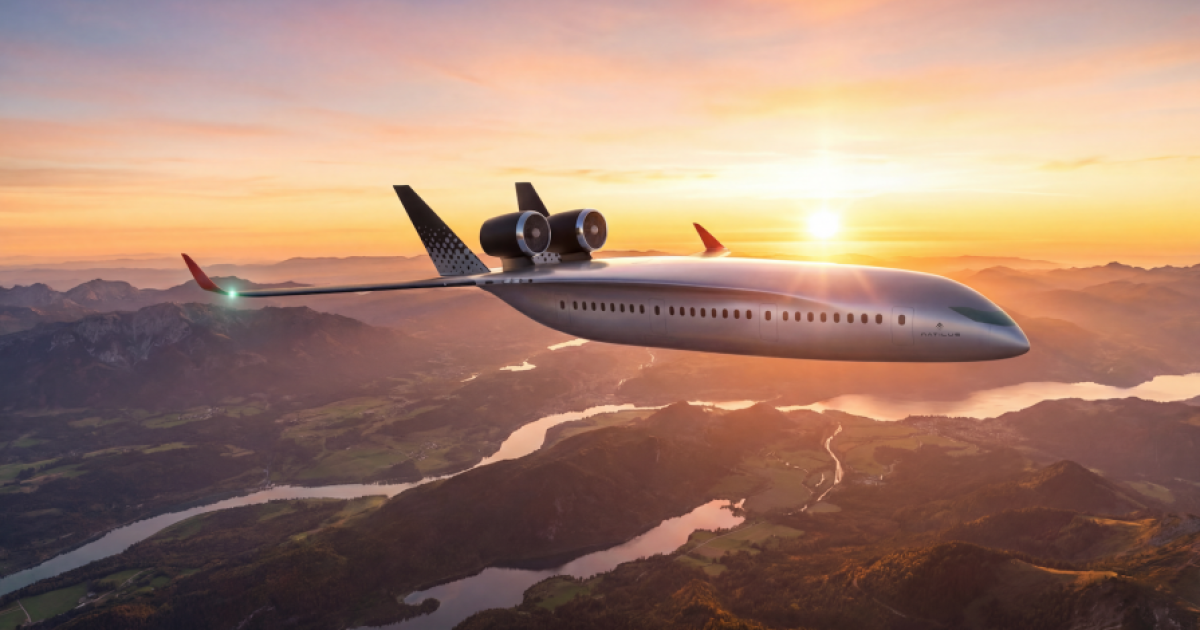
As US-based aerospace manufacturer Natilus secures US$28 million in additional financing, the company has revealed the latest supersized version of its Horizon blended-wing airliner that upgrades the basic design into a double-decker for cargo.
Up until now, Natilus has largely been operating at a conceptual level as it develops its blended-wing aircraft as a 21st-century competitor to the conventional tube-and-wings airliners that have dominated the field.
Beginning in 2016, the company initially proposed a design in which the wings and fuselage are integrated into a single lifting surface as a way of improving the payload of cargo seaplanes without going down the increasingly unpopular jumbo route. Unlike conventional aircraft, blended-wing planes generate less drag because the entire airframe contributes to lift. This can result in higher payloads, lower fuel consumption, reduced structural weight, increased internal volume, and greater overall stability.
Since then, Natilus has built subscale prototypes for testing, and in 2024 the company unveiled its Horizon concept for a 200-seat passenger aircraft aimed at competing in the narrow-body market, while continuing subscale and wind tunnel tests.

Nautilus
Now, with new funding secured, the Horizon Evo has been made public, marking the point where Natilus transitions from theoretical concepts toward creating a commercially viable airframe. In this case, the new aircraft is described as an “evolutionary” design intended to tackle the formidable engineering challenge of overcoming the certification and operational hurdles that the original Horizon couldn’t clear.
The Horizon Evo differs from its predecessor in that it features two decks. The upper deck is dedicated to passengers, while the lower deck is configured to accommodate 12 standard LD3-45 cargo containers. The general idea is that the Horizon Evo will be able to operate from standard narrow-body airport gates without special modifications, while allowing airlines to use standard cargo-handling equipment and loading procedures.
Safety has also been a focus. One criticism of blended-wing aircraft concepts is that passengers could be positioned too far from emergency exits. The new design makes the aircraft narrower without sacrificing volume, allowing not only for easier egress but also for an increased number of window seats across the airframe. The double-decker configuration also places more fuselage volume below the waterline, potentially improving buoyancy in the event of a water landing.
Powered by dual turbofan engines, the Horizon Evo will be built from carbon composites and have a volume 40% greater than that of a conventional narrow-body aircraft. It is claimed to burn 30% less fuel and deliver 50% lower operating costs. Cruising speed is estimated at between Mach 0.78 and Mach 0.80, with a range of 3,500 nautical miles (4,027 miles, 6,482 km). Depending on configuration, it could carry between 150 and 250 passengers in a 3-3-3-3 seating arrangement, with a total payload capacity of 25 tonnes.
The company is targeting entry into service in the early 2030s and says that the Horizon Evo, or some variant of it, will address the estimated 17,000-aircraft market gap anticipated in the narrow-body sector.
“In our ongoing conversations with the FAA and customers, there’s real excitement around what our new airframe brings, not only in terms of fuel economics, but in addressing some of the recent and real pain points happening in aviation today around safety, passenger experience, and plane shortages,” said Aleksey Matyushev, Co-Founder and CEO of Natilus. “These airline-validated insights really drove the design enhancements around dual-deck practicality, egress certifiability, and turnaround times and put us on a clear path to commercial certification.”
Source: Natilus