
Researchers have uncovered the mechanical properties of the nanoscale “thorns” that develop inside lithium-ion batteries, which can cause them to short circuit and die – or worse, such as spontaneously catch on fire. These thorns, known as dendrites, have been difficult to study and understand – until now.
While scientists have studied dendrites within cells for some time, researchers in Singapore and several US universities, including the New Jersey Institute of Technology (NJIT), have uncovered some key mechanical properties that contribute to their formation and expansion, which opens the door to finding ways to inhibit their growth.
“Despite decades of study, the fundamental nanomechanical properties of lithium dendrites remained a mystery – until now,” said co-lead author Qing Ai, a former research scientist at Rice University.
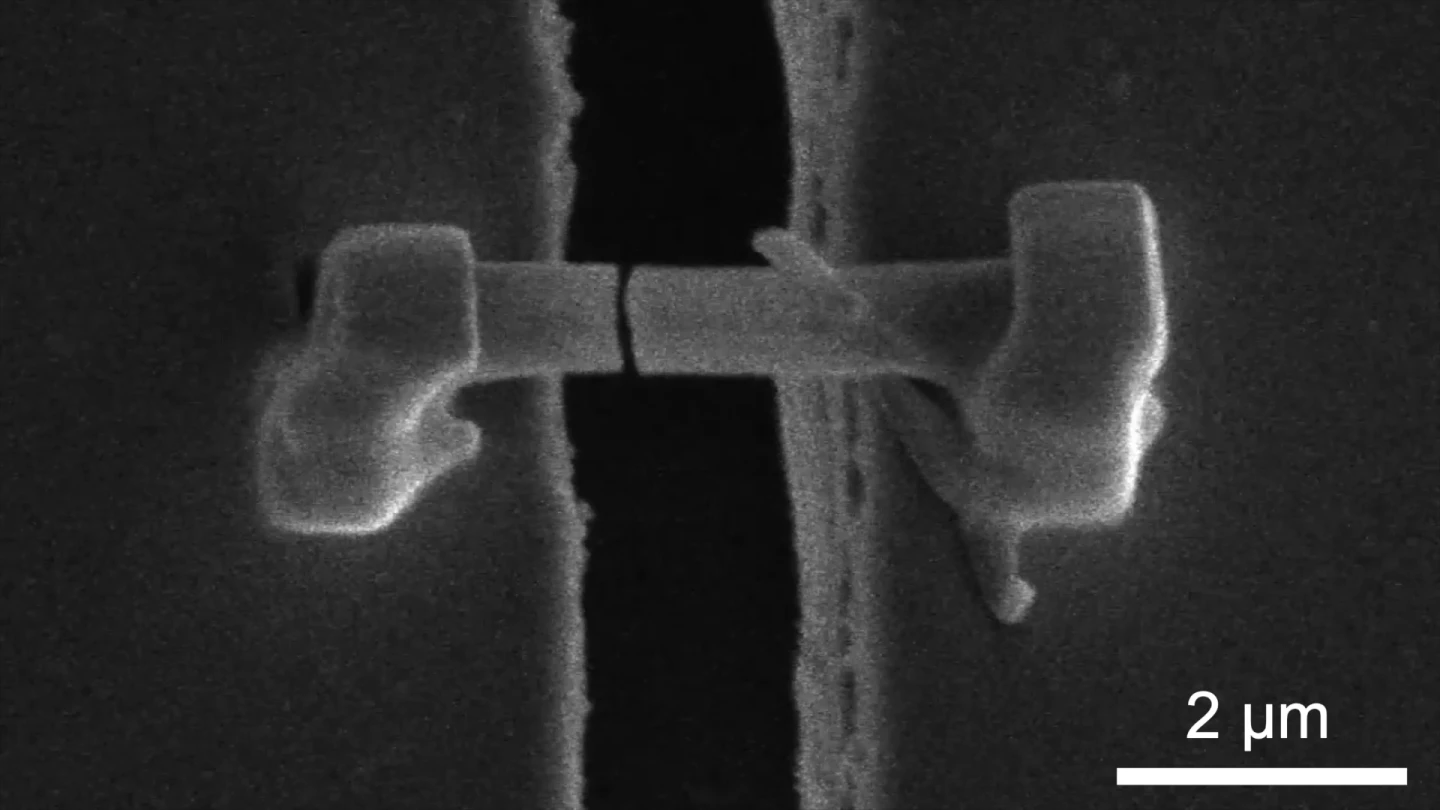
Lithium dendrites – around 100 times thinner than a single human hair – can form inside a battery during charging, growing out from the anode, or the negative terminal. Normally, lithium should spread smoothly across the surface of the negative terminal when charging, but it can instead build up as metallic needle-like structures that slowly penetrate the battery. Inside the cell, the thin separator between the negative and positive electrodes is then at risk of being breached by these dendrites, leaving the positive side of the battery exposed.
Contact can trigger a short circuit – which can also generate heat and damage the battery. From here, there are several possible outcomes – in extreme cases, the heat and chemical reactions from the circuit fail can destroy the battery or ignite a fire. In less severe scenarios, it’s still not good – as broken fragments of dendrites are essentially junk, useless lithium stuck in the cell without the ability to store energy anymore.
Lou Group/Rice University
“Lithium dendrites are widely recognized as one of the biggest obstacles to the commercialization of lithium-metal batteries,” said co-lead author Xing Liu, an assistant professor of mechanical and industrial engineering at NJIT. “During battery operation, lithium dendrites can form, break, and become electrically isolated from the lithium metal anode, creating what is known as ‘dead lithium.’ This process leads to a gradual loss of battery capacity over time. In addition, dendrites can penetrate the separator and create an internal short circuit between the anode and cathode. Both capacity loss and short-circuit risks associated with dendrites are commonly observed in lab studies.
“At present, there is no practical method to ‘clear’ dendrites from a working battery cell,” Liu added.
However, the large team of researchers behind this study are one step closer to finding a way to inhibit their growth altogether. Teams from Rice University, Georgia Institute of Technology, the University of Houston and Singapore’s Nanyang Technological University carefully collected dendrites from working batteries in order to test their mechanical strength. They built air-tight spaces to study the harvested dendrites – because lithium is highly reactive and chemically transforms when exposed to oxygen – and used high-resolution electron microscopy to better understand the behavior of these individual battery saboteurs.
“To enable the quantitative study of lithium dendrites, we developed customized sample preparation and mechanical characterization platforms for such delicate work,” said co-lead authoer Boyu Zhang, a Rice doctoral alum.
What many people may not know is that when you have enough of it, lithium is pliable and “squishy,” and the researchers assumed the dendrites would have similar physical properties. However, they were surprised to find out that through their experiments, these growths behaved unlike anything they expected.
“We conducted scale-bridging simulations to explain why lithium dendrites behave differently from previously thought,” Liu said. “Lithium dendrites have long been assumed to be soft and ductile, like Play-Doh.
“But our observations suggest that they may instead be strong and brittle – snapping more like dry spaghetti,” he added.
Essentially, following the formation of these tiny dendrites, solid electrolyte interphase (SEI) forms around them, and this layer turns the growths into rigid, needle-like spikes that can pierce battery cells’ components. But they can snap under stress, and as mentioned earlier, become dead lithium junk that reduces the battery’s power.
“Understanding the underlying physics provides new insights into how to make dendrites less prone to brittle fracture – for example, by using lithium alloy anodes,” Liu explained.
With this new understanding, researchers are eager to find a way to block the SEI layer that strengthens these dendrites, and in turn prevent these thorns from turning into tough spiky “pasta” that damages battery cells.
“Cryo–transmission electron microscopy and mechanical modeling showed that this behavior arises from solid electrolyte interface constraints and nanoscale strengthening,” noted the researchers. “These findings provide alternative mechanisms for dendrite penetration and dead lithium formation as well as guidance for design strategies for lithium-metal batteries.”
While we’re still unraveling this phenomenon specific to lithium-ion power sources, it’s a big step forward in developing ways to sabotage the dendrites before they get the chance to do that to batteries.
A paper on the research was published in the journal Science.