
This article is part of “Innovations In: Kidney Disease,” an editorially independent special report that was produced with financial support from Vertex.
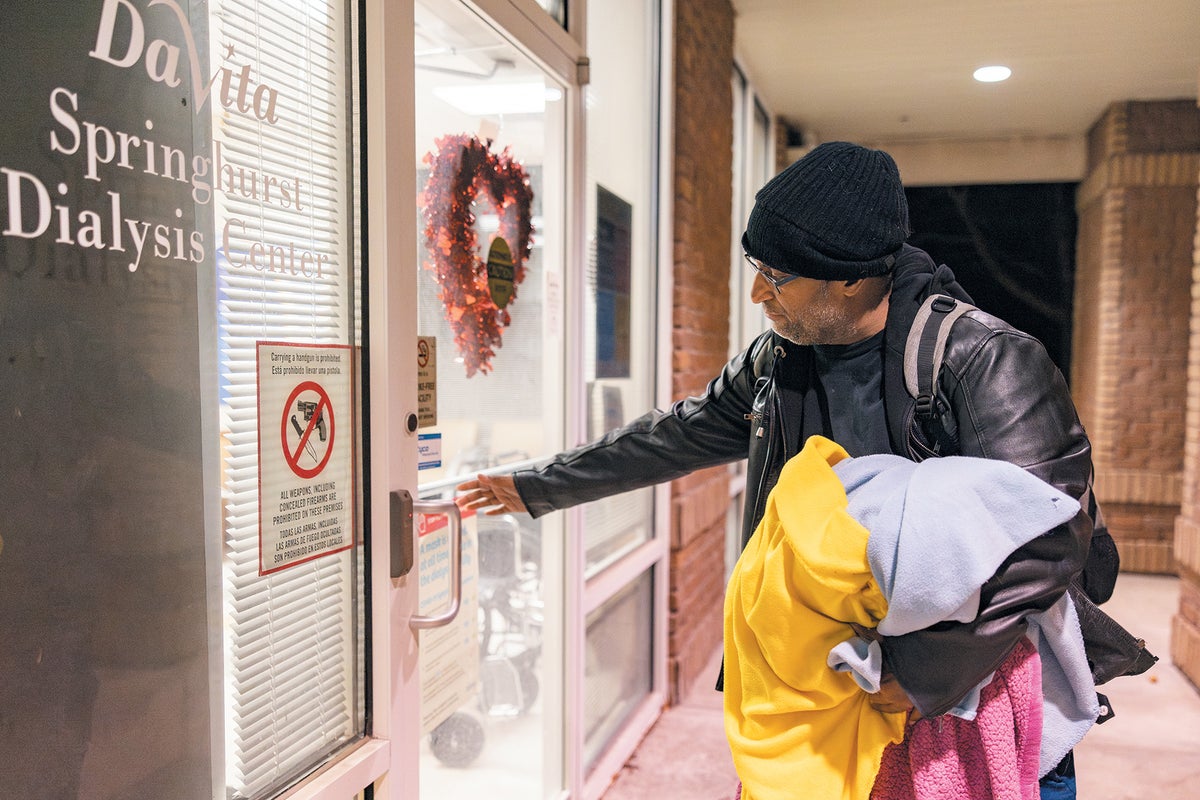
Alex Berrios arrives at the dialysis clinic when the world is still dark, shortly after 5:00 A.M. In his backpack, the Louisville, Ky., man carries a notebook for journaling and a laptop and earbuds to watch movies. Sometimes he meditates during his nearly four-hour treatment three days a week or tries to doze as the machine that keeps him alive beeps and hums beside him.
He doesn’t feel the blood leaving his body and entering the dialysis machine, which filters out toxins and extra fluids and adjusts concentrations of potassium and other minerals to safe levels. But although the dialysis chair is heated, and despite wearing a long-sleeved shirt and a knit hat and covering himself with three blankets, Berrios is always cold in the clinic. It’s a pervasive chill he attributes to his blood cooling slightly during its journey between man and machine. “I’m always needing to wear layers,” says the 46-year-old father of two.
On supporting science journalism
If you’re enjoying this article, consider supporting our award-winning journalism by subscribing. By purchasing a subscription you are helping to ensure the future of impactful stories about the discoveries and ideas shaping our world today.
Berrios is among nearly 36 million adults in the U.S. who live with some degree of kidney dysfunction. Diabetes and high blood pressure are most frequently responsible, but it can also be caused by rare genetic conditions, sickle cell disease or even certain medications. And although treatments such as drugs and dialysis can help mitigate the worst symptoms, chronic kidney disease alters the contours of daily life and presents a variety of ongoing challenges—from changes in diet to hours-long dialysis sessions—for almost everyone diagnosed with it.
When the body’s two kidneys work well, the fist-size organs filter about half a cup of blood every minute, shedding waste products and excess fluids to make urine. It’s a complex operation, reliant on roughly a million tiny filtering units, called nephrons, in each kidney to maintain a balance of water and minerals in the bloodstream. But kidneys have a built-in buffer, says Steven Fishbane, chief of nephrology at Northwell Health in Long Island in New York State. Nature provides more kidney function than you need to survive, he says, “so that you could survive the loss of a kidney.”
Berrios didn’t have that innate redundancy: he was born with only one kidney but didn’t know that until it failed. “I crashed into dialysis the first time,” he says. In 2006, at age 26, suffering from dizziness and uncontrolled vomiting, he suspected he had food poisoning and went to the emergency room. Hospital physicians later diagnosed him with kidney failure and told him he had only one of the usual pair of organs, much to his surprise. He began dialysis soon after. For roughly 18 months he made multiple visits to the dialysis clinic each week, until a woman who sat behind him at church offered him a remarkable gift: one of her kidneys.
Kidneys from living donors last 15 to 20 years on average. Berrios’s transplanted organ failed after 13 years, in part, he believes, because he was getting fewer medical checkups in the early months of the COVID pandemic to minimize his exposure to the virus. In 2020 he reluctantly returned to dialysis.
“People assume, ‘Oh, you have dialysis—you’re going to be fine,’” Berrios says. But nothing fully replicates the intricate workings of healthy kidneys. “It’s like running a marathon. You’re sitting in a chair, and you’re getting your blood cleaned and fluids pulled out,” he says. “It’s hard on the body, hard on your heart, hard on your muscles, hard on a lot of things.”
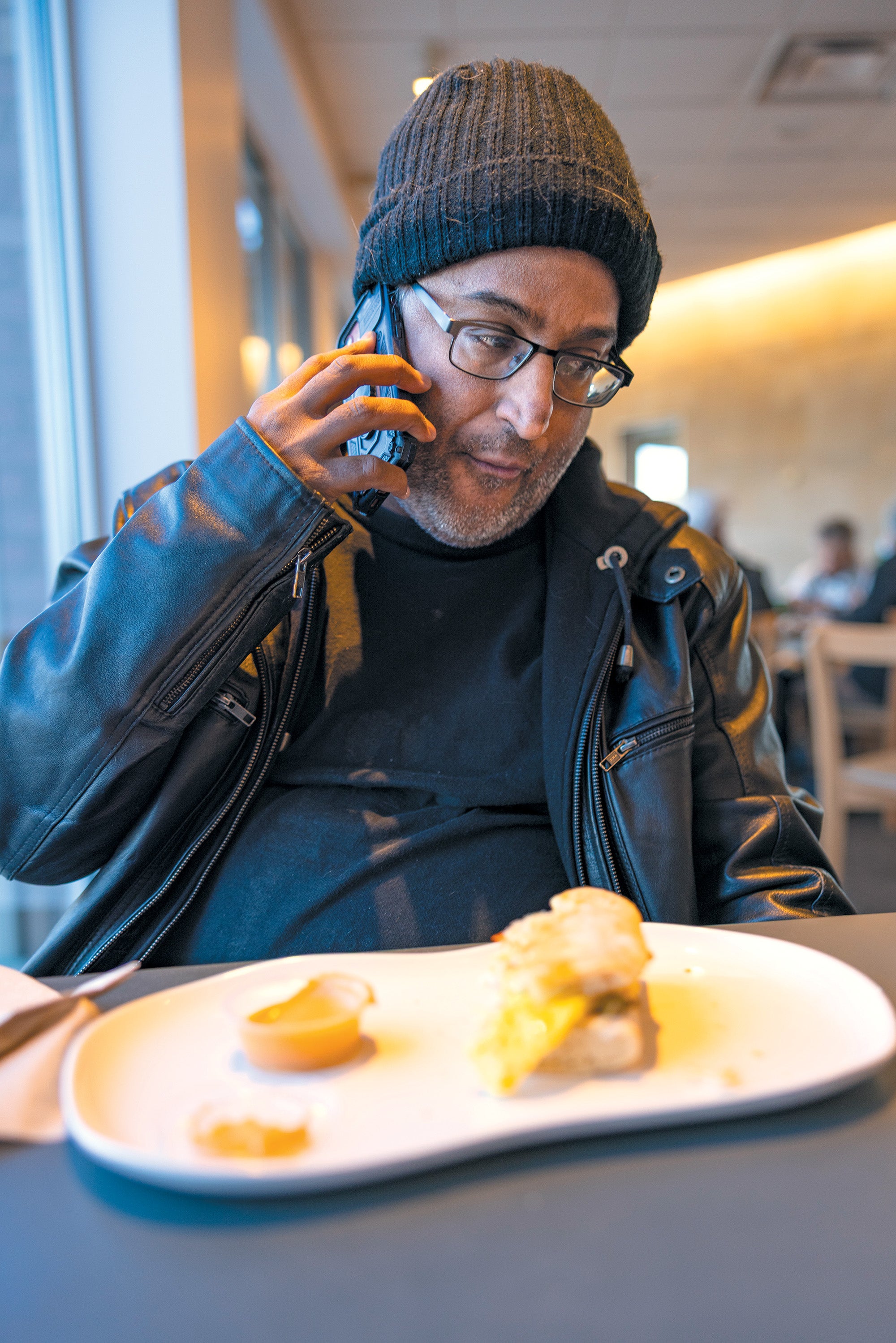
Berrios, 46, eats lunch after one of his dialysis sessions. The sessions occur three times each week, and they feel grueling, sometimes causing severe cramps and making his vision blur for a while.
Most people with kidney disease experience minimal symptoms until the organ’s function drops below 30 percent of normal, Fishbane says. For Berrios, some of the more difficult symptoms are dry or itchy skin and overall body fatigue. Sometimes during the dialysis sessions, fierce muscle cramps hit his legs and abdomen. “It’s like a charley horse but times 50,” he says. “It doesn’t go away—it will linger for a while.”
Occasionally his vision will blur toward the end of a treatment session, Berrios says, noting that clinicians have told him it can be a temporary dialysis side effect. When the blurring happens, he sits for a short stretch in the lobby until he can see clearly enough to drive home.
Marcelo A. Peña, now 39, has been on dialysis for about 25 years. He was diagnosed at age 10 with a disease called focal segmental glomerulosclerosis, in which scar tissue buildup can lead to kidney failure. By age 13 doctors told him he needed to start dialysis or get a kidney transplant.
His mother donated one of hers. But the original disease proved to be so aggressive that it was damaging the transplanted organ within a few months, Peña says. “That strong little Mexican kidney lasted about two years,” he says. “My mother is very resilient, and she’s from Mexico. It fought for its life—it really did.”
Peña, who lives in Charlotte, N.C., has tried every type of dialysis. For a few years, instead of going to a hemodialysis clinic, he tried peritoneal dialysis. In this procedure, dialysis solution flows through an abdominal lining called the peritoneum and then into the abdominal cavity to filter waste from the blood and excess fluids from the body. It’s typically done daily at home or somewhere else convenient.
For nearly a decade Peña has been giving himself hemodialysis at home, filtering his blood through a machine in his bedroom. He says that when he does home dialysis three to four evenings every week, he notices less strain on his body than when he went to the clinic, and he has more free time to paint, create music and pursue his intensive wellness routine, which incorporates yoga, meditation and backyard workouts. He also works part-time hours as a patient advocate.
Each treatment requires fresh dialysis solution—a combination of a sugar called dextrose and other chemicals similar to those found in the body—which Peña also makes at home. He preps the machine the night before so that when he wakes up, it’s ready to start the seven-hour process, and he doesn’t need to interrupt the rest of his daily routine to make time for it. “All I’ve got to do is just press two buttons,” he says, “and then I can just go about my day.” Before using the solution, Peña tests each batch to ensure the filtered water used in it is sterile. He dons a mask and gloves when he inserts the needles into his arm that withdraw his blood and then return it.
Before he begins the dialysis process, Peña cooks dinner and sets it up nearby. During treatments, he’ll read or watch podcasts or other videos. He periodically checks his blood pressure to make sure it’s not too high or too low.
Sometimes he dozes off toward the end, awakening when he senses the machine slowing down. After it’s over, Peña almost always experiences what he describes as a dialysis mental fog. “Simple questions are almost out the window, or you’re going to get a delayed response,” he says. “You feel like a shell of yourself.”
The only remedy is a good night’s sleep. “The next day I’m pretty much good to go,” Peña says, restored to 80 to 90 percent of his usual energy level.
Stacey Warr’s blood pressure readings had been high since her freshman year of college. But other than a brief prescription for blood pressure pills, her doctors hadn’t suggested any other medication, and she had no idea that hypertension posed a serious risk to her kidneys. It was only when Warr was abruptly hospitalized at 29 years old, with vomiting and severe shortness of breath, that she learned about her limited kidney function. By then, her disease had already advanced to stage 5.
“I couldn’t cook with any salt products whatsoever. No canned foods. No deli meats. I cried in the grocery store trying to find something to eat.” —Stacey Warr Patient, Age 36
As many as nine in 10 adults with kidney disease don’t realize they have it, in part because the damage can progress for years without symptoms. “The low detection rate is a major, major problem,” says Kirk Campbell, a nephrologist at the University of Pennsylvania and president of the National Kidney Foundation. People are often less savvy about the risk factors for kidney disease compared with the risks for heart trouble and other chronic conditions, he says. Plus, there’s no recommended universal kidney screening.
When Warr was diagnosed, her kidney function was low but remained stable, not severe enough to require dialysis. But her diet and social lifestyle changed overnight. She stopped drinking alcohol. Because clinicians advised her to strictly limit her consumption of calcium, phosphorus, potassium, and other common nutrients, she subsisted largely on berries, white rice, shrimp, salmon and water. “I couldn’t cook with any salt products whatsoever,” says Warr, who is now 36 and living in Upper Marlboro, Md. “No canned foods. No deli meats. I cried in the grocery store trying to find something to eat.” After meeting with a dietitian, she expanded her options, adding chicken, red meat, sweet potatoes, and other kidney-friendly foods.
“It was very hard,” Warr says. “I didn’t know anyone with chronic kidney disease, especially at my age. I felt like I couldn’t relate to anyone.”
Nearly 38 percent of people with kidney dis-ease report symptoms of anxiety or depression, as well as sleeping difficulties, according to a 2024 study in the American Journal of Nephrology for which researchers interviewed 103 adults from the U.S. and elsewhere. “Finding out that they have kidney disease initially really kind of shakes people,” says Fishbane, a co-author of the study.
Advanced disease also can cause someone to feel “loneliness, alienation, isolation, separateness,” says Molly Kierein, a California-based clinical psychologist who works with kidney patients and had a transplant herself after being diagnosed with end-stage kidney disease.
Warr got a mood boost from something she started doing to improve her physical health: running. Soon she was competing in 5K and 10K races. Running not only eased her depression but also provided her with focus and a challenge that she could conquer. In recent years she has also leaned into advocacy, sharing her story to highlight the higher risk in her Black community. In the U.S., 20 percent of Black adults have kidney disease, compared with 14 percent of Asian and Hispanic adults and 12 percent of white adults.
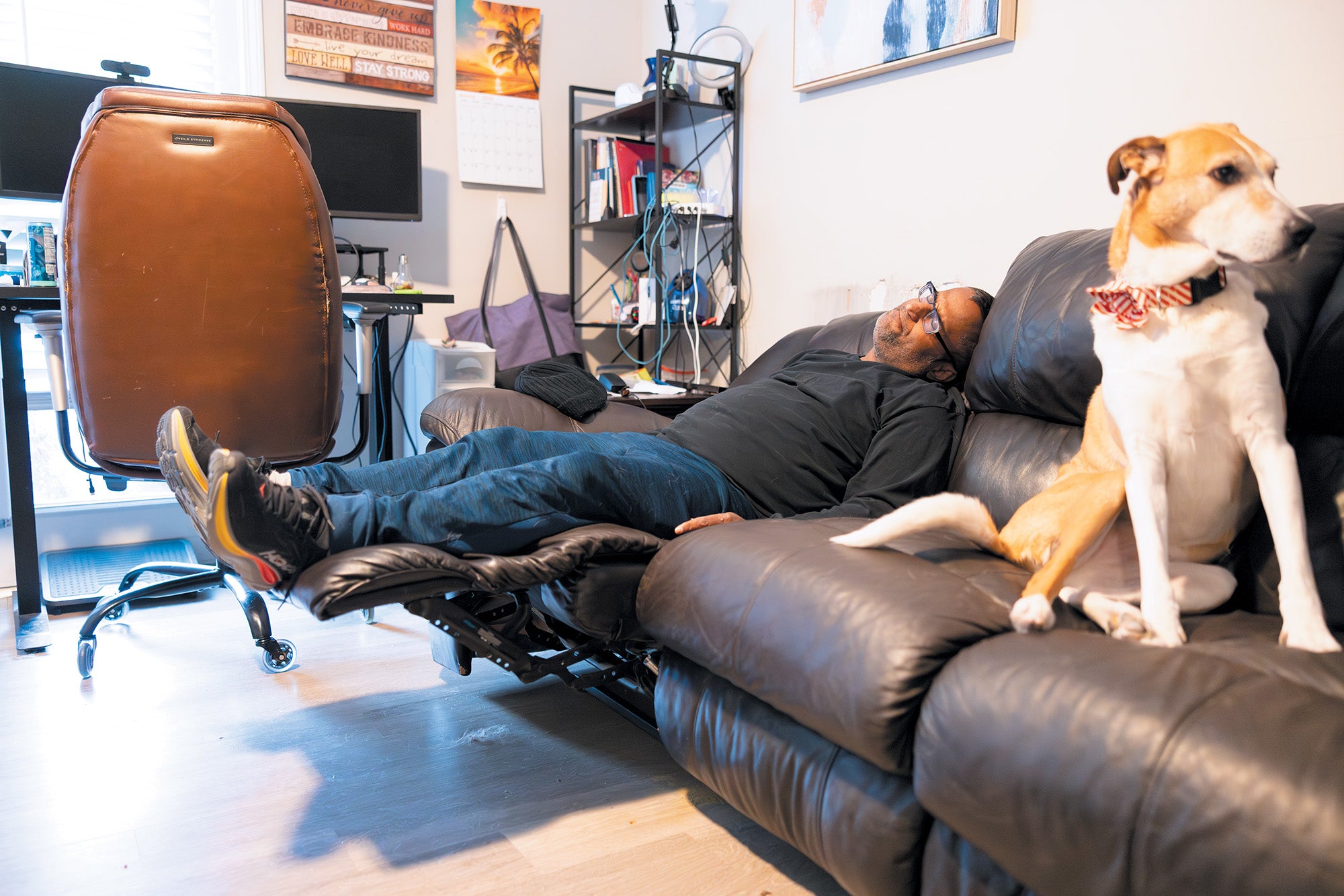
“It’s like running a marathon,” Berrios says about dialysis, sitting on a couch at his home with his dog, Jemma. “It’s hard on your body, hard on your heart, hard on your muscles, hard on a lot of things.”
Warr had been on the transplant list for nearly three years when, on September 10, 2025, she received the call about an available kidney. Within two hours she and her mother were walking into MedStar Georgetown University Hospital in Washington, D.C. By then Warr’s kidney function was between 13 and 15 percent.
“Interestingly enough, they didn’t take my kidneys out, so I have three kidneys,” Warr says. “But the new one is the only one that’s operating.” Surgeons typically leave the original kidneys behind to avoid the risks involved with removing them, says Campbell, who also notes that the nonfunctioning organs tend to shrink over time.
In the short term, Warr is still avoiding sushi, unpasteurized cheeses, and other foods that might pose a risk to her new organ. She drinks at least eight cups of water daily—unlike dialysis patients, recipients of successful transplants are encouraged to take in fluids—and indulges in only one cup of coffee or tea, less than what she consumed before her transplant. “They don’t want the new kidney to get dehydrated,” she says.
Four times every day an alarm sounds on Warr’s phone reminding her to take her pills—more than two dozen daily at this point, most of them aimed at preventing organ rejection. Shortly after the transplant, Warr was well enough to return to her remote job as an IT project manager. She and her partner picture a baby in their future, she says; Warr is setting her sights on 2027 or 2028. Before that, she says, she plans to complete her first marathon.
Berrios initially chose the predawn hours for dialysis so he could continue his work at a kidney-care start-up. But last fall he realized that he didn’t have enough energy to continue and needed to focus on his health.
“Just staying alive” is a full-time job for people on dialysis, says Kierein, the psychologist. She helps them find ways to retain their sense of autonomy, part of which involves thinking through why they recommit to treatment week after week.
The goal may be to live long enough to attend a family wedding or until an adult child is ready to move out, Kierein says. “It can be, ‘I love my partner too much.’ It really could be anything. It could be someone who is just so afraid of death that they decide that they want to keep going.”
For Berrios, much of this forward thinking involves keeping his 15-year-old daughter and 10-year-old son top of mind. He knows that his chances of getting a second kidney are low because he’s developed antibodies that make him highly likely to reject a new organ. But he’s keeping his options open, including by monitoring research involving pig kidneys for transplants.
After five years of trips to a dialysis clinic, Berrios’s stamina has flagged. At times, he says, his body feels more like that of a 70-year-old than a 40-something. He can walk only half a mile at a stretch instead of two to three.
Even so, Berrios settles into the heated chair every time, bundled under blankets, determined to keep a positive mindset. “I look beyond myself,” he says. “I’m sitting there doing it physically. But it’s for my family, my kiddos … I feel like I still have a lot of life ahead of me.”
Editor’s Note (3/18/26): On February 22 Alex Berrios received a transplanted kidney during a nearly eight-hour surgery in New York City. His donor was a 49-year-old man. In March Berrios reported he was doing well and had higher energy levels.