

The universe is filled with a cacophony of colliding black holes
A new catalog of gravitational waves more than doubles the known number of these spacetime ripples
MARK GARLICK/SCIENCE PHOTO LIBRARY via Getty Images
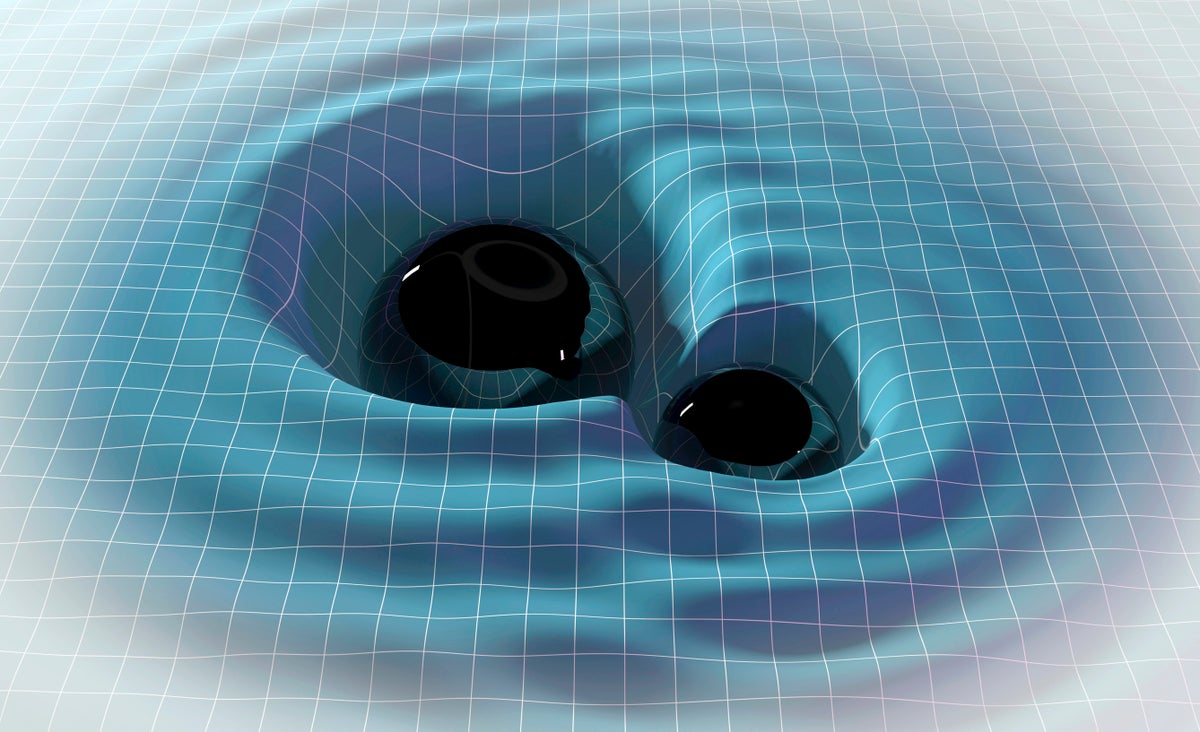
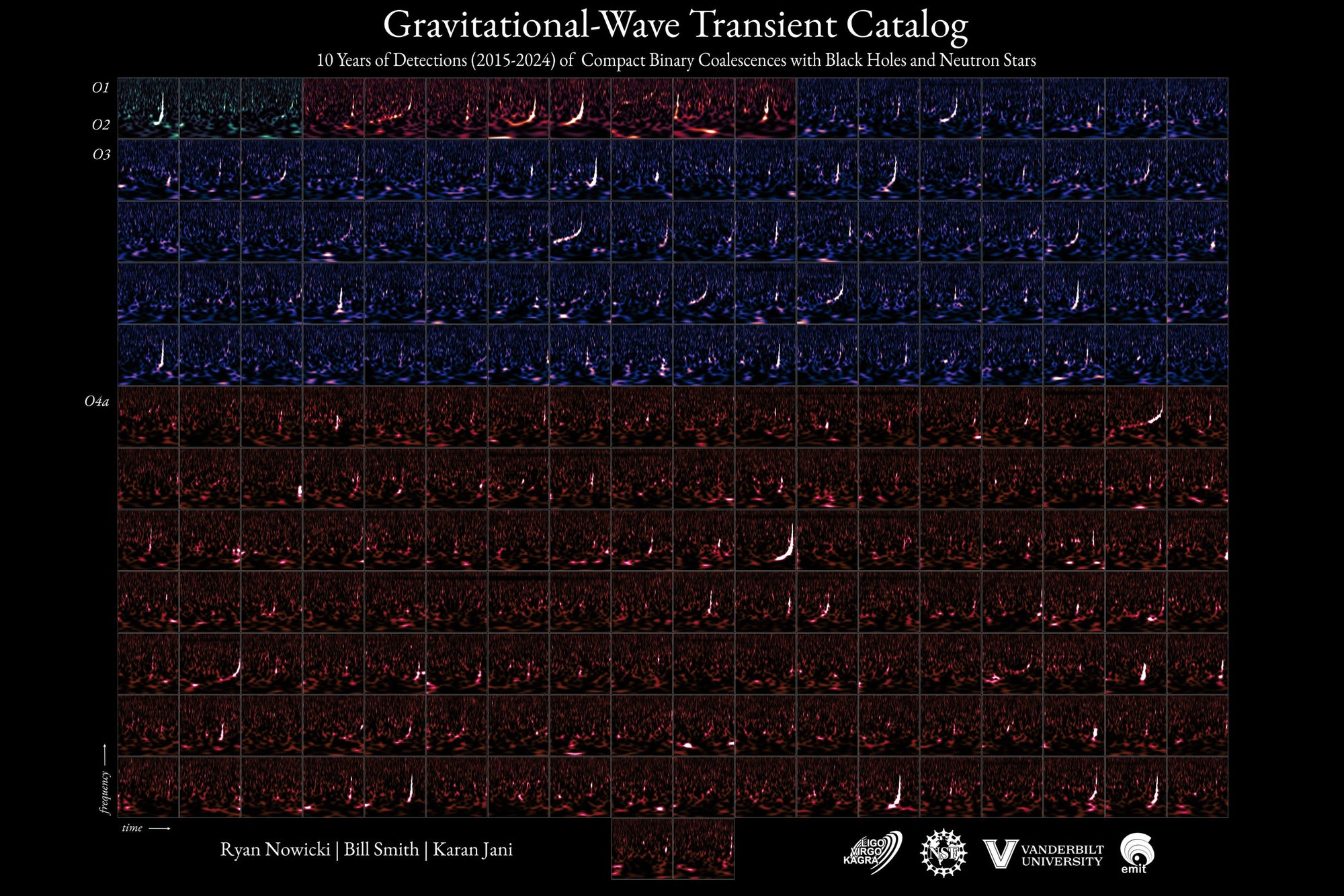
When black holes collide, the crash generates ripples in the fabric of spacetime—gravitational waves. These distortions travel far out into the universe, but by the time they reach Earth, they have become faint, making them extremely hard to detect. Thanks to a global network of observatories—called the Laser Interferometer Gravitational-Wave Observatory (LIGO), Virgo and the Kamioka Gravitational-Wave Detector (KAGRA)—scientists have found scores of these tiny wobbles in spacetime. And now the collaboration has released its latest dataset, more than doubling the number of detections.
The results reveal that our universe is reverberating with cosmic collisions. Some of the waves stem from pairs of black holes colliding, and others appear to have come from crashing black holes and neutron stars—the dense, dead cores of massive stars—as well as from two neutron stars smashing together.
The new catalog also reveals a greater variety of known black holes, including some that appear lopsided, and others that spin incredibly fast. Together, the observations are “phenomenal,” says Zsuzsanna Márka, an associate research scientist at Columbia University, who was previously involved in the LIGO-Virgo-KAGRA collaboration.
On supporting science journalism
If you’re enjoying this article, consider supporting our award-winning journalism by subscribing. By purchasing a subscription you are helping to ensure the future of impactful stories about the discoveries and ideas shaping our world today.
Ryan Nowicki/Bill Smith/Karan Jani/LIGO-Virgo-KAGRA/Vanderbilt University/EMIT/NSF
“We are really pushing the edges, and are seeing things that are more massive, spinning faster, and are more astrophysically interesting and unusual,” said Daniel Williams, a research fellow at the University of Glasgow and a member of the collaboration, to MIT News.
The expanded set of detections enables astronomers to test Albert Einstein’s general theory of relativity, which holds that gravity is a geometric property of spacetime.
Doing so can help answer one the holy grails of the field, says Szabolcs Márka, a professor of physics at Columbia University, who has worked on LIGO and is married to Zsuzsanna Márka. “What is beyond Einstein’s general relativity theory? Large catalogs are paving the way towards deep understanding of these enigma,” he says.
According to the theory, mass warps the shape of spacetime, causing objects to travel on curving pathways near heavy masses. The gravitational waves produced by these cosmic collisions will reveal new details about this warping that can confirm or challenge the predictions of Einstein’s theory.
The catalog will be detailed in the Astrophysical Journal Letters, and a paper about it was recently published online in the journal. Soon, it may be possible to release real-time data from the collaboration, the Márkas say.
“Each new gravitational-wave detection allows us to unlock another piece of the universe’s puzzle in ways we couldn’t just a decade ago,” said Lucy Thomas, a co-author of the paper and a postdoctoral researcher at the California Institute of Technology’s LIGO Lab, to MIT News. “It’s incredibly exciting to think about what astrophysical mysteries and surprises we can uncover with future observing runs.”
It’s Time to Stand Up for Science
If you enjoyed this article, I’d like to ask for your support. Scientific American has served as an advocate for science and industry for 180 years, and right now may be the most critical moment in that two-century history.
I’ve been a Scientific American subscriber since I was 12 years old, and it helped shape the way I look at the world. SciAm always educates and delights me, and inspires a sense of awe for our vast, beautiful universe. I hope it does that for you, too.
If you subscribe to Scientific American, you help ensure that our coverage is centered on meaningful research and discovery; that we have the resources to report on the decisions that threaten labs across the U.S.; and that we support both budding and working scientists at a time when the value of science itself too often goes unrecognized.
In return, you get essential news, captivating podcasts, brilliant infographics, can’t-miss newsletters, must-watch videos, challenging games, and the science world’s best writing and reporting. You can even gift someone a subscription.
There has never been a more important time for us to stand up and show why science matters. I hope you’ll support us in that mission.