
Next.js vs Node.js for business applications is one of those comparisons that comes up often, but it’s worth clarifying upfront: these two technologies are not direct competitors. Node.js is a runtime environment. Next.js is a React-based frontend framework that runs on top of Node.js.
The more accurate question is which one plays the bigger role in your specific business application, and the answer depends entirely on what you’re building. For most modern web applications, you’ll likely end up using both.
What Is Next.js and What Is Node.js?
Node.js, released in 2009, allows JavaScript to run on the server side. Before Node.js, JavaScript was strictly a browser language. Node.js changed that, making it possible to build backend services, APIs, real-time applications, and command-line tools entirely in JavaScript. It uses Google’s V8 engine and has built one of the largest package ecosystems in software development, with over 2 million packages available on NPM.
Next.js, created by Vercel and first released in 2016, is a framework built on top of React. It handles routing, server-side rendering, static site generation, and API routes out of the box. It runs on Node.js under the hood but focuses on the frontend layer and the bridge between frontend and backend.
The 2023 Stack Overflow Developer Survey showed Next.js ranked among the most popular web frameworks, with over 16% of developers reporting regular use. (source)
These are tools that solve different problems. Understanding that distinction is the first step toward making a smarter technology decision for your business.
Next.js vs Node.js: What Does Each One Actually Handle?
When businesses ask about next js vs node js, they’re usually trying to figure out where to focus their architecture. Here’s how to think about it practically.
Node.js is the engine room. It powers your server, handles your database connections, manages authentication logic, processes background jobs, and exposes API endpoints. If you’re building a standalone backend service, a REST or GraphQL API, or a real-time application like a chat system or live dashboard, Node.js is the layer doing that work.
Next.js is the front of the house. It manages what users see, how pages load, how fast they render, and how the application behaves in a browser. Its server-side rendering capability means pages can be pre-rendered on the server before reaching the user, which directly improves SEO and initial load performance. Its API routes feature also allows lightweight backend logic to live inside the same Next.js project, which reduces complexity for smaller applications.
For a business building a customer-facing web platform, Next.js handles the experience layer while Node.js handles the data and logic layer behind it. They’re complementary, not competing.
How the Two Technologies Compare Across Business Use Cases
|
Factor |
Node.js |
Next.js |
|
Primary Role |
Server-side runtime | Frontend React framework |
| Backend Logic | Full backend capability |
Limited via API routes |
|
SEO Optimization |
Not applicable directly | Built-in SSR and SSG |
|
Real-time Apps |
Strong (WebSockets, etc.) |
Limited |
| Full-stack Projects | Paired with a frontend |
Can handle both layers |
|
Learning Curve |
Moderate |
Moderate to low for React devs |
|
Deployment Flexibility |
High |
High (Vercel, AWS, self-hosted) |
| Enterprise Adoption | Very high |
Growing rapidly |
When Node.js Should Lead Your Architecture
There are project types where Node.js needs to be the primary focus and Next.js may not even be necessary.
High-throughput APIs that serve mobile apps, third-party integrations, or microservices architectures don’t need a frontend framework at all. Node.js with Express, Fastify, or NestJS handles these scenarios cleanly. If your business is building backend infrastructure that other systems consume, Next.js adds no value.
Real-time applications are another Node.js stronghold. Live order tracking, collaborative tools, event-driven systems, and anything using WebSockets benefits from Node.js’s non-blocking I/O model. It handles concurrent connections efficiently, which is why companies like LinkedIn and Netflix have used it for specific high-concurrency services.
If your team is working on content management system development for a larger platform, the backend data layer, user permissions, content storage, and API delivery will all run through Node.js regardless of what frontend framework sits above it.
When Next.js Should Lead Your Architecture
Next.js earns its place when the user-facing experience is a priority and SEO matters.
E-commerce platforms, marketing sites, SaaS dashboards, and any web application where search visibility drives traffic should lean heavily on Next.js. Its static site generation and server-side rendering capabilities mean pages load fast and index well. Page speed directly affects conversion rates. Google’s Core Web Vitals are a ranking factor, and Next.js is built with those metrics in mind.
For businesses that need a full-stack solution without the overhead of maintaining a completely separate backend, Next.js API routes handle lightweight server logic well enough to cover many common use cases. This makes it particularly attractive for early-stage products trying to ship quickly without over-engineering.
Teams looking to hire Next.js developers will find a growing and skilled talent pool, particularly among React developers who have adopted the framework as their default choice for production applications.
The Case for Using Both Together
Most serious business applications end up using Next.js on the frontend and Node.js on the backend as separate services or within the same monorepo. This combination is increasingly common because it gives you the best of both.
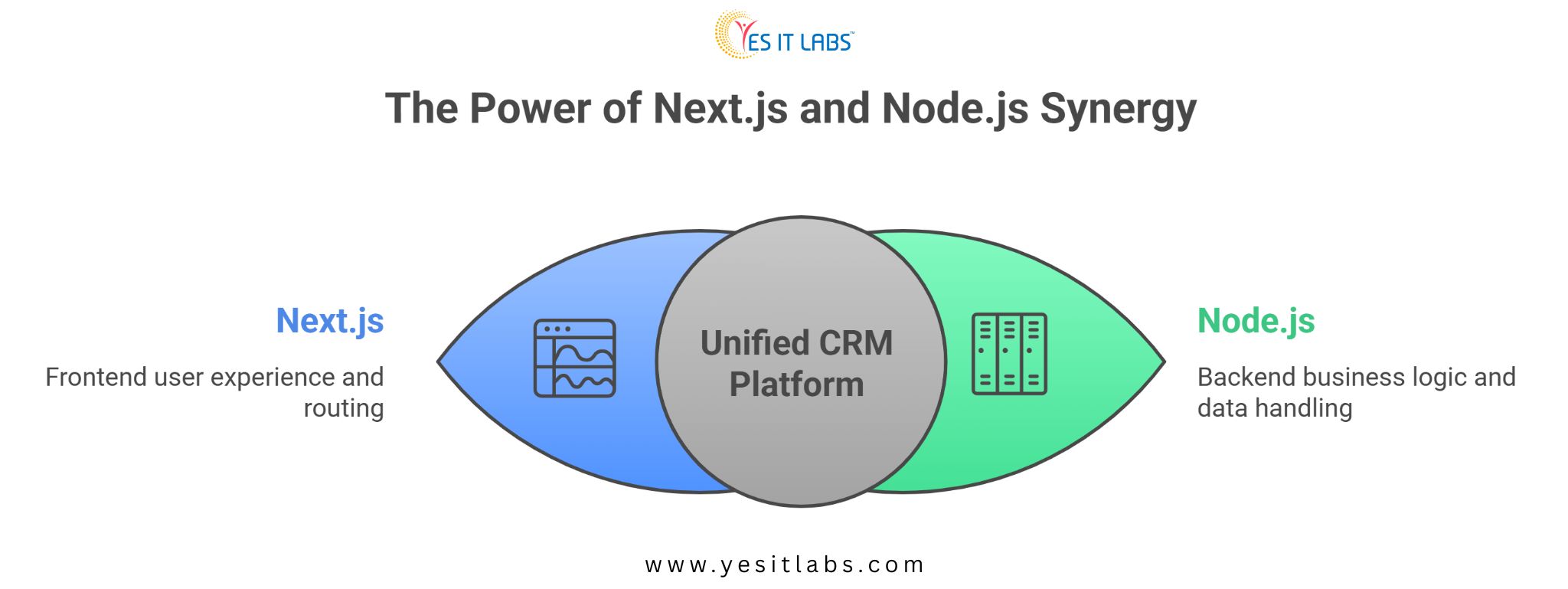
Next.js handles routing, rendering, and the client-side experience. Node.js, often through a framework like NestJS or Express, handles business logic, database operations, authentication, and third-party service integrations. The two communicate via internal APIs.
This architecture scales well. It separates concerns cleanly. And it allows frontend and backend teams to work independently without stepping on each other.
For businesses building something like CRM system development services or a custom CRM platform, this split architecture is particularly sensible. The CRM frontend, dashboards, contact views, pipeline management, sits in Next.js. The backend, data models, workflow automation, integrations with email and calendar services, lives in Node.js.
Challenges and Honest Considerations
Next.js has a few real limitations worth acknowledging. The framework evolves quickly. The App Router introduced in Next.js 13 was a significant architectural shift, and teams that had built patterns around the Pages Router had to adapt. Keeping up with breaking changes requires active effort.
Node.js, on the other hand, has a more stable release cadence with clearly defined LTS versions. For businesses that need long-term maintainability, Node.js infrastructure tends to be more predictable to support over time.
Neither technology is the right choice for every team. A business with a small development team might do better with a more opinionated full-stack framework rather than stitching together Next.js and a Node.js backend separately. The architecture that looks clean on a whiteboard can become a maintenance burden if the team doesn’t have the bandwidth to manage it properly.
Practical Advice for Making the Right Call for Next.js vs Node.js
Start by mapping your application’s actual requirements before picking a technology.
If SEO matters, users interact directly with the frontend, and you need fast page loads, Next.js should be a central part of your stack. If you’re building data-heavy backend services, APIs, or real-time features, Node.js takes priority.
For teams that need backend flexibility and are scaling an existing product, it makes sense to hire node js app developers with experience in production-grade API architecture. The backend decisions made early have long-term consequences that are harder to undo than frontend choices.
For most modern web applications, the honest recommendation is to use both. Next.js for the frontend and Node.js for the backend is a well-understood, well-documented pattern with strong community support. Trying to force one to do the job of the other usually creates problems that could have been avoided.
FAQ: Next.js vs Node.js for Business Applications
Is Next.js a replacement for Node.js?
No. Next.js runs on top of Node.js and cannot replace it. Next.js is a React framework focused on frontend rendering and user experience. Node.js is the runtime environment that powers the server. They serve different purposes and are often used together in the same application stack.
Can Next.js handle backend logic on its own?
To a limited extent. Next.js API routes allow you to write server-side logic within the same project, which works well for simple operations like form submissions or data fetching. For complex backend requirements involving heavy database operations, background jobs, or extensive business logic, a dedicated Node.js backend is a more appropriate choice.
Which is better for SEO, Next.js or Node.js?
Next.js is better for SEO because it supports server-side rendering and static site generation, both of which help search engines crawl and index content effectively. Node.js alone doesn’t handle frontend rendering, so SEO depends on what frontend framework or rendering approach is layered on top of it.
Which technology is more in demand for hiring?
Both are in high demand, but in different contexts. Node.js developers are sought for backend and API roles. Next.js developers are sought for frontend and full-stack roles. Teams building complete web applications often look for developers comfortable with both, since modern projects tend to use them together.
How does this choice affect project cost?
Using Next.js alone for a simple application can reduce initial costs by avoiding a separate backend service. However, as an application grows, the cost of working around Next.js’s backend limitations often exceeds the savings. Starting with a clear separation between Next.js and a Node.js backend from the beginning tends to be more cost-effective at scale.
Conclusion
The next js vs node js comparison is really a question about which layer of your application needs the most attention. Node.js powers the server, the data, and the logic. Next.js powers the experience, the rendering, and the SEO. For most business applications of any real complexity, the answer isn’t choosing between them. It’s understanding how to use each one where it actually belongs.
Technology decisions made on surface-level comparisons tend to create problems later. Map your requirements honestly, match the tool to the job, and you’ll spend less time undoing decisions that looked good on paper.