

At dusk, the greatest migration of biomass on Earth unfolds through the oceans in near silence, largely unnoticed. Trillions of often tiny creatures – zooplankton, krill, lanternfish – rise in synchrony from the depths, drawn by blooms of phytoplankton in the uppermost layers of water. They feast through the night, safe from predators that hunt by sight, then retreat as the sun rises.
The ebb and flow of the sun and moon dictate the behaviour of many sea creatures. But in recent decades, large areas of the ocean surface have mysteriously been darkening. Tim Smyth, a marine scientist at Plymouth Marine Laboratory in the UK, and his colleagues were the first researchers to spot this pattern in the open ocean last year. Since then, he has continued to study how the oceans are shifting in response to global warming alongside changes in land use – and the crucial role that light plays within these habitats.
Smyth tells New Scientist about the origins of ocean darkening, what the implications are for marine ecosystems and what can be done to let more light pierce the surface layers of the oceans.
Thomas Lewton: How did you discover that large swathes of the ocean are darkening?
Tim Smyth: We first approached this issue from an unexpected direction. For the past decade, I’ve been working with Tom Davies, a marine conservation scientist at the University of Plymouth, to understand the impacts of artificial light pollution at night. As part of this work, we analysed 20 years of global satellite data to track changes in the ocean’s optical properties. To our surprise, we found consistent patterns of darkening, meaning that the surface waters are becoming more opaque to incoming light. Instead of random patches scattered across the global ocean, these changes form large, connected regions. Overall, we discovered that roughly one‑fifth of the world’s oceans have darkened in some way.
Why is the ocean darkening?
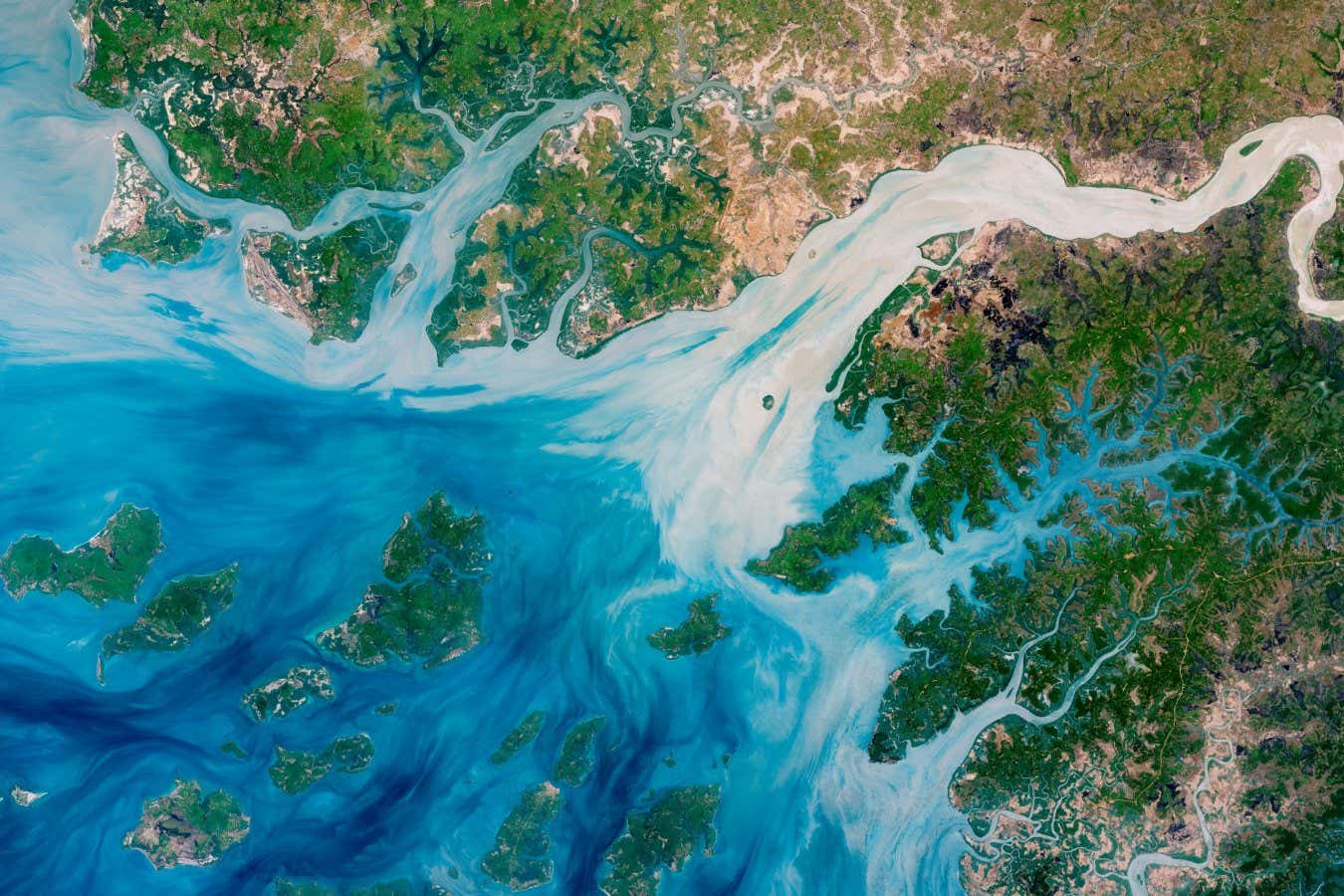
In coastal regions, ocean darkening is closely linked to changes in the rivers that flow into the sea. Along coastlines, shifts in land use affect what becomes dissolved or suspended in the water, which, in turn, alters the optical quality of the water entering the ocean. For example, when a landscape changes from forested to agricultural, it influences how materials are washed into rivers. During floods, rivers carry far more suspended particulates and much higher levels of coloured, dissolved organic matter, the substances that give rivers that “steeped tea” colour.
Another key driver of coastal ocean darkening is nutrient loading. Fertilisers used in industrial agriculture are washed into rivers, stimulating phytoplankton growth. When phytoplankton blooms increase, they reduce how deeply light can penetrate the water column. We have known for some time that coastal waters are darkening, but what we have now uncovered is that these changes extend beyond coastlines: there is also a wider‑scale darkening of the open ocean.

Tim Smyth studies how the oceans are being affected by land-use changes and global warming
Klawe Rzeczy
What is causing the changes in the open ocean?
They may be linked to shifts in phytoplankton blooms driven by climate change. Globally, we are seeing rising ocean temperatures, more frequent marine heatwaves and changes in salinity in some regions. Together, these changes influence large‑scale ocean circulation patterns.
Phytoplankton blooms themselves depend on a combination of light, nutrients, temperature and the vertical structure of the water column. In winter, the open ocean is usually well-mixed by storms sweeping over the surface. But as spring arrives, more stable surface layers begin to form. These stratified surface layers limit vertical mixing, concentrating light and nutrients in the upper ocean, where phytoplankton can most effectively grow.
So, my suspicion is that we are observing a complex interplay of altered global circulation patterns and more localised shifts in weather, such as sunnier conditions and increasingly stable surface waters, all of which promote phytoplankton growth and contribute to the broader darkening of the open ocean.
How does ocean darkening impact marine ecosystems?
It helps to think about the different levels in the ocean of the food web. At the lowest level are the primary producers, the phytoplankton, which can be one of the causes of darkening. Then the next level up are the zooplankton, such as Calanus copepods, which fish feed on. Calanus copepods are really important because they are the midpoint in that first part of the food web. They perform what’s known as diel vertical migration, moving hundreds of metres up and down the water column every single day.

Zooplankton are the second step in a chain of organisms affected by ocean darkening
Flo Li/Getty Images
During the daytime, they descend to depths of 200 to 300 metres, where light levels are much lower, making it harder for visual predators to predate them, and then, at nighttime, they return to the surface to feed.
This is the largest migration of biomass on the planet. When you think about the seasonal migration of species on the planet, you immediately think of David Attenborough’s wonderful narration of the wildebeest in the Serengeti. There are about a couple million wildebeest migrating in the Serengeti. But what we are seeing in the oceans is a far, far larger – but pretty much unseen – migration of zooplankton at a scale that dwarfs the migration of wildebeest. There are several gigatonnes of zooplankton, around 10 quintillion individuals, doing this each day.
So, what will happen to these critters if light doesn’t travel as deeply into the water?
The overall implication, where you’ve got regions of darkening, is that we’re vertically squeezing the usable habitat of the ocean’s surface layers by tens if not hundreds of metres – a bit like squeezing the population of London into the size of Hyde Park. If you are compressing the ability of organisms to grow, to move, to hunt, communicate, to reproduce and to photosynthesise into a smaller area, then competition for resources will become acute. In the short term, it might become easier for some species to predate because they can expend less energy in terms of hunting down quarry. All of this has knock-on effects for things like food webs and global fisheries – although we don’t know yet what the wider consequences will be.
Fish that rely on vision to hunt, from small schooling species to larger predators like tuna, could also find their hunting grounds compressed closer to the surface. Meanwhile, phytoplankton – the microscopic, plant-like organisms that underpin the marine food chain and produce around half the oxygen we breathe – may find the depths at which they can photosynthesise shifting as the ocean grows darker.
Is ocean darkening still a problem at night?
Yes. Daylight isn’t the whole story. We have also looked at what happens under moonlight. To human eyes, the sea at night looks almost completely black, but for many marine animals, the faint glow of the moon is surprisingly important. It helps guide nightly migrations and signals when it is safe to rise towards the surface to feed and when to slip back into the darkness below.
Our lunar modelling suggests that, as the ocean becomes murkier, this weak light struggles to penetrate the water. The result could be a subtle but meaningful shift in the underwater nightscape: the thin layer of ocean illuminated by moonlight may become shallower. For creatures that depend on those delicate light cues, that could compress their nighttime world closer to the surface, potentially reshaping who meets whom in the dark.

What are the global consequences of all these changes?
Ocean darkening also matters for things like carbon cycling. If zooplankton don’t go to such great depths as before to avoid predation, because the light level is constricted to that top level, that means they’re not as efficient at taking carbon out of the atmosphere. When zooplankton die, they sink to the bottom of the ocean and lock the carbon stored in their bodies away, but if they aren’t going to such great depths, then they’re less able to transport that carbon into the deep ocean. Instead, more of it is likely to remain in the upper layers, where it can be respired back into the atmosphere, rather than being locked away for decades or centuries.
But getting a handle on the export of carbon from the lit upper layers of the ocean to the sea floor is challenging. Satellites give us this fantastic global scale, but only really at the surface. We’ve only got maybe a handful of sufficiently long-term in-field observations that measure the raining down of the carbon from the top of the water column to the sea floor.
Is there anything that can be done to reverse ocean darkening?
In some places, yes. Coastal waters are particularly sensitive to what happens on land, especially agriculture. Fertilisers, soil and organic matter washed off from fields can end up in rivers and, eventually, the sea, where they increase the amount of light-absorbing material in the water. That means improving how we manage land could help restore some coastal clarity. One effort tackling this is the AgZero+ programme, led by the UK Centre for Ecology & Hydrology, which brings together scientists and farmers to develop low-pollution, climate-neutral farming systems that reduce runoff while protecting soils, biodiversity and water quality. The project is testing approaches such as smarter fertiliser use, nature-based solutions like agroforestry and better management of river catchments so that water – and the nutrients it carries – moves more slowly from land to sea. These kinds of changes could help limit darkening in coastal waters.
In the open ocean, however, the drivers are much harder to tackle. Even if global emissions dropped to net zero tomorrow, the ocean would take decades, if not centuries, to respond.
Is there hope for the oceans yet?
Absolutely. One of the most encouraging discoveries in recent years is just how resilient the ocean can be when it’s given the chance. Marine ecosystems can recover surprisingly quickly when key species and habitats are protected. Take kelp forests along the California coast. After the intense marine heatwaves between 2014 and 2016, scientists found that kelp growing inside well-managed marine protected areas [regions of the ocean established to safeguard habitats and species] rebounded faster than forests outside them. Where predators, grazing balances and other ecological relationships had been left intact, the underwater forests were better able to bounce back.
That’s one reason there’s now a global push to expand marine protected areas. When they are properly enforced, they act like ecological breathing spaces, allowing marine life to rebuild and ecosystems to regain their natural balance. In a warming world, they may also help ecosystems withstand climate shocks such as heatwaves.
So, yes – there is reason for optimism. The ocean still has a remarkable capacity to heal itself. Give marine ecosystems a little room to recover and they often respond with surprising speed. And that matters for all of us. The oceans cover around 70 per cent of Earth’s surface, regulate our climate and absorb huge amounts of carbon and heat. Protecting them isn’t just about saving wildlife, it’s about safeguarding the life-support system of the planet.
Topics: