
From wildfires to our wars on nature and each other, the subjects captured in the winning 42 images of the 69th World Press Photo Contest are not the easiest to view – but it’s what makes this annual competition such a prestigious and powerful one.
The winning images, chosen from a pool of 57,376 shots submitted by 3,747 photographers in 141 countries, capture turmoil and evoke emotion in a single frame. Many of these photojournalists put themselves in the line of fire to shine a light on a reality we sometimes want to turn away from, and in doing so provide a compelling window into a world outside our own small existences.
We’ve picked out of a few powerful images that made the winning list, but you can view all of them at the World Press Photo site, along with the fascinating stories behind the scenes that led to the shots.
2026 World Press Photo Contest winners announced
As Joumana El Zein Khoury, executive director of World Press Photo, said: “Take the time to truly look at these images, to sit with them, to question them, to allow them to move you.”
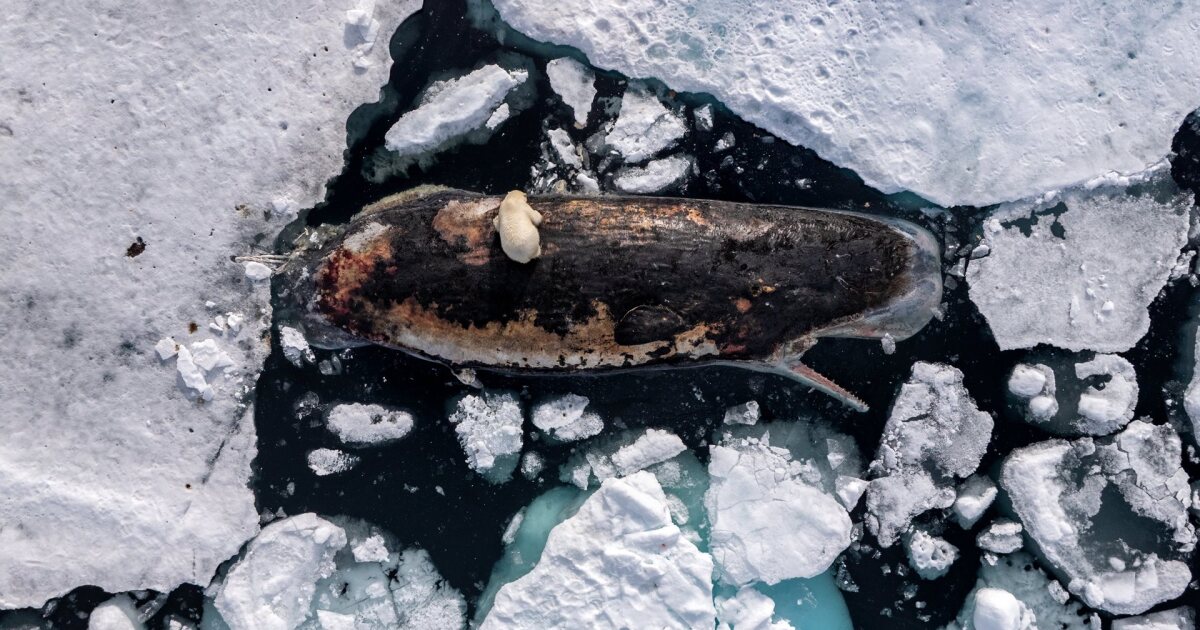
The highlighted image is a good example of this: What looks like a serene image of ice and water becomes much more when you zoom in – or read the title, “Polar Bear on Sperm Whale.” The image, captured by Roie Galitz, a winner in the Europe category, shows a female polar bear feeding on the carcass of a sperm whale north of the Norwegian archipelago of Svalbard.
“Polar bears are primarily seal predators, but as ice retreats in the summer and hunting becomes harder, they increasingly rely on opportunistic scavenging,” noted an accompanying statement with the image. “Near Svalbard, the ice-free season has lengthened by 20 weeks in the last 30 years. Sperm whales typically avoid ice-covered polar waters, so this carcass was a rare sight. Scientists speculate that after dying, the male sperm whale drifted north, carried by winds and currents. The photographer spent two days observing the scene from a small boat, capturing it by drone to reveal a scale difficult to grasp from sea level.”
“Emma the Social Robot” – Paula Hornickel (Europe)

Paula Hornickel/World Press Photo
In this captivating shot, Waltraud, a resident of aged-care facility Haus im Wiesengrund in Albershausen, Germany, bonds with Emma, her robot companion developed by a Munich startup. The technology was introduced to keep residents company and to combat staffing and chronic loneliness issues facing the aging population in the country.
“When she tells her jokes, that’s really good,” Waltraud said of her social robot that remembers faces and previous conversations. “That’s my kind of humor.”
“Mountain Resident of Wanglang” – Rob G. Green (Asia Pacific and Oceania)

Rob G. Green/World Press Photo
In an incredibly rare event, a wild panda is captured beautifully by a camera trap in the Wanglang National Nature Reserve in Sichuan Province, China. It’s believed that only about 2,000 of these animals remain in the wild, with just a few dozen in this protected area, which was established in 1965 and is now a critical site for panda research. Green may have been using a camera trap to get this shot of the notoriously people-shy animal, but it would have been unlikely to have happened any other way.
“This rare sighting was made possible through the National Geographic Society’s US-China Parks Exchange, a 2025 pilot program supported by the Henry Luce Foundation,” the caption reads. “The initiative paired two American and two Chinese photographers to work across each other’s most iconic landscapes – from Glacier National Park in Montana to the Min Mountains of Sichuan. Aimed at fostering cross-cultural cooperation, the project demonstrated how a shared duty toward the natural world can transcend political and geographic boundaries. The resulting image is not merely a product of technology, but of years of relationship-building between photographers and local rangers.”
“Mexico, A Changing Climate” – César Rodríguez (North and Central America)

César Rodríguez/World Press Photo
While it looks like someone walking on water, this shot captures a man standing on the remnants of a breakwater in the fishing town of Sánchez Magallanes in Mexico. In the last 20 years, more than 500 meters (nearly a third of a mile) of land in Tabasco has been swallowed up by the sea due to shoreline erosion.
“Mexico is especially vulnerable to climate extremes, with 52% of its territory situated in arid or semi-arid zones,” the caption explained. “Over the last two decades, environmental disasters have internally displaced approximately 2.7 million people, a figure projected to reach up to eight million by 2050. This project documents the enormous cost of these changes on a human scale: from the rapid erosion of Tabasco’s coastlines, where sea levels are rising three times faster than the global average, to the systemic water scarcities in Monterrey and the State of Mexico, where renewable water availability has plummeted by 81% since 1950.”
You can see a selection of the winners from around the globe in our gallery.
Source: World Press Photo